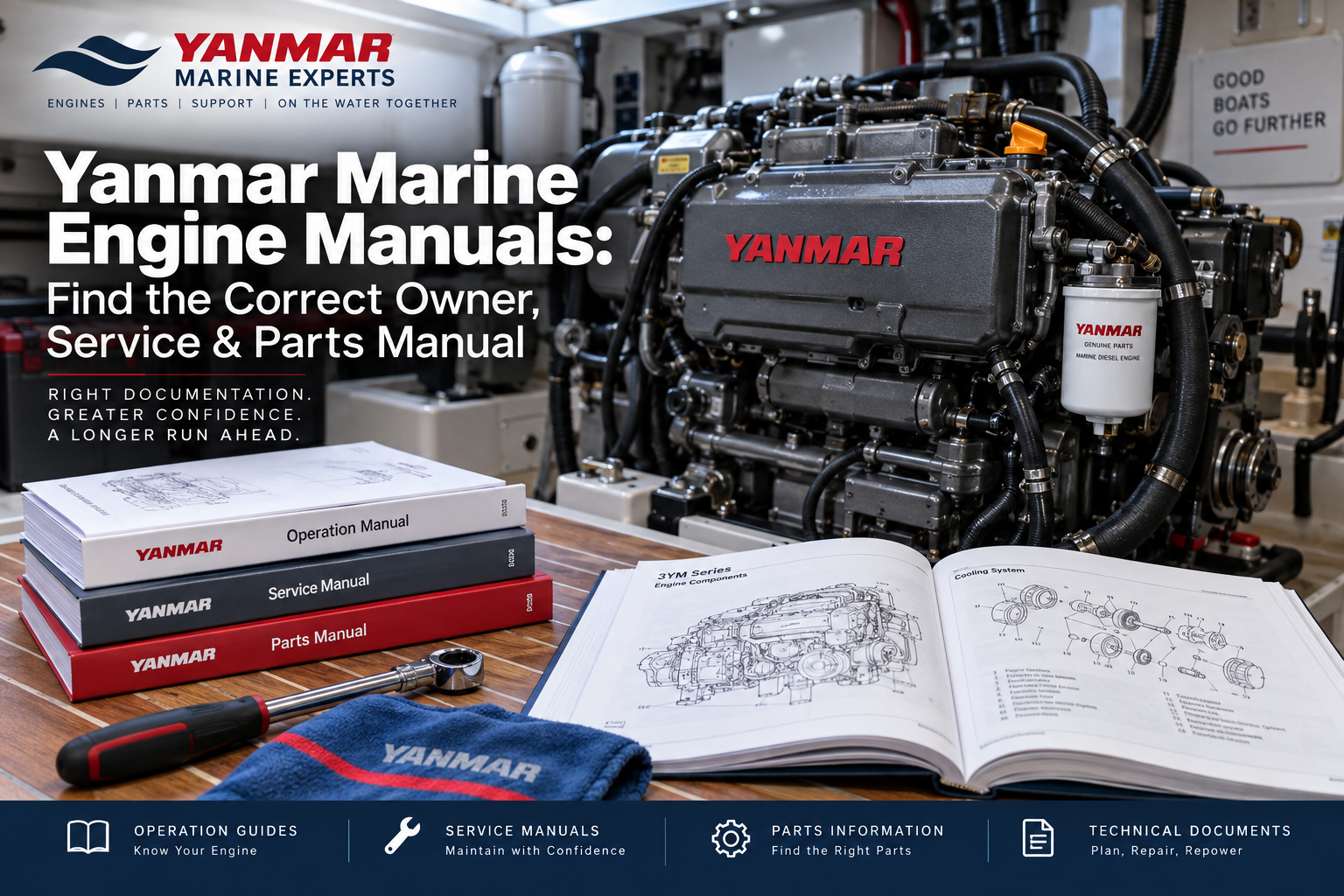
Finding a Yanmar manual online isn’t particularly difficult. Finding the right manual for the exact engine sitting in your boat is where people get into trouble.
A situation we regularly encounter in marine engine identification work goes something like this: an owner knows he has “a 30-horsepower Yanmar,” searches online, finds a PDF that looks close enough and starts using the maintenance specifications in it. The problem is that horsepower alone doesn’t identify an engine. A 3GM30, 3YM30 and 3YM30AE belong to different generations, and a manual intended for one should not automatically be treated as the technical reference for another.
That is why our first question at Yanmar Marine Experts is rarely, “What horsepower is it?”
It is:
What is the complete engine model and serial number?
Those two pieces of information can save an extraordinary amount of guesswork.
If you’re looking for Yanmar marine engine manuals, this guide will show you how to identify the correct owner’s or operation manual, understand when you need deeper service information, locate parts information, and avoid using documentation for the wrong engine generation.
The most important rule is simple:
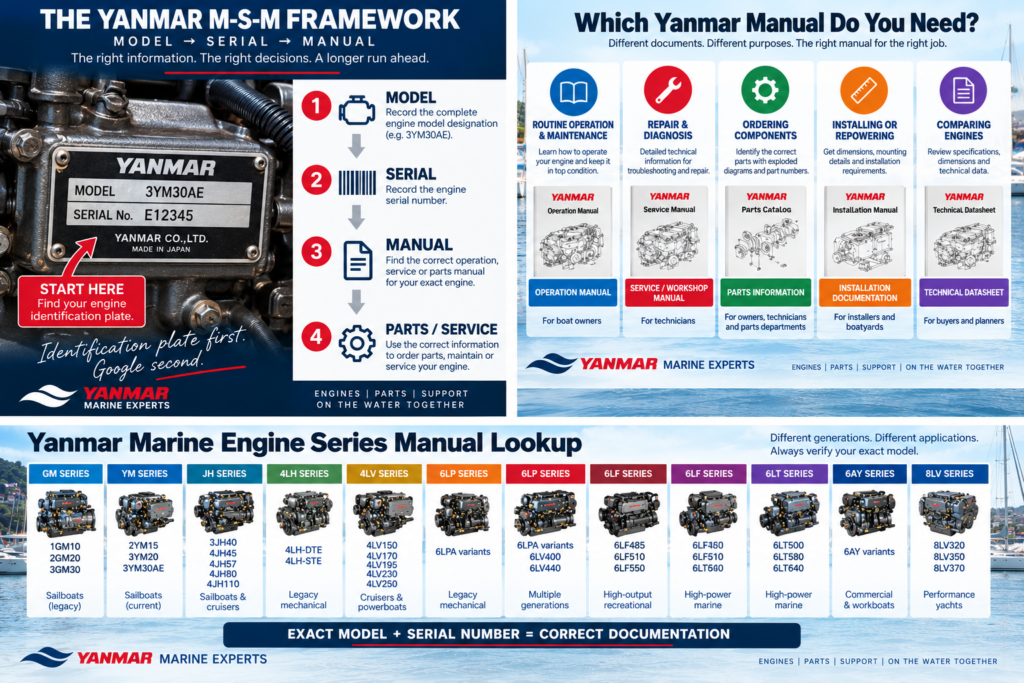
MODEL → SERIAL → MANUAL
Identify the engine first. Find the documentation second.
That sounds obvious, but it is one of the easiest steps to skip.
The phrase Yanmar marine engine manual is broader than it sounds.
When someone asks for “the manual,” they may actually need one of several different documents. An owner preparing for an oil change needs different information from a technician diagnosing an injection problem. A boatyard installing a replacement engine needs different documentation again.
Yanmar’s current marine product pages illustrate this distinction clearly. For example, the 3YM30AE page separately provides an Operation Manual, specification datasheet and multiple technical drawings for bobtail, marine-gear and saildrive configurations.
Understanding these document types is the first step toward finding the correct information.
For most boat owners, the Yanmar operation manual is the place to start.
You may also hear this called an owner’s manual, although Yanmar commonly uses “Operation Manual” in its current marine documentation.
An operation manual typically addresses subjects such as:
For example, Yanmar’s current YM Series Operation Manual specifically identifies the 2YM15, 3YM20 and 3YM30AE as covered models.
That detail is important.
A good Yanmar marine diesel engine manual doesn’t merely tell you how a diesel engine works. It tells you what applies to a defined model or family.
Yanmar also directs owners back to the model-specific Operation Manual when they need information such as the correct engine or gear oil, coolant and replacement intervals.
So if you’re carrying out routine ownership and maintenance tasks, start here.
A Yanmar service manual or Yanmar workshop manual serves a different purpose.
The operation manual is designed primarily around operating and maintaining the engine. Technician-level service information may go considerably deeper into areas such as:
This distinction matters because an Operation Manual should not automatically be treated as a complete repair manual.
There is another important point: don’t assume every workshop or service manual is available as a free public PDF.
Yanmar’s current support information states that manuals can be obtained through authorized distributors or dealers, while its marine FAQ directs owners of currently offered recreational engines to downloadable Operation Manuals on individual product pages. For non-current engines, Yanmar recommends contacting a dealer or regional distributor.
If you’re searching for a Yanmar repair manual because you’re planning internal engine work, first make sure you’re looking for the correct type of technical documentation—not simply an owner’s manual with a similar model number.
A parts document has yet another job.
Rather than teaching you how to operate the engine, parts information helps identify the components that make up an assembly.
Depending on the system and document available, parts information can help with:
But there is a trap here.
Never order an expensive engine component solely because it looks identical in a diagram or photograph.
Yanmar specifically states that engine identification may require the complete model number and serial number because of the size of its product range.
For commercial marine engines, Yanmar USA also states that its complete parts catalog isn’t made available directly to customers and directs owners through its distributor network for parts support.
That is why searching for a random Yanmar parts manual or Yanmar engine parts diagram should never replace proper engine identification.
We’ll return to the correct parts-ordering process later in this guide.
If you’re repowering a vessel or installing a new engine, an owner’s manual alone isn’t enough.
Installation-related documentation and technical drawings can help establish critical information such as:
This becomes especially important during a repower.
An engine can be perfect in terms of horsepower but wrong for the boat because of mount geometry, gearbox arrangement, exhaust requirements, overall dimensions or installation clearances.
Yanmar currently provides downloadable 2D and 3D technical drawings for many engines through its online product pages.
For example, the 3YM30AE product page offers separate drawings for the bobtail engine, KM2P-1 marine-gear installation and SD25 saildrive installation.
Likewise, the 4LV230 page provides drawings for several gearbox configurations as well as ZT370 sterndrive information.
For a repower project, that information can be every bit as important as the Yanmar engine manual itself.
A specification datasheet is useful, but it is not a substitute for an operation or service manual.
A Yanmar engine specifications sheet typically concentrates on information such as:
Take the current 3YM30AE as an example. Yanmar lists it at 21.3 kW / 29.1 mhp at 3,200 rpm, with 1.266 L displacement, three cylinders and indirect injection. The same product page separately provides the Operation Manual, specification sheet and technical drawings.
That separation tells you something important:
Specification sheet = what the engine is.
Operation manual = how the engine should be operated and maintained.
Technical drawings = how the engine physically integrates into an installation.
Service information = how deeper diagnosis and repair are performed.
Knowing which question you’re trying to answer prevents you from using the wrong document.
If you’re unsure which document to look for, use this quick guide:
| Document | Best Used For | Typical Information | Typical User |
|---|---|---|---|
| Operation / Owner’s Manual | Operation and routine maintenance | Starting, fluids, checks, maintenance, basic troubleshooting | Boat owner |
| Service / Workshop Information | Diagnosis and repair | Testing, repair procedures, adjustments, technical specifications | Technician |
| Parts Information | Identifying components | Assemblies, part identification and replacement information | Owner / technician / parts department |
| Installation Documentation | Installation and repowering | Dimensions, connections, mounting and drive configuration | Installer / boatyard |
| Technical Datasheet | Engine comparison and planning | Horsepower, RPM, dimensions, weight and configuration | Buyer / installer |
The simplest way to remember it is:
Routine maintenance? Start with the Operation Manual.
Repairing or diagnosing? You may need service information.
Ordering a component? Use verified parts information together with the engine model and serial number.
Repowering? You will usually need specifications and installation drawings in addition to the Operation Manual.
One document doesn’t do every job.
Now we get to the part that prevents most mistakes.
Before searching for a Yanmar diesel engine manual PDF, take a few minutes to identify what you actually have.
Start at the engine identification plate.
Don’t rely on what a previous owner called the engine. Don’t rely on an old advertisement for the boat. And don’t reduce the model to its approximate horsepower.
Write down the complete designation exactly as shown.
This matters because small additions to a Yanmar model name can indicate a different generation or configuration.
For example:
3YM30 and 3YM30AE are not names you should casually interchange.
Likewise, someone who says he has “a 6LY” hasn’t yet given enough information to identify the correct documentation. The 6LY family spans different generations, including older mechanically controlled engines and newer common-rail variants.
The series name narrows the search.
The complete model designation makes it useful.
Next, record the serial number.
This is especially important when you’re identifying parts or working with an older engine.
Yanmar’s own support guidance says identification requires the complete model number and serial number because of the breadth of its engine and product range.
If the identification plate is difficult to read, take several clear photographs under good lighting rather than guessing at a character.
A single wrong letter or number can send a parts or documentation search in the wrong direction.
Our rule is:
If you’re not certain what the plate says, photograph it before interpreting it.
Later in this content series, we’ll cover the identification process in detail in our dedicated Yanmar Engine Serial Number guide.
Once you have the model, establish its family and generation.
Common Yanmar marine families include:
Why does generation matter?
Because Yanmar has continually developed its marine engines.
Fuel systems changed. Controls changed. emissions systems changed. Alternator specifications changed. Compatible gearboxes changed. Service procedures changed.
A Yanmar maintenance manual written for an older mechanical engine should not be assumed to apply to a newer electronically controlled common-rail engine simply because both engines carry a familiar series designation.
The engine isn’t always the entire propulsion package.
If your installation includes a marine gearbox or saildrive, record its identification information separately.
A Yanmar marine engine manual may cover the engine while separate documentation applies to the transmission or drive.
This matters when you’re checking:
For example, Yanmar’s current 3YM30AE documentation distinguishes between the bobtail engine, a KM2P-1 gear configuration and an SD25 saildrive configuration.
Don’t assume the gearbox manual is automatically contained inside the engine manual.
This step determines where you’re likely to find the documentation.
For currently offered recreational engines, Yanmar says Operation Manuals can be downloaded from the corresponding online product pages.
That makes current models relatively straightforward.
Older and discontinued engines can require a different approach. Yanmar recommends contacting a local dealer or regional distributor for manuals relating to non-current engines.
This is particularly relevant to owners of older GM, YSM, 4LH, 6LP, CH/CX and earlier JH or 6LY installations.
The absence of a current product page doesn’t necessarily mean documentation or support no longer exists. Yanmar says it maintains a spare-parts portfolio covering current and previous engine models, supported through its service network.
You’ve found a PDF. You’re not finished.
Before using it, check:
Yanmar itself notes in its manuals that product information can evolve as engines and products are improved.
That’s another reason to verify the document rather than assuming the first search result is correct.
Here’s the framework we recommend using whenever documentation is uncertain.
Find the complete model designation on the engine.
Not “Yanmar 30 HP.”
Not “three-cylinder Yanmar.”
Not “one of the YM engines.”
The complete model.
Record the serial number.
This provides another layer of identification and becomes particularly important for parts and production variations.
Only after confirming the first two should you select the appropriate documentation.
So the workflow becomes:
MODEL → SERIAL → MANUAL → PART / SERVICE
The useful thing about this framework is that it extends beyond manuals.
Use the same process when:
This is where we disagree with the way many owners search for engine information.
The instinct is to type:
“Yanmar 30 HP manual”
or:
“Yanmar 40 HP service manual”
into Google.
That’s backwards.
Two engines can produce similar horsepower while differing substantially in displacement, fuel system, rated speed, control system, cooling arrangement, service requirements and replacement parts.
So don’t start with horsepower.
Start with the identification plate.
That one habit can prevent a surprising number of wrong-manual, wrong-part and wrong-maintenance decisions.
Once you understand the Model → Serial → Manual framework, the next step is narrowing the search to the correct Yanmar engine family.
This is where things can become confusing. Yanmar’s marine portfolio spans compact sailboat engines, recreational common-rail engines, high-output yacht propulsion and heavy-duty commercial engines. Some families are current; others have been out of production for years but remain in service worldwide.
The table below provides a practical starting point.
| Yanmar Series | Example Models | General Engine Generation | Documentation to Look For |
|---|---|---|---|
| GM Series | 1GM10, 2GM20, 3GM30 | Legacy mechanical | Model/GM Series documentation |
| YM Series | 2YM15, 3YM20, 3YM30AE | Current compact mechanical | YM Series Operation Manual |
| JH Series | 3JH40, 4JH45, 4JH57, 4JH80, 4JH110 | Current recreational | Model/series Operation Manual |
| 4LH Series | 4LH-DTE, 4LH-STE | Legacy mechanical | Model-specific 4LH documentation |
| 4LV Series | 4LV150, 170, 195, 230, 250 | Common rail | 4LV Series documentation |
| 6LP Series | 6LPA variants | Earlier mechanical generation | 6LP/6LPA documentation |
| 6LY Series | Older 6LY variants, 6LY400, 6LY440 | Multiple generations | Generation-specific 6LY manual |
| 6LF Series | 6LF485–6LF550 | Common rail | 6LF Series documentation |
| 6LT Series | 6LT500–6LT640 | Common rail | 6LT Series documentation |
| 6AY Series | Multiple commercial variants | Heavy-duty commercial | Exact-model 6AY documentation |
| 8LV Series | 8LV320, 8LV350, 8LV370 | Common-rail V8 | 8LV Series documentation |
Treat this table as a navigation tool, not permission to use one manual across every engine in a series.
Always verify the exact model coverage printed inside the document.
The GM family remains familiar to sailors because engines such as the 1GM10, 2GM20 and 3GM30 were installed in many sailboats.
These are older engines, which creates a particular documentation challenge: a boat may have changed owners several times, the original paperwork may be gone, and online copies may not clearly state which revision they represent.
If you own a GM engine, establish the complete model and serial number before searching for a Yanmar service manual, parts information or maintenance specifications.
Don’t substitute a modern YM Series manual simply because the newer engine appears to occupy a similar horsepower class.
Our separate Yanmar GM Series Guide will examine the 1GM10, 2GM20 and 3GM30 in considerably greater detail, including specifications, common issues and modern repower options.
The current YM family includes the 2YM15, 3YM20 and 3YM30AE. Yanmar publishes an official YM Series Operation Manual covering those three models. (yanmar.com)
This is a good example of when a series-level manual is appropriate: the document itself tells you exactly which engines it covers.
But even here, pay attention to the full model designation.
Someone searching for a Yanmar 3YM30 manual shouldn’t automatically assume every document labeled “3YM30” applies to a 3YM30AE—or vice versa.
When in doubt, compare the manual’s model list with the identification plate.
The JH family covers a broad range of recreational marine applications.
Current models include engines such as the 3JH40, 4JH45, 4JH57, 4JH80 and 4JH110. Current JH engines also demonstrate why identifying the exact model matters: the family spans different outputs and technical configurations.
Yanmar’s current product pages provide model-specific downloads and documentation. For example, its 4JH57 product page provides an Operation Manual, specification sheet, and technical drawings for different marine-gear and saildrive configurations.
Owners should therefore avoid searching simply for “Yanmar JH manual” and assuming the first document covers every JH engine ever produced.
The 4LH and 6LP families remain relevant because many are still installed in working boats.
These engines belong to earlier generations than current common-rail recreational engines. That makes accurate documentation particularly important when troubleshooting, ordering parts or planning replacement.
For an older 4LH-DTE, 4LH-STE or 6LPA variant, record the entire model suffix.
That suffix is not decorative. It helps identify the actual engine configuration.
When original documentation is unavailable, use Yanmar’s dealer/distributor support route for non-current engines rather than assuming documentation from a superficially similar model is interchangeable. (yanmar.com)
The 4LV family is a good example of modern Yanmar documentation.
The range includes the 4LV150, 4LV170, 4LV195, 4LV230 and 4LV250. These are electronically managed common-rail marine diesels rather than older purely mechanical engines.
Yanmar’s current product pages provide operation documentation, datasheets and configuration-specific technical drawings. (yanmar.com)
That distinction becomes especially important when diagnosing electronic faults or working with vessel controls.
A legacy Yanmar workshop manual for an older mechanical engine cannot substitute for documentation relevant to a modern electronically controlled engine.
The 6LY family deserves special attention because the name spans significantly different generations.
Older engines such as 6LY2-series variants use a different fuel-system and control architecture from current 6LY400 and 6LY440 common-rail engines.
The current 6LY-CR family uses Denso common-rail direct injection and electronic control. (yanmar.com)
This is exactly why searching for a generic Yanmar 6LY manual can be risky.
The correct question isn’t:
“Do you have a 6LY manual?”
It is:
“Which 6LY model and generation do I have?”
Then match the documentation accordingly.
The 6LF and 6LT families occupy higher-output recreational and light-duty commercial territory.
Both use modern common-rail technology, meaning owners and technicians may need documentation covering not only mechanical maintenance but electronic engine-management systems and controls.
As with the other current ranges, start from the exact product/model documentation rather than selecting manuals based on horsepower alone.
The 6AY Series is used in demanding commercial applications, and documentation should be approached accordingly.
Commercial engines can have rating, cooling, certification and installation differences that matter substantially in real operation.
For 6AY documentation, don’t stop at “6AY.”
Record the complete model designation, serial number and application.
This is particularly important if you’re using the documentation to identify a component, establish a service procedure or plan a replacement engine.
The current 8LV family includes the 8LV320, 8LV350 and 8LV370.
These are electronically controlled, common-rail V8 marine engines, and they can be installed with different propulsion configurations.
Yanmar’s current 8LV product pages provide Operation Manual and technical-document access for the family.
Again, the principle remains the same:
Series identifies the neighborhood. Exact model identifies the address.
Once you know what you’re looking for, the next question is where to get it.
There are plenty of PDFs scattered across the internet, but the best starting point is usually the manufacturer.
For currently offered recreational engines, Yanmar states that Operation Manuals can be downloaded from the corresponding engine product pages.
The basic process is:
1. Identify your exact engine model.
2. Locate that model on Yanmar’s marine website.
3. Open its documentation/download section.
4. Select the appropriate Operation Manual, datasheet or technical drawing.
5. Confirm that the document lists your model before using it.
This should normally be your first route when searching for current Yanmar marine engine manuals.
Product pages can also provide valuable supporting information such as specifications, compatible marine gears and technical drawings.
This is where many owners become frustrated.
You may search the current website for an engine that was installed 20 or 30 years ago and find that there is no current product page.
That doesn’t mean you should grab the closest-looking PDF.
Yanmar’s marine FAQ advises owners seeking manuals for engines that are no longer current to contact their local dealer or regional distributor.
Before making that request, collect:
Providing those details makes it much easier to identify the correct information.
There is a good reason manufacturer support networks remain important even in an age when almost everything seems searchable online.
A manual search isn’t always just a PDF search.
Sometimes the underlying question is:
“Which engine do I actually have?”
or:
“Which version of this part fits my serial number?”
or:
“Is this gearbox original to this engine?”
or:
“What replaces this discontinued component?”
Those questions often require model and parts-system knowledge rather than a simple document download.
Yanmar maintains a global service network and directs customers to authorized dealers and distributors for parts and technical support. Yanmar Marine FAQ.
There are legitimate archives, boat-owner communities and technical resources online, and an older manual found outside the manufacturer’s current website isn’t automatically wrong.
But you should verify it before trusting it.
This is the most obvious risk.
A file name might say:
Yanmar 3GM / 3YM manual
That doesn’t mean the same procedures apply to both families.
Look inside the document for its actual model coverage.
Manufacturers revise technical documentation.
Specifications, procedures, warnings or product information may change.
For routine maintenance, always prefer documentation that can be tied confidently to your exact engine and generation.
This is particularly relevant to legacy engines.
A scan might be missing:
A 100-page PDF isn’t necessarily complete simply because it looks official.
If you can’t establish where the document came from, be cautious about using it for a safety-critical repair or expensive parts order.
This becomes especially important with information such as:
The safest rule is:
Use official manufacturer documentation or documentation whose model coverage and authenticity you can verify.
Finding the manual is only half the job.
You also need to use it correctly.
Before jumping to the maintenance table, look at the opening pages.
Confirm the exact engines covered by the document.
For example, the current YM Series Operation Manual explicitly identifies 2YM15, 3YM20 and 3YM30AE.
That is much stronger evidence than a search-result title saying “Yanmar YM manual.”
It’s tempting to skip the safety section because you want the oil capacity or troubleshooting chart.
Don’t.
Marine diesel systems combine:
The warnings are there because the consequences of a mistake can be serious.
For an owner, this may be one of the most valuable sections in the entire Yanmar maintenance manual.
It tells you which checks or services are required according to engine hours and/or elapsed time.
This is better than relying on a generic online statement such as:
“Change every marine diesel impeller at X hours.”
The correct interval and procedure should come from the documentation for your engine and operating conditions.
Don’t assume every Yanmar engine uses the same:
Yanmar specifically directs owners to their Operation Manual for recommended fluids and replacement intervals.
That is why model-specific documentation beats generic advice.
Maintenance isn’t always based only on engine hours.
A sailboat engine may accumulate relatively few hours in a year while still experiencing aging of fluids, belts, hoses, impellers and other components.
Where the manual specifies both time and operating-hour criteria, follow the requirement applicable to your situation.
A good manual becomes far more valuable when you treat it as part of the vessel’s maintenance system rather than something you search for only after the engine develops a problem.
Depending on the engine, the manual may guide maintenance involving:
One of the smartest things an owner can do is create a maintenance record based on the schedule for the exact engine model.
Record:
Date → engine hours → work performed → parts used → next service due
That record becomes useful not only for reliability but also when troubleshooting and eventually selling the vessel.
A manual can also be the first technical reference when an engine starts behaving differently.
Common symptoms include:
The key is not to jump immediately from symptom to replacement part.
For example:
Overheating does not automatically mean “bad water pump.”
There may be restrictions at the seawater intake, a closed or partially closed seacock, a clogged strainer, impeller damage, heat-exchanger fouling, coolant problems or another circulation issue.
Likewise:
An engine that won’t start doesn’t automatically need injectors.
The diagnostic path may begin with battery condition, cranking speed, fuel supply, shutdown controls, air in the fuel system or another basic cause.
This is where the manual helps establish the correct checks before parts are replaced.
Our dedicated Yanmar Marine Engine Troubleshooting Guide, Yanmar Engine Won’t Start Guide and Yanmar Marine Engine Overheating Guide will go deeper into those diagnostic paths.
The principle, however, stays the same:
Diagnose the system before replacing the part.
Finding the correct Yanmar marine engine parts starts with the same principle we’ve used throughout this guide:
Identify first. Order second.
It’s tempting to remove an old filter, impeller, thermostat or sensor, find something online that looks identical and order it.
That approach may work sometimes.
It can also become expensive very quickly.
Yanmar has produced many engine families, revisions and configurations. Parts that look similar aren’t automatically interchangeable. This becomes even more important with components such as injectors, pumps, sensors, electrical components, gaskets and internal engine parts.
A better parts-identification workflow is:
ENGINE MODEL → SERIAL NUMBER → ASSEMBLY → PART NUMBER → SUPERSESSION CHECK → AVAILABILITY
Let’s break that down.
Start with the identification plate.
Don’t submit a parts request saying only:
“I need an impeller for a 30 HP Yanmar.”
Provide the complete model designation.
For example:
3YM30AE
is considerably more useful than:
30 HP Yanmar
The same applies to older engines. Complete suffixes can matter when distinguishing between configurations and generations.
The serial number provides another level of identification.
Yanmar itself advises customers seeking parts support to provide the complete model and serial number because of the size and variety of its engine range.
This becomes particularly important when there were production changes within a model’s lifespan.
Determine where the required component belongs.
Examples include:
If you’re unsure, a clear photograph can be extremely helpful.
If you have an existing part number, provide it.
But don’t assume the number is necessarily still current.
Manufacturers can supersede older part numbers with newer replacements. A knowledgeable parts source can help verify whether the original number remains active or has been replaced.
Once identification is complete, check availability and lead time.
This is particularly important for older engines where components may be:
Yanmar states that its genuine parts support covers current and previous engine models through its service network.
That is why an older engine shouldn’t automatically be considered unsupported simply because it no longer appears in the current recreational engine lineup.
Typical requests include:
For routine maintenance items, your Yanmar operation manual can help establish the correct service requirement.
For exact component identification, however, parts information tied to the model and serial number remains the safer approach.
Our dedicated Yanmar Marine Engine Parts Guide will go much deeper into this process, including how to identify parts when the original part number is unreadable.
Don’t assume the engine is too old or obscure to identify simply because Google isn’t giving you a clean answer.
This happens regularly with older boats.
The vessel may have changed owners several times. The original paperwork may be gone. The engine might have been installed during a repower rather than when the boat was built. A previous owner may even have described the engine incorrectly in maintenance records.
If you cannot find the correct Yanmar engine manual, gather the following information before contacting a marine engine specialist, Yanmar dealer or distributor.
Copy everything from the identification plate.
Don’t abbreviate it.
Record the complete serial number.
A photograph allows someone familiar with Yanmar engines to review the information rather than relying on a transcription that may contain an incorrect character.
Take photographs from several angles.
Useful areas include:
These can provide context when an identification plate is damaged or difficult to read.
Treat this as a separate identification task.
If a gearbox plate is present, photograph it too.
Provide:
This shouldn’t replace engine identification, but it can provide useful context.
Don’t simply ask:
“Can you send me the Yanmar manual?”
Tell the supplier whether you need:
The more precise the request, the easier it is to find the appropriate document.
A manual is an extremely useful technical resource.
It is not a replacement for experience, diagnostic equipment or qualified marine-engine service.
That distinction is particularly important with modern electronically controlled engines.
Modern Yanmar engines such as current 4LV and 6LY-CR models use common-rail fuel injection.
These systems operate differently from older mechanical injection systems.
Problems involving:
may require proper diagnostic procedures and equipment.
Replacing expensive common-rail components because “the symptoms sound like injectors” is not a good diagnostic strategy.
Modern engines may store diagnostic information that helps identify faults.
A generic Yanmar troubleshooting manual can provide direction, but electronic diagnosis may require appropriate service tools and trained interpretation.
If an engine:
the problem may go beyond routine maintenance.
Compression testing, leak-down testing, inspection or internal engine diagnosis may be necessary.
If an engine has overheated badly, simply replacing the failed impeller and restarting it may not be enough.
Severe overheating can potentially affect:
The original cause should be identified and the engine inspected appropriately before normal operation resumes.
Transmission slipping, abnormal noise, contaminated lubricant or failure to engage shouldn’t automatically be diagnosed from the engine manual.
Identify the exact marine gear and use the correct transmission documentation.
The guiding rule is:
Use the manual to inform the diagnosis not to replace the diagnosis.
Documentation becomes valuable for another reason when you’re evaluating a used Yanmar marine diesel engine.
A seller may describe an engine as:
“Yanmar 40 HP diesel, runs great.”
That’s not enough information for a serious purchase.
Start by confirming the actual model and serial number.
Then use reliable documentation to establish what the engine is supposed to be.
Don’t rely solely on an advertisement.
Check the model’s documented output and rated RPM.
Determine whether you’re looking at:
This becomes especially important if the engine is being purchased for a repower rather than as a direct replacement.
The manual can help you understand what servicing the engine should have received.
Then compare that with the seller’s maintenance records.
Before buying an older engine at an attractive price, consider whether the parts you are likely to need remain obtainable.
This is important.
Having the correct manual doesn’t prove that the engine was maintained according to it.
For a used-engine purchase, also evaluate:
When the purchase value justifies it, professional inspection is worth considering.
If you’re replacing an existing engine, Yanmar marine engine manuals and technical documentation become part of the planning process.
But horsepower is only one consideration.
A successful repower should consider the entire propulsion installation.
Compare:
A more powerful engine is of little value if routine service becomes nearly impossible after installation.
Check mount positions and bed geometry.
Changing engines can require modifications to the engine beds or mounting arrangement.
The transmission must be appropriate for:
Don’t assume the existing gearbox should automatically be retained.
A change in horsepower, rated RPM or gear ratio may affect propeller requirements.
Verify exhaust diameter, routing, back-pressure requirements and mixing-elbow arrangement according to the relevant installation requirements.
Check:
Modern engines may have requirements different from the engine being replaced.
Moving from an older mechanical engine to a modern electronic platform can involve substantial changes in:
This is why a specification sheet alone isn’t enough.
The datasheet may tell you that the engine produces the desired horsepower.
The installation drawing tells you whether it has a realistic chance of fitting.
For current models, Yanmar provides various technical drawings through its product pages.
If you’re considering replacing an older engine Yanmar installation with a current model, collect the documentation for both the existing installation and proposed replacement before ordering equipment.
Here’s a simple practice that can save a lot of frustration years from now.
Create a digital folder for the engine.
Name it using:
VESSEL – ENGINE MODEL – SERIAL NUMBER
Then store:
If you sell the boat, pass the folder to the new owner.
If the engine develops a problem, you won’t have to start from zero.
And if you contact a parts supplier three years from now, you already have the identification information available.
For commercial operators, this documentation discipline becomes even more valuable across multiple vessels and engines.
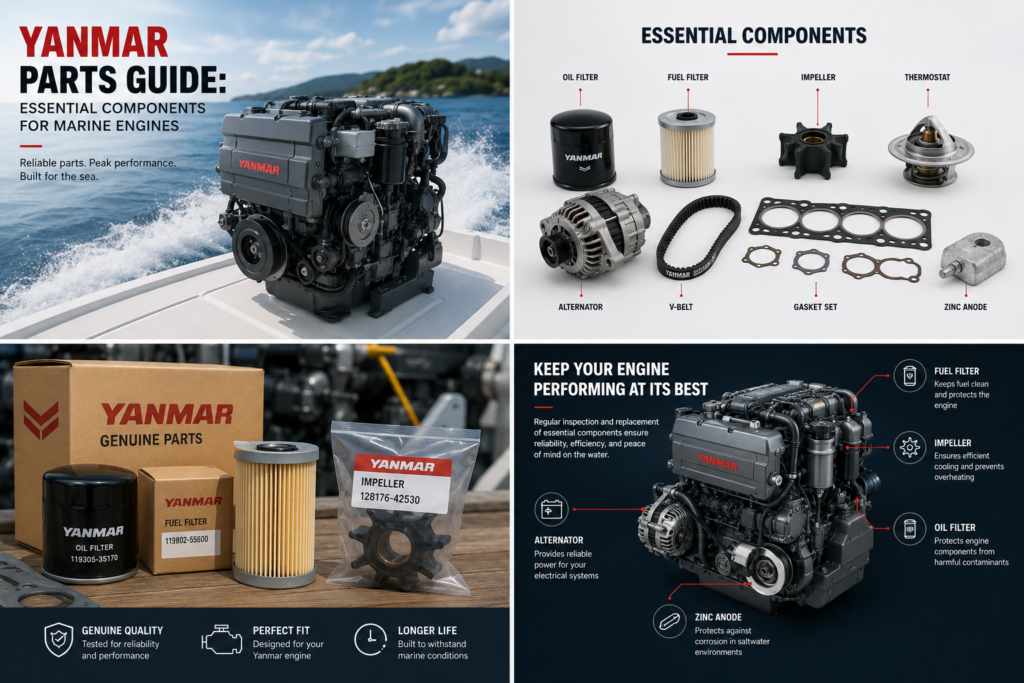
For currently offered recreational marine engines, start with the official Yanmar Marine product page for your exact model. Yanmar states that Operation Manuals for current recreational engines can be downloaded from the corresponding product pages. For non-current engines, Yanmar recommends contacting a local dealer or regional distributor. (yanmar.com)
Always verify that the document explicitly covers your engine model before using it.
Many current Yanmar operation manuals are available in PDF format through Yanmar’s marine website. Availability varies according to engine model, age and document type.
A downloadable Operation Manual doesn’t necessarily mean that every workshop, service or parts document for the engine is publicly available.
Use the M-S-M framework:
MODEL → SERIAL → MANUAL
First record the complete engine model. Then record the serial number. Finally, select documentation that explicitly applies to that engine model and generation.
Don’t select a manual based only on horsepower or cylinder count.
Availability depends on the engine and document type. Start with official Yanmar resources and the dealer/distributor network. Detailed technician-level service information shouldn’t be confused with the standard Operation Manual supplied for owner use.
Parts information varies by engine and market. Yanmar directs customers to its dealer/distributor network for complete parts support in cases where public parts information isn’t available.
For the best result, provide the complete engine model and serial number.
Not unless the manual specifically states that it covers your model.
Two engines may look similar or produce similar horsepower while having different fuel systems, capacities, service procedures, electrical systems or parts.
Similar isn’t the same as verified.
The model and serial information is normally found on the engine identification/nameplate, although the precise location varies by model.
Record the complete information and take a clear photograph.
Our dedicated How to Find and Decode a Yanmar Engine Model and Serial Number guide will cover identification locations and procedures in greater detail.
Documentation may still be obtainable for many discontinued engines. Yanmar recommends contacting a local dealer or regional distributor when an engine is no longer part of the current recreational lineup.
Provide the model, serial number and identification-plate photograph when requesting help.
They can.
The engine and propulsion component should be identified separately. Don’t assume every gearbox or saildrive procedure is contained in the engine Operation Manual.
Record the transmission or saildrive model and serial information where available.
Provide as much of the following as possible:
This is far more useful than simply requesting “the manual for my Yanmar diesel.”
If you remember only one thing from this guide, make it this:
Don’t identify a Yanmar manual by horsepower alone.
Use:
MODEL → SERIAL → MANUAL
The correct Yanmar marine engine manual should correspond to the engine actually installed in your vessel—not merely an engine that looks similar or produces approximately the same horsepower.
Start with the identification plate. Record the complete model and serial number. Identify the marine gear or saildrive separately. Then look for documentation that explicitly covers that configuration.
That approach makes everything that follows easier:
maintenance, troubleshooting, parts identification, gearbox support, repairs and repowering.
A manual is ultimately more than a PDF stored on a laptop. Used correctly, it becomes part of the maintenance history and technical identity of the engine.
And when you’re dealing with an older Yanmar whose paperwork disappeared years ago, don’t guess.
Identify what you have first.
If you’re having difficulty identifying a Yanmar marine engine, replacement component, gearbox or repower option, Yanmar Marine Experts can assist with engine and parts identification, marine gearbox matching, replacement-engine requirements and technical sales support.
For the fastest assistance, send us:
Engine model + serial number + clear identification-plate photo + gearbox/saildrive information + details of what you need.
If you’re requesting a replacement engine, also include your vessel information, current engine and transmission, intended application and destination.
The better the identification information, the more accurately we can help you determine the correct Yanmar parts, gearbox, engine or replacement configuration.
Request technical assistance or a quotation from Yanmar Marine Experts.