
If you’ve ever tried to choose a Yanmar marine diesel engine by searching online, you’ve probably noticed something quickly:
There are a lot of Yanmar marine engine models.
And the model names don’t always make the differences obvious.
A 3YM30AE, for example, isn’t simply a “30 HP Yanmar.” A 4JH57 isn’t just another four-cylinder engine. A 6LY440 belongs to a completely different performance category from a 6LY model from an earlier generation.
Then there are the GM, YM, JH, 4LV, 8LV, 6LY, 6LF and 6LT families, along with older and legacy engines that are still powering thousands of boats.
A representative situation we see in marine engine identification is an owner saying, “I need a Yanmar around 30 horsepower,” when what actually matters is much more specific: boat type, displacement, installation space, rated RPM, propulsion arrangement, existing gearbox or saildrive, operating profile and the exact engine model being considered.
That is why a useful Yanmar marine engine model chart needs to do more than list horsepower.
It needs to answer three questions:
What is the engine?
How much power does it produce?
What type of boat and application is it designed for?
This guide brings those three pieces together.
It covers the major current Yanmar marine diesel engine families, selected legacy models that remain important in the installed fleet, representative horsepower ranges, typical applications and the differences that matter when you’re comparing engines for a new installation or repower.
Important: Horsepower is a starting point, not an engine-selection formula. The correct Yanmar marine engine depends on the vessel, propulsion system, operating profile and installation requirements.
Yanmar’s current marine diesel portfolio spans several distinct power classes.
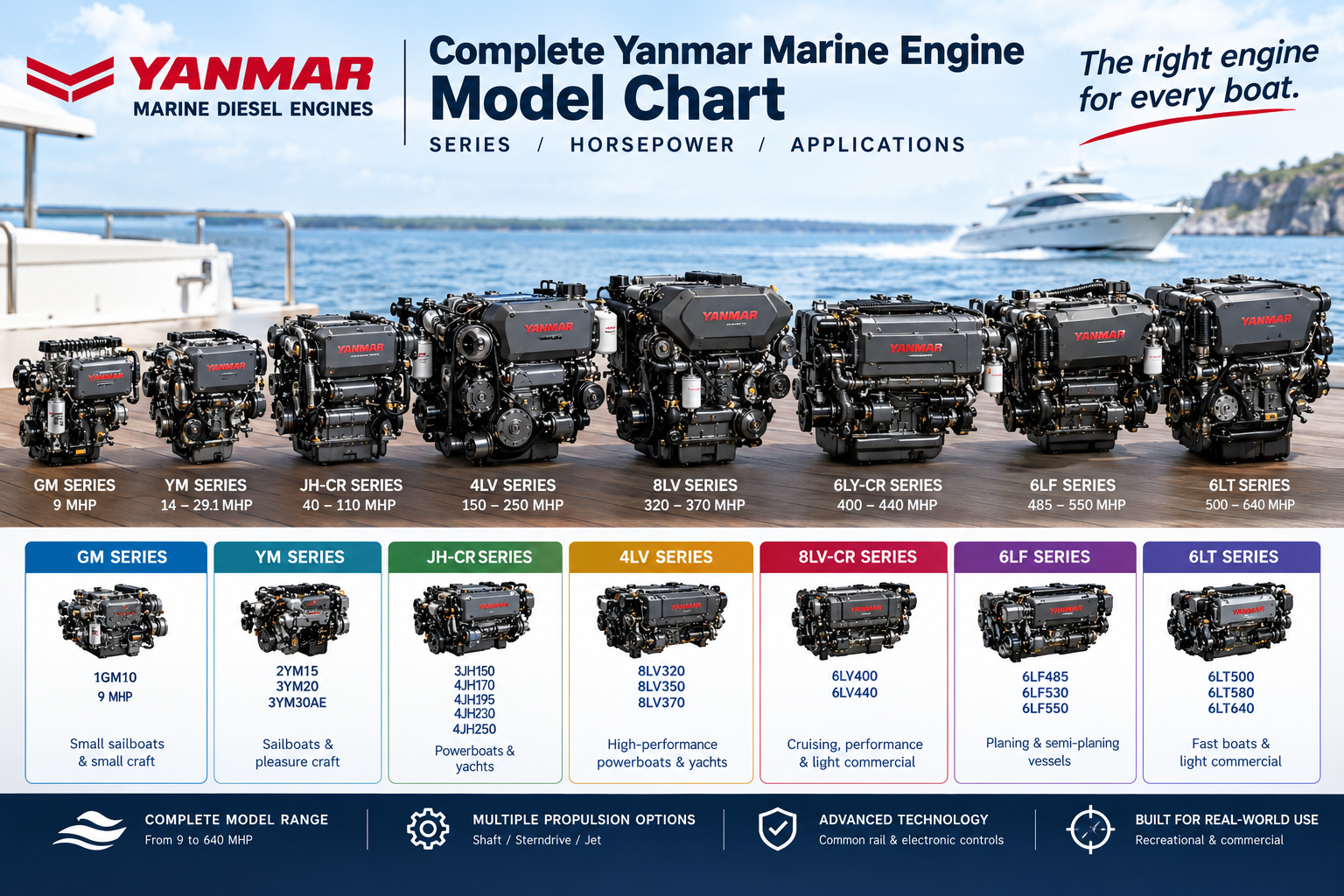
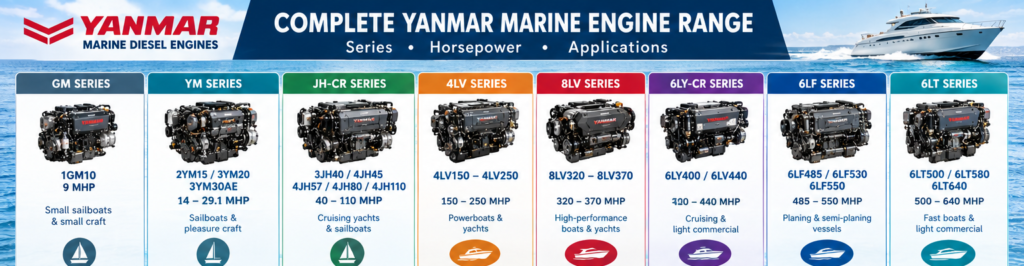
The current manufacturer lineup includes the 1GM10, YM Series, JH-CR Series, 4LV Series, 8LV Series, 6LY-CR Series, 6LF Series and 6LT Series. Yanmar’s current marine engine search also distinguishes current and legacy products, which is important when researching older engines still operating in the field.
Here is the high-level picture:
| Yanmar Engine Family | Representative Models | Approx. Rated Output | Typical Application |
|---|---|---|---|
| GM | 1GM10 | 9 mhp | Small sailboats and small craft |
| YM | 2YM15, 3YM20, 3YM30AE | 14–29.1 mhp | Sailboats and pleasure craft |
| JH-CR | 3JH40, 4JH45, 4JH57, 4JH80, 4JH110 | 40–110 mhp | Sailboats and cruisers |
| 4LV | 4LV150–4LV250 | 150–250 mhp | Powerboats, yachts and light commercial |
| 8LV | 8LV320–8LV370 | 320–370 mhp | High-performance powerboats and yachts |
| 6LY-CR | 6LY400, 6LY440 | 400–440 mhp | Larger powerboats |
| 6LF | 6LF485, 6LF530, 6LF550 | 485–550 mhp | Planing/semi-planing boats and light commercial |
| 6LT | 6LT500, 6LT580, 6LT640 | 500–640 mhp | Fast boats and light commercial vessels |
These figures reflect Yanmar’s current published marine lineup. Individual configurations, ratings, certifications and drive options should always be verified against the exact product documentation before specifying an engine.
And that leads to one of the most important ideas in this guide:
This is the mistake behind many poor engine comparisons.
Imagine two engines both producing approximately 30 horsepower.
That doesn’t mean they are interchangeable.
They may differ in:
Even within one Yanmar family, model differences can be significant.
The current YM Series demonstrates this clearly.
The 2YM15 is rated at 14 mhp at 3,600 rpm, the 3YM20 at 21 mhp at 3,600 rpm, while the 3YM30AE produces 29.1 mhp at 3,200 rpm. Yanmar identifies all three as part of its current YM Series for smaller sailboats and pleasure craft.
So when someone asks:
“Which Yanmar 30 HP engine should I buy?”
the better question is:
“Which Yanmar model is appropriate for this boat, propulsion system and installation?”
That’s the question this model chart is designed to help answer.
The GM Series is one of the most recognizable names in the Yanmar marine-engine world.
The family is particularly important to owners of older sailboats and small craft because GM engines have been installed in a large number of vessels over the years.
The current Yanmar product portfolio specifically lists the 1GM10, rated at 9 mhp, as a compact marine diesel for pleasure craft. Yanmar describes it as a naturally aspirated one-cylinder engine available with marine gear or saildrive configurations.
Rated output: 9 mhp / 6.6 kW
Rated speed: 3,600 rpm
Cylinders: 1
Displacement: 0.318 L
Aspiration: Naturally aspirated
The 1GM10 is aimed at smaller sailboats and small craft where compact dimensions, modest fuel requirements and straightforward propulsion are more important than high output.
It is an example of why a marine engine should be evaluated in context.
Nine horsepower may sound small compared with modern 400- or 600-mhp engines, but a small auxiliary sailboat doesn’t need 500 horsepower.
The right engine is the one that provides appropriate propulsion for the vessel.
The 2GM20 and 3GM30 are important legacy Yanmar models even though they are not part of the current mainstream product lineup displayed by Yanmar alongside its current YM, JH-CR and larger engine families.
They remain relevant because many older sailboats still use them.
If you’re researching one of these engines, don’t assume that because the engine is no longer a current product it is irrelevant.
Legacy engines can still require:
This is where the distinction between current Yanmar marine engine models and legacy Yanmar engines becomes important.
An engine can be discontinued as a new-production model while remaining very much alive in the boating world.
For owners looking for a compact current Yanmar diesel, the YM Series is one of the most important families to understand.
Yanmar currently lists three YM models:
The manufacturer describes the YM Series as mechanical engines designed for smaller sailboats and pleasure craft.
Rated output: 14 mhp / 10 kW
Rated speed: 3,600 rpm
The 2YM15 is a compact two-cylinder diesel intended for smaller sailboats and pleasure craft.
Its relatively low output makes it appropriate for vessels where a compact auxiliary engine is needed without moving into a larger engine package.
Rated output: 21 mhp / 15.3 kW
Rated speed: 3,600 rpm
The 3YM20 adds another cylinder and increases output compared with the 2YM15.
For an owner comparing these engines, the decision shouldn’t simply be:
14 HP vs 21 HP.
You should also consider:
Rated output: 29.1 mhp / 21.3 kW
Rated speed: 3,200 rpm
The 3YM30AE is currently the largest YM Series engine listed by Yanmar. The manufacturer publishes its output at 29.1 mhp and 3,200 rpm.
This is an especially important model for owners searching for a modern Yanmar around the 30-horsepower class.
But don’t confuse the 3YM30AE with every older engine carrying a similar “3YM30” name.
Model suffixes matter.
For installation, repower and parts work, always verify the complete model designation.
Moving up from the compact YM engines brings us into the JH-CR Series.
This is a major Yanmar family for sailboats, cruising yachts and other recreational marine applications.
The current JH lineup includes:
Yanmar’s current marine engine lineup identifies the JH-CR range as covering 40–110 mhp.
Rated output: 40 mhp
The 3JH40 provides a step up from the YM family and is suited to larger sailing vessels and applications requiring greater propulsion power.
Its position in the range makes it particularly relevant to owners moving from small auxiliary engines into larger cruising sailboats.
Rated output: 45 mhp
The 4JH45 sits just above the 3JH40 and provides additional output for vessels requiring more propulsion capability.
For repower applications, the difference between 40 and 45 mhp may appear small on paper.
But engine selection should also account for:
Rated output: 57 mhp
The 4JH57 is one of the best-known modern Yanmar engines in this power category.
It provides a significant step above the 45-mhp class and is suitable for larger sailing yachts and cruising applications.
When comparing it with a 4JH45, don’t look only at maximum horsepower.
Look at how the engine will be loaded during normal cruising.
A marine diesel that spends most of its life under an appropriate load is generally a better match than an oversized engine selected simply because it has a larger horsepower number.
Rated output: 80 mhp
The 4JH80 moves the JH family into substantially higher propulsion output.
This is where installation and propulsion matching become increasingly important.
At this level, you need to evaluate the complete package:
Engine + marine gear/saildrive + shaft + propeller + vessel
not simply the engine itself.
Rated output: 110 mhp
The 4JH110 is currently the highest-output member of the JH family.
It occupies the upper end of Yanmar’s current recreational sailboat/cruiser-oriented JH range and bridges the gap toward larger powerboat-oriented engines.
For a repower, the question should not be:
“Can I fit a 110-horsepower engine?”
It should be:
“Can the vessel’s propulsion system and installation safely and efficiently use a 110-mhp engine?”
That distinction is crucial.
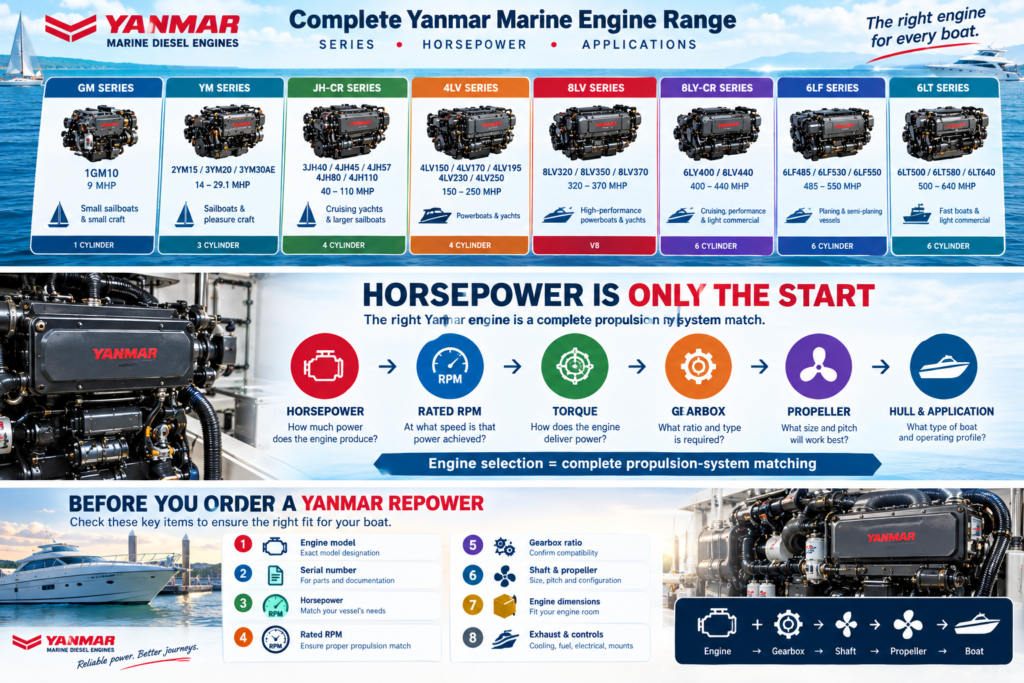
A useful way to understand the Yanmar lineup is to stop thinking about it as one long horsepower list.
Instead, think of it as several application zones.
Typical choices:
These engines emphasize compact installation and appropriate auxiliary propulsion for smaller vessels.
Typical choices:
These provide progressively higher output for larger vessels and more demanding propulsion requirements.
The current Yanmar powerboat range begins much higher than the compact sailboat range, with the 4LV Series starting at 150 mhp and extending to 250 mhp. The 8LV, 6LY, 6LF and 6LT families then move into progressively higher output classes.
We’ll examine those families in detail in Part 2.
A model chart should answer more than:
“How many horsepower?”
Use this five-point check instead.
What output does the engine produce?
At what engine speed is that output achieved?
Was the engine designed primarily for:
Can it be supplied with the appropriate:
Will it physically and mechanically fit the vessel?
This five-point check is much more useful than comparing horsepower alone.
Suppose two marine engines both produce approximately 250 horsepower.
If one reaches its rated output at a substantially different engine speed from the other, the transmission and propeller system may be different.
That affects:
This is why an engine repower isn’t simply a matter of matching horsepower.
Horsepower tells you how much power is available.
Rated RPM helps determine how that power reaches the propeller.
That is one reason Yanmar’s model specifications should be reviewed together with the appropriate marine-gear and installation information.
Here’s the simplest way to understand the current lineup:
GM / YM → compact sailboat and small-craft propulsion
JH-CR → larger sailboats and cruisers
4LV → 150–250-mhp powerboat/light-commercial range
8LV → 320–370-mhp high-performance V8 range
6LY-CR → 400–440-mhp powerboat range
6LF → 485–550-mhp high-output range
6LT → 500–640-mhp high-power range
Yanmar’s current published lineup confirms these broad power bands, although individual models and applications should always be checked against current product documentation.
This gives you a much better mental map of the product family than memorizing dozens of model names.
This is an important distinction for anyone researching a used boat.
The current Yanmar website is not a complete historical catalog of every Yanmar marine diesel ever produced.
Older engines such as:
can still be found in vessels around the world.
Yanmar’s current engine search explicitly separates current and legacy products, illustrating why buyers should distinguish between today’s new-production lineup and the broader installed fleet.
This matters when you’re:
A discontinued engine isn’t necessarily a bad engine.
But it should be evaluated differently from a current-production model.
This is one of the biggest mistakes people make when searching for Yanmar marine engine models.
Consider the difference:
“JH” is a family.
“4JH57” is a specific model.
Likewise:
“6LY” is a family.
“6LY440” is a specific current model.
And:
“YM” is a family.
“3YM30AE” is a specific model.
That distinction becomes critical when ordering parts, finding manuals or comparing specifications.
If someone tells you:
“I have a Yanmar JH.”
you still don’t know enough.
If they tell you:
“I have a 4JH57 with a specific serial number and marine gear,”
you have something useful to work with.
This is exactly why we recommend recording the complete model designation from the engine identification plate rather than relying on memory.
If you’re researching engines for a boat, use this sequence:
BOAT → POWER → RPM → DRIVE → INSTALLATION
What vessel is the engine going into?
How much propulsion power does the vessel actually require?
What rated speed and cruising range are appropriate?
What propulsion arrangement will be used?
Will the engine, gearbox and controls physically fit?
This framework prevents a common mistake:
starting with the engine and trying to make the boat fit the engine.
For a repower, start with the boat and work toward the engine.
For a new build, evaluate the complete propulsion package from the beginning.
This article is designed to help you understand the Yanmar product landscape.
It can help you determine:
But it cannot determine the correct engine for your vessel without additional information.
For that, you need to consider:
That’s where a proper marine-engine sizing exercise becomes important.
A 250 MHP engine is not automatically interchangeable with another 250 MHP engine. The same is true when comparing a 400 MHP, 500 MHP or 640 MHP engine.
The engine has to match the hull, propulsion system, operating profile, available engine-room space, cooling and exhaust arrangement, gearbox or sterndrive, control system and regulatory requirements.
Yanmar’s current marine diesel lineup extends from the small 1GM10 through the 6LT640 at 640 MHP, covering applications from sailboats to high-performance recreational and light-commercial vessels.
Let’s break down the larger Yanmar marine engine models one series at a time.
The Yanmar 4LV Series is an important step up from the JH family.
It is designed for applications where a compact diesel engine needs to deliver substantially more power without moving into the physical size and weight of the larger six- and eight-cylinder engines.
The current 4LV range contains five output ratings:
| Model | Rated Output | Rated Speed |
|---|---|---|
| 4LV150 | 150 MHP / 110 kW | 3,500 rpm |
| 4LV170 | 170 MHP / 125 kW | 3,500 rpm |
| 4LV195 | 195 MHP / 143 kW | 3,500 rpm |
| 4LV230 | 230 MHP / 169 kW | 3,800 rpm |
| 4LV250 | 250 MHP | 3,800 rpm |
Yanmar confirms that the 4LV series uses a 2.8-litre engine platform and is offered in five output models from 150 to 250 MHP. The 150, 170 and 195 models are rated at 3,500 rpm, while the 230 and 250 versions operate at 3,800 rpm.
The 4LV is primarily relevant to powerboats, larger yachts, sailing yachts and light-duty marine applications where more power is required than the JH family can provide.
It can be especially attractive when the owner wants a modern common-rail diesel with electronic controls without immediately stepping up to a much larger six-cylinder installation.
One important point is that the 4LV family is available in configurations supporting different propulsion arrangements, including shaft-drive and sterndrive applications.
That means you should never quote a 4LV engine based only on horsepower.
The complete package matters.
For example:
4LV195 + appropriate gearbox + shaft installation
is a completely different installation consideration from:
4LV195 + sterndrive configuration.
The engine output may be identical, but the propulsion package, installation dimensions, controls and associated components can differ.
The first three 4LV models operate at 3,500 rpm, which makes them relatively easy to compare from a basic power perspective.
The temptation is to simply select the largest engine that will physically fit.
That’s not always the right answer.
If a vessel was engineered around approximately 160–180 MHP, installing a substantially larger engine may introduce additional considerations involving propeller loading, shafting, cooling, exhaust, weight distribution and vessel operating characteristics.
The correct question is:
What power does this hull and propulsion system actually require?
—not:
What is the biggest engine that fits?
At the upper end, the 4LV230 and 4LV250 provide 230 and 250 MHP respectively and operate at 3,800 rpm.
These engines move the 4LV platform firmly into higher-performance powerboat and yacht territory.
For a repower, however, you need to compare the original engine’s:
That is why a Yanmar repower should be treated as a system conversion rather than simply an engine swap.
If the 4LV is the four-cylinder high-output option, the 8LV takes a major step forward with a compact V8 architecture.
The current 8LV Series includes:
| Model | Rated Output | Rated Speed |
|---|---|---|
| 8LV320 | 320 MHP / 235 kW | 3,800 rpm |
| 8LV350 | 350 MHP / 257 kW | 3,800 rpm |
| 8LV370 | 370 MHP / 272 kW | 3,800 rpm |
Yanmar identifies the 8LV as a V8 common-rail diesel using twin turbochargers and intercooling. All three current models are rated at 3,800 rpm.
At this power level, cylinder configuration becomes more than a technical detail.
A V8 can provide a useful combination of:
High power + compact installation + smooth operation + strong acceleration
The 8LV has a 4.46-litre displacement and weighs approximately 435 kg dry without gear in the 8LV320 specification.
That is significant because engine-room packaging can become a serious issue as horsepower increases.
A larger engine is not necessarily a better engine if it creates installation problems.
The three current models are straightforward from a power standpoint:
All operate at 3,800 rpm.
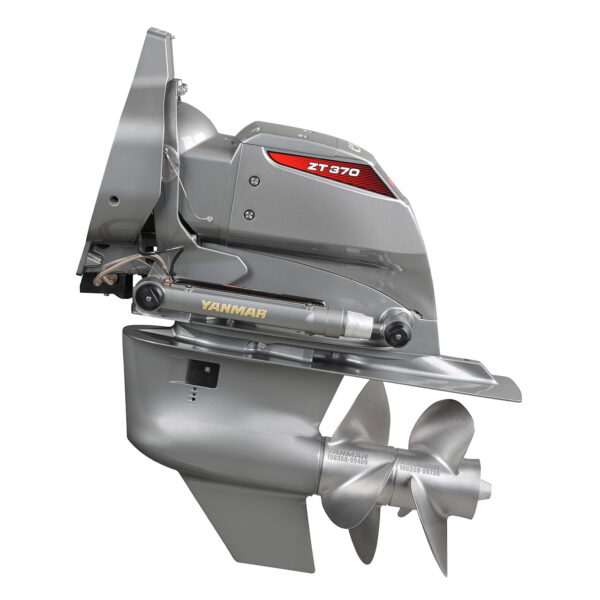
The 8LV platform supports shaft and jet-drive installations and is also compatible with the YANMAR ZT370 sterndrive. Yanmar also lists electronic control through its VC10 Vessel Control System and joystick-control options for applicable configurations.
This makes the 8LV particularly interesting for modern recreational powerboats and yacht applications where electronic integration and maneuverability are important.
Don’t assume that because two engines have similar horsepower they can use the same propulsion package.
For example, comparing a 4LV250 and 8LV320 solely by output misses the bigger picture.
The 8LV has:
The installation needs to be engineered around the complete package.
The Yanmar 6LY-CR Series is another major step upward.
The current range contains two models:
| Model | Rated Output | Rated Speed |
|---|---|---|
| 6LY400 | 400 MHP / 294 kW | 3,300 rpm |
| 6LY440 | 440 MHP / 324 kW | 3,300 rpm |
Yanmar describes the current 6LY-CR as a six-cylinder inline engine designed for cruising, racing and light-commercial applications. Both current models operate at 3,300 rpm.
The 6LY400 specification provides a useful picture of the platform:
This is a very different class of engine from the small GM and YM engines discussed in Part 1.
The 6LY-CR is intended for boats where substantial continuous propulsion power and acceleration are required.
The CR designation refers to common-rail technology.
Instead of relying on a traditional mechanical injection arrangement, the engine uses electronically controlled high-pressure fuel injection.
That allows the engine management system to control fuel delivery much more precisely.
The practical benefits can include:
But there is a tradeoff.
Modern common-rail engines depend more heavily on clean fuel, correct electrical supply, sensors, electronic controls and proper diagnostic procedures.
In other words, common rail can improve performance and efficiency, but fuel quality and maintenance become even more important.
This is an area where buyers can easily become confused.
The name 6LY has been used across different generations of Yanmar engines.
A specification for an older 6LY should not automatically be treated as the specification for the current 6LY-CR.
You may encounter older 6LY models, different ratings, different control systems and different emissions configurations in used-engine listings.
That’s why the engine’s:
Model + serial number + specification plate
should be checked before ordering parts or planning a replacement.
This is the same principle we discussed in the Yanmar manuals guide:
Model first. Serial number second. Documentation third.
That process becomes especially important when dealing with legacy engines.
The Yanmar 6LF Series moves into the 500-MHP class and is designed for planing and semi-planing vessels.
The current models are:
| Model | Rated Output | Rated Speed |
|---|---|---|
| 6LF485 | 485 MHP / 356 kW | 3,000 rpm |
| 6LF530 | 530 MHP / 390 kW | 3,000 rpm |
| 6LF550 | 550 MHP / 404 kW | 3,000 rpm |
Yanmar describes the 6LF as a compact common-rail diesel for planing and semi-planing vessels, including recreational and light-duty commercial applications. All three models are rated at 3,000 rpm.
The 6LF is an inline six-cylinder engine with:
The 6LF485, for example, has a dry weight of approximately 780 kg without gear.
At this level, engine weight becomes a major repower consideration.
You cannot look only at horsepower.
A replacement engine that is significantly heavier or has different mounting geometry can affect the vessel’s trim and installation.
These three engines belong to the same family, share the same 3,000-rpm rated speed and are closely related in architecture.
The main difference for the buyer is the required output.
Think of them as three steps within the same performance class:
485 MHP → 530 MHP → 550 MHP
But again, don’t assume that moving from 485 to 550 MHP is automatically an upgrade.
The propeller, gearbox, shaft system, hull and cooling/exhaust systems all have to support the additional output.
At the top end of the current Yanmar marine diesel range sits the 6LT Series.
This is where we reach 640 MHP.
The current models are:
| Model | Rated Output | Rated Speed |
|---|---|---|
| 6LT500 | 500 MHP / 367 kW | 2,530 rpm |
| 6LT580 | 580 MHP / 426 kW | 2,530 rpm |
| 6LT640 | 640 MHP / 470 kW | 2,530 rpm |
Yanmar specifically positions the 6LT for fast boats, planing hulls and light-commercial applications. All three current models operate at 2,530 rpm.
One of the first things you should notice is the rated RPM.
Compare:
This illustrates an important point:
Horsepower does not tell you how an engine produces its power.
The 6LT500 produces 500 MHP at only 2,530 rpm, while the 8LV370 produces 370 MHP at 3,800 rpm.
Those engines therefore have very different requirements for their propulsion systems.
The 6LT uses:
The 6LT500 has a dry weight of approximately 1,125 kg without gear.
The 6LT580 and 6LT640 use the same 8.710-litre platform and are also rated at 2,530 rpm.
The power progression is substantial:
500 → 580 → 640 MHP
That makes the 6LT family particularly useful when a vessel needs serious propulsion power without stepping outside the same general engine family.
However, the jump from 500 to 640 MHP represents a major increase in propulsion demand.
Before selecting the 6LT640, verify that the vessel’s:
are all appropriate for the proposed installation.
Here’s the bigger picture.
| Yanmar Series | Current Output Range | Cylinders | Rated RPM | Typical Position |
|---|---|---|---|---|
| 4LV | 150–250 MHP | 4 | 3,500–3,800 | Mid/high-output recreational |
| 8LV | 320–370 MHP | V8 | 3,800 | High-performance powerboats/yachts |
| 6LY-CR | 400–440 MHP | 6 | 3,300 | Cruising, performance, light commercial |
| 6LF | 485–550 MHP | 6 | 3,000 | Planing/semi-planing vessels |
| 6LT | 500–640 MHP | 6 | 2,530 | Fast boats and light commercial |
The current Yanmar lineup confirms these output ranges and series distinctions.
Notice something interesting.
The ranges overlap.
For example:
6LF485
and
6LT500
are only 15 MHP apart.
Does that mean they are interchangeable?
Absolutely not.
Their rated RPM, displacement, dimensions, weight and propulsion requirements are different.
The 6LF is a 6.728-litre engine rated at 3,000 rpm, while the 6LT uses an 8.710-litre platform rated at 2,530 rpm.
That’s why an experienced marine-engine selection process never stops at horsepower.
This is one of the most commonly overlooked points when people compare Yanmar marine engine models.
Imagine a boat currently equipped with an engine that reaches its rated output at 2,500 rpm.
Now imagine replacing it with another engine producing similar horsepower at 3,500 rpm.
At first glance, the numbers might look acceptable.
But the propulsion system sees something very different.
The gearbox ratio may need to change.
The propeller may need to change.
The shaft system may need to be evaluated.
The engine control system may be different.
The exhaust and cooling requirements may change.
This is why the proper comparison is:
Horsepower + RPM + torque + gearbox ratio + propeller + hull
rather than horsepower alone.
Most of the modern higher-output Yanmar engines discussed in this section use common-rail fuel injection.
That includes the 8LV, 6LY-CR, 6LF and 6LT families. Yanmar describes common rail as an electronically controlled high-pressure fuel-injection system intended to optimize engine efficiency and performance.
For the boat owner, this means the engine is increasingly dependent on the complete electronic and fuel system working correctly.
A common-rail diagnostic problem might involve:
This is very different from diagnosing an older mechanically injected diesel.
The advantage is sophisticated control.
The disadvantage is that guessing becomes expensive.
A modern common-rail Yanmar should be diagnosed systematically using the correct technical documentation and appropriate diagnostic equipment.
Let’s compare three engines:
4LV250 — 250 MHP
8LV320 — 320 MHP
6LY400 — 400 MHP
You might think of them simply as three points on a horsepower scale.
But technically they are very different machines.
The 4LV is a four-cylinder 2.8-litre platform.
The 8LV is a V8 4.46-litre twin-turbocharged platform.
The 6LY-CR is a six-cylinder 5.813-litre platform.
Their rated speeds are also different.
That means they deliver their power through different combinations of:
So if someone asks:
“I have a 250-horsepower engine. Which Yanmar should replace it?”
The correct answer is not simply:
“Buy the 4LV250.”
The correct answer is:
“Let’s identify the existing engine, boat, propulsion arrangement and installation before selecting the replacement.”
That approach protects the customer from an expensive mismatch.
When two models appear suitable, use this five-step comparison.
Determine the power requirement based on the vessel and its intended operating profile.
Don’t automatically choose the highest available rating.
This is essential for matching the propulsion system.
A 2,530-rpm engine and a 3,800-rpm engine cannot simply be treated as equivalent because both are diesel engines.
For repower projects, engine weight can affect:
A significant weight difference should be evaluated before ordering.
Determine whether the installation uses:
The engine package and propulsion system must be compatible.
Finally, verify:
Only after these checks should you finalize the engine model.
A useful Yanmar marine engine model chart isn’t simply a list of horsepower numbers.
It should help you answer five questions:
| Question | Why It Matters |
|---|---|
| How much power? | Establishes the required output range |
| At what RPM? | Determines propulsion compatibility |
| What vessel? | Defines the engine’s intended application |
| What propulsion system? | Determines gearbox/drive compatibility |
| What installation? | Confirms physical and technical fit |
That’s the information that turns a model list into a useful buying tool.
And there’s one more important distinction.
A customer may have a Yanmar engine installed today that is no longer part of the current production lineup.
That doesn’t automatically mean the engine is obsolete or impossible to support.
It means the replacement process needs to be approached differently.
You may need to compare:
Original model → current equivalent → mounting → gearbox → controls → propeller → installation
rather than searching for an identical model number.
This is particularly important with older GM, JH, 4LH, 6LY and other legacy Yanmar engines.
If you remember only one thing from this article, remember this:
Never select a marine diesel engine by horsepower alone.
Start with:
Boat → Application → Required Power → Rated RPM → Propulsion → Installation
That six-step process will eliminate a huge number of poor engine choices before they become expensive mistakes.
In Part 3, we’ll bring the entire Yanmar range together and turn this model information into a practical engine-selection guide for sailboats, cruising boats, fishing vessels, powerboats and commercial applications. We’ll also look at repower considerations, common buying mistakes, current versus legacy engines, and the questions buyers should ask before ordering a Yanmar marine diesel.
By now, you’ve seen that the Yanmar range covers a remarkably wide spread of applications.
From the compact 1GM10 to the 6LT640, there is a Yanmar diesel for everything from small auxiliary sailboats to large, high-performance and light-commercial vessels.
But here’s where the model chart becomes useful.
Knowing that a 3YM30AE produces 29.1 MHP or that a 6LT640 produces 640 MHP is only the beginning.
The real question is:
Which Yanmar marine engine is right for my boat?
That answer depends on the vessel, how it is used, the existing propulsion system and what you are trying to accomplish.
Let’s make the selection process practical.
One of the biggest mistakes buyers make is starting their search with an engine.
They see a Yanmar engine for sale, notice the horsepower and immediately think:
“That should work.”
Marine propulsion doesn’t work that way.
The correct sequence is:
Boat → Application → Existing Engine → Required Power → RPM → Propulsion → Installation
This is particularly important when replacing an existing engine.
A boat that needs 30 horsepower isn’t necessarily compatible with every 30-horsepower diesel.
The same principle applies to a 150, 250, 400 or 600-horsepower installation.
The engine is part of a propulsion system.
A practical way to narrow the current Yanmar marine engine models is to start with the type of vessel.
For smaller sailing yachts and auxiliary sailboats, the lower-output Yanmar families are usually the most relevant starting point.
Potential models include:
These engines cover approximately 9 to 29.1 MHP, depending on the model.
The 1GM10 is a particularly compact option at 9 MHP, while the YM Series provides progressively more power for larger sailing yachts.
For this class of boat, installation space and engine weight can be just as important as horsepower.
A small sailboat may have a relatively tight engine compartment, limited ventilation and a propulsion system designed around a specific engine footprint.
That’s why replacing a small engine with a larger one isn’t automatically an improvement.
As vessel size and displacement increase, the JH-CR Series becomes particularly relevant.
The current JH-CR range includes:
The series covers approximately 40–110 MHP. (yanmar.com)
These engines are designed around the needs of modern sailing yachts and cruising vessels where dependable auxiliary propulsion, compact packaging and electronic/common-rail technology are important.
For a sailboat repower, however, don’t simply compare the horsepower of the old and new engines.
Check:
Engine mounts + gearbox + propeller + shaft + exhaust + controls + engine dimensions
before deciding.
Powerboat applications open the door to several higher-output Yanmar families.
Depending on the vessel, the relevant range may include:
The current lineup extends from 150 MHP through 640 MHP across these families.
This is where vessel speed and hull design become particularly important.
A displacement cruiser and a fast planing boat can require very different engine characteristics even when their nominal horsepower requirements appear similar.
Fishing vessels and light-commercial boats typically place different demands on an engine than recreational boats.
Depending on the vessel and duty cycle, Yanmar’s higher-output families can be used in applications including fishing, workboats and other light-commercial vessels.
The 6LF and 6LT families are particularly relevant to planing and semi-planing vessels and light-commercial applications. Yanmar specifically lists applications such as workboats, RIBs, rescue boats and other fast vessels for the 6LT platform. (yanmar.com)
For commercial buyers, one additional question becomes extremely important:
How many hours per year will the engine actually operate, and under what load?
A recreational boat that runs a few hundred hours annually is a very different operating environment from a commercial vessel running long shifts.
That distinction should be considered when evaluating the appropriate engine rating, installation and service requirements.
If you’re specifically looking for the best Yanmar engine for fishing boats, don’t start by asking which model has the highest horsepower.
Start with the fishing operation.
An inshore fishing boat may prioritize:
Depending on the vessel, smaller Yanmar models may be appropriate, while larger planing fishing boats may require an engine from the 4LV or larger families.
Offshore boats generally place greater demands on propulsion.
You may need:
The correct engine will depend heavily on hull type and vessel displacement.
A 40-foot displacement fishing vessel and a 40-foot planing fishing boat should not automatically receive the same engine.
The dimensions of the boat alone aren’t enough.
Commercial operators should also consider downtime.
An engine that is slightly cheaper to purchase but difficult to support can become much more expensive over its working life.
When comparing engines, consider:
Purchase price + installation cost + fuel consumption + maintenance + parts availability + downtime
That is a much better commercial calculation than simply comparing the initial engine price.
Repowering is one of the most common reasons people research Yanmar marine engine models.
And repowering is where choosing the wrong model can become particularly expensive.
A proper repower evaluation should begin with the existing engine.
Record:
Then compare those details with the proposed Yanmar package.
This is one of the most important points in a repower.
A new engine may have completely different:
Even when the horsepower appears similar, the existing gearbox may not be suitable.
The same applies to the propeller.
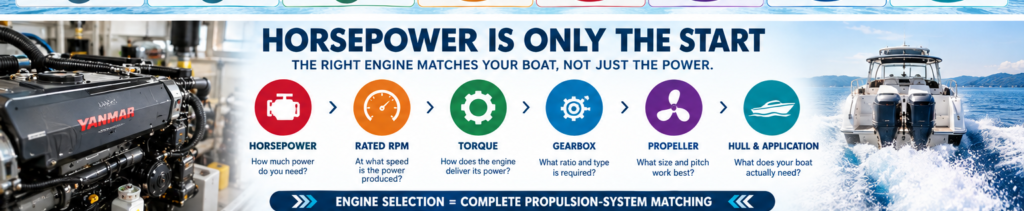
Think of the propulsion system as a chain:
Engine → Gearbox → Shaft → Propeller → Water
Changing one component can affect the others.
For example, if you change from a lower-RPM engine to a higher-RPM engine, the appropriate gearbox ratio may change.
That can then affect propeller speed.
The propeller may need a different diameter or pitch.
This is why a marine engine repower should be evaluated as a complete system.
This is another question we receive frequently.
The short answer is:
Don’t choose extra horsepower simply because it is available.
More horsepower can provide additional reserve, but it can also create unnecessary cost and installation complications.
A higher-output engine may require changes to:
It may also change the vessel’s weight distribution.
The right engine is the one that provides the appropriate power for the hull and intended operating profile while remaining compatible with the propulsion and installation systems.
This distinction matters enormously when researching older boats.
Yanmar has produced marine engines for decades, so you will encounter many models that are no longer part of the current production lineup.
Examples include older engines from families such as:
That doesn’t mean these engines are automatically worthless.
It means you need to distinguish between:
Current production model
and
Legacy/discontinued model
The official Yanmar Marine product resources distinguish current engine offerings from archived products, which is useful when researching an older installation.
Suppose you have an older Yanmar engine and search online for a component.
You find a part that appears to fit because the description contains the same engine family name.
That is not enough.
Different generations can use different:
The safest approach is to identify the exact model and serial number before ordering.
If you’re unsure where to find that information, see our guide on how to identify a Yanmar engine model and serial number.
This is the biggest one.
Two engines can have similar horsepower but completely different RPM, dimensions, weight and torque characteristics.
Fix: Compare the complete engine specification.
RPM directly affects gearbox and propeller selection.
Fix: Always record the existing engine’s rated RPM before selecting a replacement.
A gearbox is not a universal accessory.
Fix: Identify the existing gearbox model and reduction ratio and verify compatibility.
Especially during repower projects, additional weight can affect the boat’s trim.
Fix: Compare dry engine weights and installation configurations.
Yanmar model numbers can look similar across different generations.
Fix: Use the model and serial number together.
A recreational engine installation and a commercial application can have very different operating demands.
Fix: Tell your supplier how the boat will actually be used.
Before placing an order, have the following information available.
If the vessel is commercial, also identify:
This information allows a marine-engine specialist to evaluate the complete installation instead of making a guess from horsepower.
Here’s a practical starting point for understanding the current range:
| Boat/Application | Yanmar Family to Investigate | Approx. Output Range |
|---|---|---|
| Small auxiliary sailboats | GM / YM | 9–29.1 MHP |
| Larger sailing yachts | JH-CR | 40–110 MHP |
| Mid/high-output powerboats | 4LV | 150–250 MHP |
| High-performance powerboats/yachts | 8LV | 320–370 MHP |
| Cruising/performance/light commercial | 6LY-CR | 400–440 MHP |
| Planing/semi-planing vessels | 6LF | 485–550 MHP |
| Fast boats/light commercial | 6LT | 500–640 MHP |
This is a starting-point chart, not a final installation recommendation. The vessel’s actual requirements must be evaluated before selecting an engine.
Fuel economy is another area where buyers sometimes make the wrong comparison.
A larger engine does not necessarily consume its maximum rated fuel quantity all the time.
Actual fuel consumption depends on:
Therefore, comparing engines by their maximum fuel-consumption figure alone can produce a misleading result.
The better question is:
How efficiently will the complete boat operate at the speed and load I actually use?
That’s a much more useful way to evaluate fuel economy.
Yanmar does not design every engine simply to provide a certain horsepower number.
Different engine families are positioned for different applications.
For example, Yanmar describes the 6LF for planing and semi-planing recreational and light-duty commercial vessels, while the 6LT is positioned toward fast boats and light-commercial applications.
That distinction matters.
A vessel’s hull determines how the engine’s power is ultimately converted into movement through the water.
A displacement hull, semi-planing hull and high-speed planing hull don’t use engine power in exactly the same way.
So when selecting an engine, ask:
What is the boat designed to do?
before asking:
How much horsepower can I install?
Repowering may make sense when:
But repowering isn’t automatically the cheapest solution.
Sometimes repairing the existing engine is economically smarter.
The decision should compare:
Repair cost vs. replacement cost vs. expected remaining service life
and include installation and associated components.
For a deeper look at this decision, see our Yanmar Engine Repower Guide.
Before requesting a quotation, provide as much technical information as possible.
A good request might include:
“I have a 42-foot planing fishing boat currently fitted with a 500 MHP diesel at 2,600 rpm. It uses a shaft-drive transmission with a 2.0:1 reduction ratio. I need a replacement engine and would like to know which current Yanmar package is suitable.”
That’s far more useful than:
“I need a 500-horsepower Yanmar.”
The first request gives the supplier enough information to begin evaluating the installation.
The second only gives a horsepower number.
That’s completely normal, particularly with older boats.
Look for the engine identification plate/nameplate.
It may provide:
If the plate is difficult to read, take clear photographs of it and the complete engine.
Also photograph:
Good photographs can often save significant time during the identification process.
The 1GM10 is one of Yanmar’s smallest current marine diesel engines, rated at 9 MHP. It is a compact one-cylinder naturally aspirated diesel intended for small marine applications.
The current YM Series consists of the 2YM15, 3YM20 and 3YM30AE, with outputs ranging from approximately 14 to 29.1 MHP.
The current JH-CR range includes the 3JH40, 4JH45, 4JH57, 4JH80 and 4JH110, covering approximately 40–110 MHP. (yanmar.com)
The current Yanmar marine lineup extends to the 6LT640, rated at 640 MHP.
There is no single “best” Yanmar engine for every fishing boat.
The correct model depends on the boat’s hull, displacement, cruising speed, propulsion arrangement, operating hours and duty cycle.
For fast or planing fishing and light-commercial vessels, the 6LF and 6LT families may be relevant starting points, while smaller vessels may require engines from the GM, YM, JH or 4LV families.
Often, a modern Yanmar can be a good repower solution, but compatibility must be checked.
The new engine needs to be evaluated against the existing:
Mounts + gearbox + shaft + propeller + exhaust + cooling + electrical system + controls
Don’t assume that the newest engine with similar horsepower is a direct replacement.
No.
Too little power can prevent the vessel from achieving its intended performance.
Too much power can create unnecessary cost and place additional demands on the propulsion and installation systems.
The goal is appropriate power, not maximum power.
After looking at the entire Yanmar model range, the selection process becomes much simpler.
Don’t start with:
“Which Yanmar has the most horsepower?”
Start with:
“What does my boat actually require?”
Then work through:
1. Vessel
What boat is it?
2. Application
Sailboat, cruiser, fishing boat, workboat, RIB or commercial vessel?
3. Power
How much propulsion power does the vessel actually need?
4. RPM
At what engine speed must that power be delivered?
5. Propulsion
What gearbox, shaft, sterndrive or jet-drive system will be used?
6. Installation
Will the engine physically and technically fit?
7. Duty cycle
How hard and how often will the engine operate?
8. Support
Can the engine, parts, service and technical documentation be supported where the vessel operates?
That is the difference between simply buying a diesel engine and selecting the right marine propulsion package.
The current Yanmar marine engine models cover a huge range of marine applications.
For smaller sailboats, the GM and YM families provide compact propulsion options.
For larger sailing yachts and cruising vessels, the JH-CR family provides a broader power range.
For powerboats, the 4LV and 8LV families move into higher-output applications.
For even larger and faster vessels, the 6LY-CR, 6LF and 6LT families provide outputs reaching 640 MHP.
But the horsepower number should never be the only deciding factor.
The right Yanmar engine is the one that matches the boat, hull, application, RPM, propulsion system, installation and duty cycle.
If you’re replacing an existing engine, identify the original engine and gearbox first. If you’re building or repowering a vessel, evaluate the complete propulsion package before ordering.
And if you’re unsure, don’t guess.
A clear engine nameplate, serial number, gearbox identification plate and a few photographs of the installation can provide far more useful information than a simple horsepower request.
If you are looking for a new Yanmar marine diesel engine, gearbox or replacement parts, our team can help you identify the appropriate configuration before you purchase. Contact us with your engine model, serial number, boat information and propulsion details so we can work from the actual installation rather than making assumptions.
For more detailed information, continue with our related guides:
The goal isn’t simply to find a Yanmar engine that fits the horsepower requirement.
The goal is to find the right Yanmar engine for the boat — and make sure the entire propulsion system works together.
