
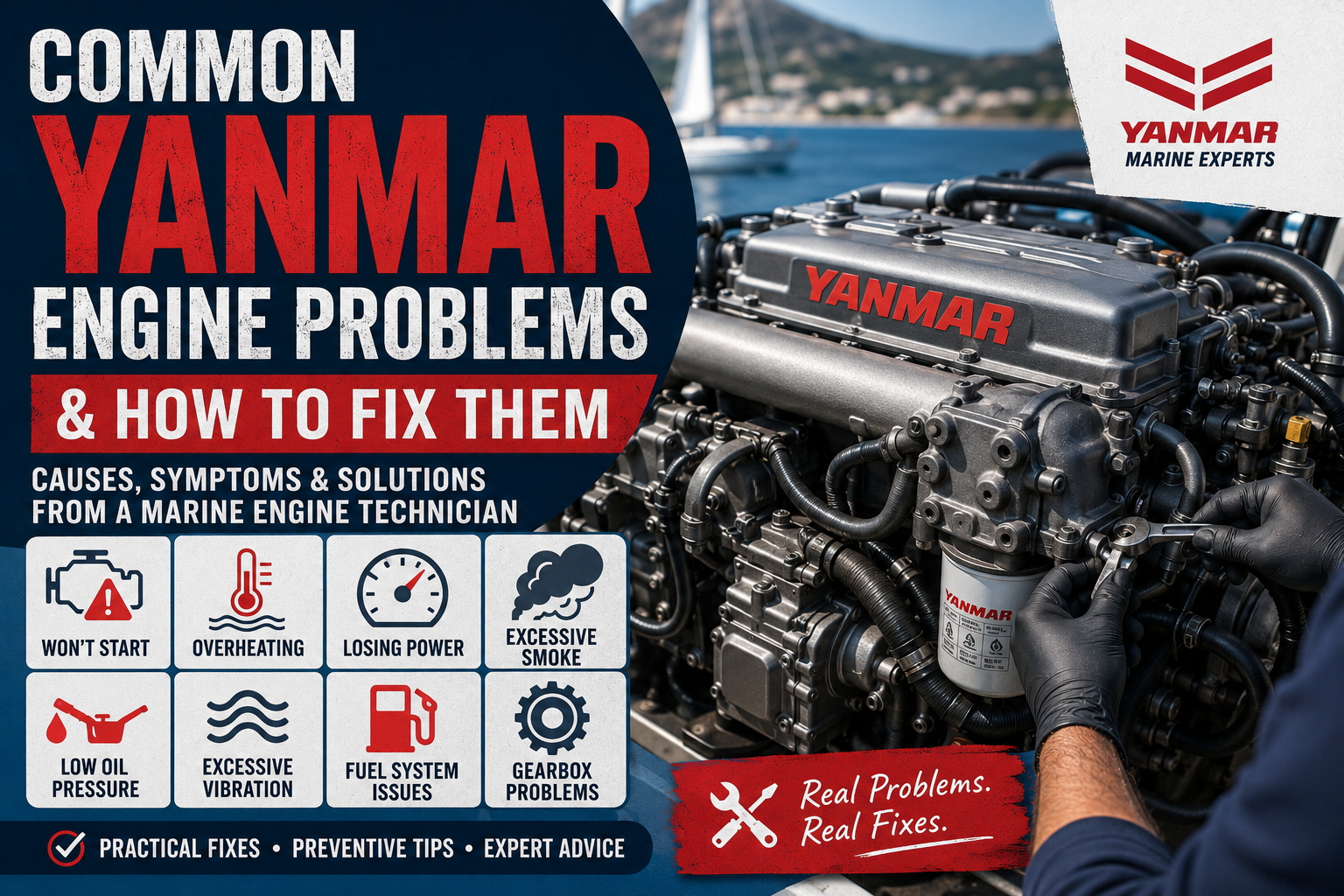
Yanmar marine diesel engines have earned a strong reputation for reliability, fuel efficiency, compact engineering, and long service life. Walk through almost any marina, boatyard, fishing harbor, or sailing club, and there is a good chance you will find a Yanmar engine quietly doing its job.
Models such as the Yanmar 1GM10, 2YM15, 3YM20, 3YM30, 3JH40, 4JH45, 4JH57, 4JH80, and 4JH110 are widely used in sailboats, cruising yachts, fishing vessels, and commercial marine applications. Many properly maintained Yanmar engines operate for thousands of hours without requiring major internal repairs.
But reliable does not mean maintenance-free.
Like every marine diesel engine, a Yanmar operates in a demanding environment. Saltwater, heat, vibration, moisture, fuel contamination, corrosion, long storage periods, and inconsistent maintenance can gradually affect engine performance. A small restriction in the fuel system may eventually cause power loss. A partially blocked mixing elbow can increase exhaust back pressure. A worn raw-water pump impeller may cause overheating when the engine is placed under load.
The encouraging part is that many common Yanmar engine problems begin with recognizable warning signs and can be corrected before they develop into expensive failures.
This guide explains the symptoms, likely causes, diagnostic steps, and practical solutions for some of the most frequently reported Yanmar marine diesel engine issues. Whether your Yanmar Diesel engine will not start, produces excessive smoke, overheats under load, loses power, vibrates excessively, or has an oil-pressure warning, the goal is to help you understand what the engine may be telling you.
Important: This guide provides general troubleshooting information. Always follow the service procedures, specifications, and safety instructions published for your exact Yanmar engine model. Complex fuel-injection, electrical, internal-engine, and major cooling-system repairs should be handled by a qualified marine diesel technician.
One of the most common troubleshooting mistakes is replacing parts before identifying the actual cause of the problem.
An engine that will not start does not automatically need new injectors.
An overheating engine does not automatically need a new heat exchanger.
A diesel engine producing black smoke does not automatically require an overhaul.
Several unrelated faults can produce similar symptoms. For example, low engine power may result from:
Good diagnosis begins by asking a few simple questions:
Did the problem appear suddenly, or did engine performance gradually become worse?
A sudden problem may indicate a failed component, an empty fuel tank, a loose electrical connection, a blocked fuel line, a broken belt, or an overheated component.
A gradual decline may point toward filter restriction, carbon buildup, corrosion, injector wear, cooling-system deposits, or normal component deterioration.
An engine that starts easily when cold but becomes difficult to restart when warm may require a different diagnostic approach from an engine that struggles only during cold starts.
Temperature-related symptoms can sometimes indicate electrical resistance, starter-motor weakness, fuel-system issues, valve-clearance problems, or reduced compression.
Some engines appear perfectly healthy at the dock but develop problems when the propeller places the engine under load.
A Yanmar engine that maintains normal temperature at idle but overheats at cruising speed may have restricted seawater flow, a damaged impeller, heat-exchanger deposits, exhaust restriction, or excessive engine loading.
Likewise, an engine that reaches full RPM in neutral but cannot reach its rated operating speed under load may have a fuel restriction, propeller issue, hull fouling, exhaust restriction, or mechanical problem.
Think about recent work or operating conditions:
Sometimes the most useful diagnostic clue is the last thing that changed.
| Engine symptom | Common possible causes | First checks |
|---|---|---|
| Engine does not crank | Weak battery, corroded terminals, faulty switch, starter issue | Battery voltage, cables, connections |
| Engine cranks but will not start | Fuel shutoff, air in fuel lines, blocked filter, contaminated fuel | Fuel level, filters, bleeding |
| Engine starts and stops | Restricted fuel supply, air leak, blocked tank vent | Fuel flow, hoses, vent |
| Engine overheats | Low coolant, damaged impeller, blocked intake, restricted heat exchanger | Coolant level and raw-water flow |
| Black exhaust smoke | Engine overload, restricted air, excessive fuel, propeller issue | Air intake, RPM, propeller |
| White exhaust smoke | Cold combustion, unburned fuel, injector issue, possible coolant entry | Operating temperature and fuel system |
| Blue exhaust smoke | Engine oil entering the combustion chamber | Oil level and consumption |
| Engine loses power | Fuel restriction, exhaust blockage, fouled propeller | Filters, exhaust, propeller |
| Excessive vibration | Propeller damage, shaft misalignment, worn mounts | Propeller, shaft, engine mounts |
| Low oil-pressure alarm | Low oil level, wrong oil, faulty sender, internal wear | Stop engine and inspect oil level |
This table is a starting point—not a final diagnosis. The sections below explain each problem in greater detail.
Few situations are more frustrating than pressing the start button and hearing nothing—or hearing the engine crank without starting.
The first step is to identify which type of no-start condition you have.
There is an important difference between:
Each condition points toward a different group of possible causes.
If the starter motor does not turn the engine, begin with the electrical system.
Possible causes include:
Marine electrical systems operate in a humid and often corrosive environment. A cable connection may appear secure from the outside while corrosion beneath the terminal increases resistance and reduces current flow.
Begin by checking the battery state of charge and inspecting the positive and negative connections. Battery terminals should be clean, secure, and free from heavy corrosion.
Pay particular attention to the engine-ground cable. A poor ground connection can imitate a weak battery or failing starter motor.
If the starter clicks but does not turn the engine, do not immediately assume the starter is defective. The battery may have enough energy to activate the solenoid but not enough current to rotate the engine.
A Yanmar diesel engine cranking slowly may have:
Diesel engines require adequate cranking speed to generate the compression temperature needed for combustion. A starter may still rotate the engine while turning too slowly for reliable starting.
If the battery is fully charged but the engine continues to crank slowly, a qualified technician can perform voltage-drop testing across the positive and ground sides of the starting circuit.
If the starter turns the engine at a normal speed but the engine does not fire, begin with the fuel system.
Check the basics first:
A surprising number of no-start conditions occur after routine fuel-filter maintenance because air remains trapped in the system.
Diesel fuel-injection systems require a continuous supply of clean fuel without air pockets. If air enters through a loose fitting, empty filter housing, cracked hose, or improperly sealed filter, the injection system may not deliver fuel correctly.
The exact procedure varies by model, so consult the operating manual for your engine.
A general process may include:
Do not loosen high-pressure injection lines unless the service procedure for the specific engine requires it and you are qualified to perform the work. High-pressure diesel fuel can penetrate the skin and cause serious injury.
If air repeatedly returns after the fuel system has been properly bled, inspect for a leak on the suction side of the fuel system. Loose hose clamps, damaged hoses, worn seals, cracked filter housings, or improperly installed filter elements may allow air to enter without producing an obvious external fuel leak.
A Yanmar engine that starts briefly and then shuts down may have:
Try observing how long the engine operates.
If it runs for several seconds and gradually loses speed before stopping, fuel starvation may be more likely than an electrical starting problem.
A blocked tank vent can also create vacuum inside the fuel tank. The engine may start normally, run briefly, and then lose power as fuel flow becomes restricted.
Air entering the diesel fuel system is one of the most common causes of difficult starting, unstable idle, hesitation, and unexpected engine shutdown.
Typical symptoms include:
If the engine operates normally immediately after bleeding but the symptoms return, there is probably an unresolved air-entry point.
Common sources include:
One detail that often confuses boat owners is that an air leak may not produce visible diesel leakage.
The fuel line between the tank and lift pump may operate under suction. A small opening can draw air inward while allowing little or no fuel to leak outward.
Use the correct fuel-filter elements and seals for your engine and filtration system. Before installing a new filter, clean the sealing surface and inspect the gasket position carefully.
After service:
Avoid overtightening filter housings and bleed screws. Excessive force may damage threads, deform seals, or crack components.
An overheating alarm should always be treated seriously.
If the temperature warning activates, reduce engine load and follow the shutdown procedure recommended for your model. Continuing to operate an overheating engine may damage the cylinder head, head gasket, pistons, valves, exhaust components, hoses, seals, and cooling-system parts.
Common causes of Yanmar marine engine overheating include:
Many Yanmar marine engines use raw seawater to remove heat from the engine’s closed freshwater-cooling circuit.
Begin with the basic checks:
Reduced exhaust-water flow may indicate a blocked intake, clogged strainer, damaged impeller, hose restriction, heat-exchanger blockage, or exhaust-system restriction.
Never open a hot coolant-pressure cap. Hot coolant can escape under pressure and cause serious burns.
The flexible impeller is a small component with an important job. Its rubber vanes pull seawater through the cooling system.
Over time, the vanes may:
A damaged impeller may still move some water at low engine speed but fail to provide sufficient cooling under load.
This explains why an engine may maintain normal temperature while idling at the dock but overheat during cruising.
If impeller blades are missing, replacing the impeller is only part of the repair. The broken pieces may travel downstream and restrict the heat exchanger or other cooling passages.
When the engine is completely cool, check the coolant level according to the manufacturer’s instructions.
Low coolant may result from:
Coolant condition also matters. Old or incorrect coolant may provide reduced corrosion protection and contribute to deposits inside the cooling system.
Use coolant that meets the requirements specified for your Yanmar engine. Avoid mixing incompatible coolant types unless the manufacturer confirms compatibility.
A Yanmar engine overheating under load may indicate:
An overloaded engine produces more heat while operating inefficiently.
If the engine previously reached its normal maximum RPM but can no longer do so, investigate both the engine and vessel. A heavily fouled hull or damaged propeller can increase engine load even when the engine itself is functioning correctly.
The exhaust mixing elbow is one of the most important—and frequently overlooked—components in a marine diesel installation.
Its job is to introduce cooling seawater into the hot exhaust stream. Because it is exposed to heat, saltwater, exhaust gases, carbon, and corrosive deposits, internal restriction may develop over time.
Symptoms of a clogged Yanmar mixing elbow may include:
The outside of the elbow may appear acceptable while the internal passage is heavily restricted.
This is why visual inspection of the exterior alone may not reveal the problem.
A restricted elbow increases exhaust back pressure and can affect engine breathing. The engine may receive sufficient fuel but struggle to discharge exhaust gases efficiently.
Inspection intervals depend on engine model, operating hours, duty cycle, installation, water conditions, and material type. Follow Yanmar’s maintenance guidance for the specific engine and exhaust configuration.
If severe corrosion, internal blockage, cracking, or wall deterioration is found, replacement may be safer than attempting to reuse the component.
Many common Yanmar engine faults begin with basic systems:
The key is to diagnose systematically.
Do not replace expensive components simply because they appear on a list of possible causes. Begin with the symptom, verify the basics, inspect the simplest likely causes, and move toward more complex testing only when the evidence supports it.
In Part 2, we will examine:
One of the most frustrating problems for boat owners is an engine that starts normally, idles smoothly, and appears healthy at the dock—but loses power when the vessel is underway.
This is a very common complaint among owners searching for solutions to Yanmar marine diesel engine losing power, Yanmar engine not reaching full RPM, or Yanmar engine bogging down under load.
The important thing to understand is that marine engines operate differently from automotive engines. A boat engine spends much of its working life under continuous load. When you leave the dock and push the throttle forward, the engine must overcome:
A small problem that is invisible at idle can become obvious when the engine is working hard.
Several issues can cause a Yanmar diesel engine to lose power:
The best troubleshooting approach is to separate fuel, air, exhaust, and load-related problems.
Fuel problems are among the most common causes of Yanmar diesel engine performance problems.
Diesel engines require a precise amount of clean fuel delivered at the correct pressure and timing. Even a partial restriction can prevent the engine from producing full power.
Common fuel-related problems include:
The primary fuel filter/water separator protects the engine from contaminants before fuel reaches the engine-mounted filter.
Over time, it can collect:
A partially blocked filter may allow enough fuel flow for idle operation but restrict fuel delivery during acceleration or cruising.
This creates a common pattern:
Many owners immediately suspect the injection pump or injectors, but a simple fuel restriction is often the actual cause.
Marine diesel tanks are exposed to condensation because temperature changes create moisture inside the tank.
Over time, tanks can accumulate:
A boat that has been sitting unused for months is especially vulnerable.
Before blaming the engine, inspect the fuel quality.
Signs of contaminated fuel include:
For vessels operating in remote areas, carrying spare fuel filters is always recommended.
A $20 filter replacement can prevent a major inconvenience offshore.
A restricted fuel supply line can create the same symptoms as a bad injection system.
Inspect:
A blocked tank vent is often overlooked.
If the vent becomes restricted, the fuel pump creates increasing vacuum inside the tank. The engine may run normally initially, then gradually lose power.
A simple diagnostic method is to temporarily open the fuel cap while the engine is experiencing the problem. If performance improves, investigate the tank vent system.
Another common question is:
“Why will my Yanmar engine not reach rated RPM?”
Every Yanmar engine model has a specified operating range. For example, a properly installed engine should generally be capable of reaching its recommended maximum RPM under normal operating conditions.
If your engine reaches only 2,800 RPM when it should achieve 3,600 RPM, something is limiting performance.
Possible causes include:
A propeller that is too large in diameter, too much pitch, damaged, or incorrectly matched to the vessel can overload the engine.
Symptoms include:
This situation is similar to driving a car permanently uphill in the wrong gear.
The engine is working harder than it was designed to operate.
A boat’s underwater condition directly affects engine performance.
Marine growth such as:
can dramatically increase resistance.
Before performing expensive engine repairs, inspect the simple things:
Many “engine problems” are actually vessel-load problems.
Black smoke is one of the most recognizable diesel-engine symptoms.
When boat owners see black exhaust smoke, they often assume the engine is failing internally.
Usually, black smoke means:
The engine is receiving more fuel than the available air can burn efficiently.
This is commonly described as an air-to-fuel imbalance.
Common causes of Yanmar diesel black smoke include:
Before troubleshooting, it helps to understand what exhaust colors usually indicate.
| Smoke color | Usually indicates |
|---|---|
| Black smoke | Too much fuel or insufficient air |
| White smoke | Unburned fuel or coolant-related issue |
| Blue smoke | Burning engine oil |
Smoke diagnosis is not always absolute, but it provides valuable direction.
A small amount of black smoke during sudden acceleration can be normal for some diesel engines because fuel increases immediately before airflow fully catches up.
However, continuous heavy black smoke is not normal.
If a Yanmar engine produces thick black smoke while cruising, investigate:
Diesel engines depend heavily on airflow.
Check:
A restricted air supply reduces combustion efficiency.
Turbocharged Yanmar engines rely on the turbocharger to increase airflow.
A damaged turbocharger may cause:
Possible turbocharger problems include:
Before replacing a turbocharger, confirm that the problem is actually related to the turbo system.
A restricted exhaust system prevents the engine from efficiently removing combustion gases.
Common causes include:
A restricted exhaust system can create symptoms that look like fuel problems.
White smoke from a marine diesel engine requires careful diagnosis.
Not all white exhaust is a serious problem.
A cold diesel engine may produce temporary white vapor because fuel does not completely burn until combustion temperatures increase.
However, continuous white smoke after the engine reaches operating temperature requires investigation.
Possible causes of Yanmar diesel white smoke include:
When diesel fuel enters the cylinder but does not burn completely, it exits as white smoke.
Causes may include:
A worn injector may not atomize fuel correctly.
Instead of creating a fine mist, the injector may produce larger droplets that burn poorly.
Symptoms may include:
Injectors should be tested according to manufacturer specifications.
Diesel engines rely on compression heat to ignite fuel.
If compression is reduced because of:
the engine may struggle to burn fuel efficiently.
Compression testing can help identify internal mechanical problems.
White smoke combined with coolant loss is more concerning.
Possible causes include:
Warning signs include:
These conditions require prompt attention.
Blue smoke indicates that engine oil is entering the combustion chamber and burning.
A small amount during startup may occur on some engines, especially older units.
Continuous blue smoke usually requires investigation.
Possible causes include:
An overfilled engine can produce blue smoke.
Many owners assume more oil equals better protection, but excessive oil can create problems.
Always maintain oil at the manufacturer’s recommended level.
Check:
Keep records of oil consumption.
An engine that uses a small amount of oil over hundreds of hours may be normal.
A sudden increase in oil consumption is a warning sign.
A Yanmar engine that repeatedly speeds up and slows down at idle is often described as “hunting.”
Symptoms include:
Common causes include:
Fuel-system issues should be investigated before adjusting mechanical settings.
Many owners attempt to increase idle speed to hide the problem, but this does not correct the underlying cause.
Injectors play a critical role in diesel combustion.
A properly functioning injector must:
A faulty injector may cause:
Injector testing is usually more cost-effective than replacing major engine components unnecessarily.
Some vibration is normal in marine diesel engines.
After all, a diesel engine produces powerful combustion forces while mounted inside a vessel.
However, excessive vibration should never be ignored.
Common causes of Yanmar marine engine vibration include:
The propeller is often the first place to inspect.
Look for:
A damaged propeller can create vibration throughout the entire vessel.
Engine mounts absorb vibration and maintain alignment between the engine and drivetrain.
Over time, mounts can:
A failed mount can cause:
Replacing worn mounts often dramatically improves vessel smoothness.
Many expensive repairs begin as small maintenance issues.
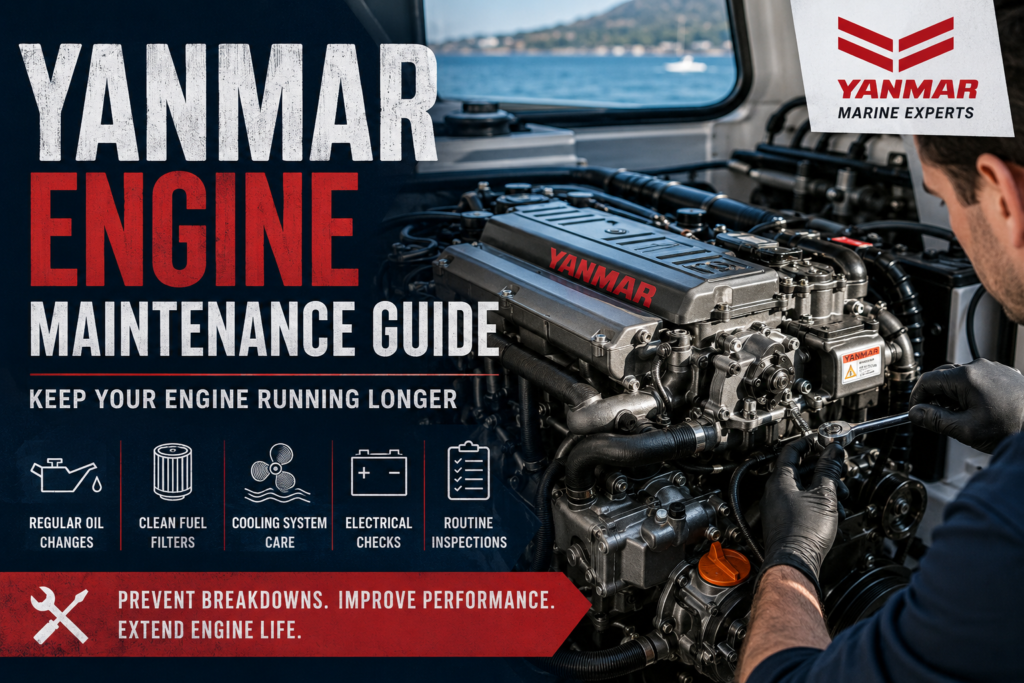
A strong preventive maintenance routine should include:
A marine diesel engine rewards owners who pay attention to small details.
A Yanmar engine is not complicated because it is unreliable—it is complicated because it is designed to operate in one of the harshest environments on earth.
Saltwater, vibration, temperature changes, and long periods of inactivity create challenges that a normal automotive engine never experiences.
A Yanmar low oil-pressure alarm should never be ignored.
Oil pressure is what allows engine oil to circulate through bearings, crankshaft journals, valve-train components, turbocharger parts, and other critical surfaces. Without adequate lubrication, severe engine damage can occur quickly.
If the oil-pressure warning activates while the engine is running, reduce load and stop the engine safely as soon as conditions allow.
Do not continue operating simply because the engine still sounds normal.
Possible causes include:
The first step is simple:
Check the oil level using the correct procedure for the engine model.
If the oil level is low, identify why.
Possible reasons include:
If the oil level is correct, the next step is to determine whether the warning is caused by an electrical fault or genuine low pressure.
A qualified technician may install a mechanical oil-pressure gauge to compare actual pressure against the engine specification.
Never assume the sender is faulty without testing.
That assumption can become very expensive.
The oil level and condition can provide important diagnostic clues.
Milky or creamy oil may indicate:
An oil level that rises unexpectedly may suggest:
Fuel dilution reduces oil viscosity and weakens lubrication.
Possible causes may include injector leakage, fuel-pump issues, repeated unsuccessful starting, or other fuel-system faults.
Do not continue normal operation until the cause has been identified.
All internal-combustion engines may consume a small amount of oil, especially as operating hours increase.
The concern begins when consumption changes noticeably or becomes excessive.
Signs of Yanmar engine burning oil may include:
Possible causes include:
Do not judge oil consumption from one reading.
Keep a service record showing:
A trend is more useful than a single measurement.
This problem deserves special attention because it is often misdiagnosed.
A boat owner presses the start button, hears a click, and assumes the starter motor has failed.
Sometimes that is correct.
Often, it is not.
On some older marine installations, resistance can develop in the starter circuit because of:
The starter solenoid may receive enough voltage to click, but not enough to engage reliably.
Inspect:
A connection may look clean externally while corrosion or looseness increases resistance.
Technicians often use voltage-drop testing because a simple continuity test may not reveal resistance under load.
Some owners try to bypass wiring or jump the starter terminals.
That can create risks, including:
Any relay modification or harness repair should preserve the original neutral-safety and engine-control protections.
For a detailed electrical guide, connect this section to Yanmar Engine Starting Problems or Yanmar Electrical Troubleshooting.
A charging-system warning can be caused by more than a failed alternator.
Possible causes include:
A slipping alternator belt may produce:
Do not overtighten the belt.
Excessive tension can damage alternator or water-pump bearings.
Use the adjustment procedure and tension specification for your model.
A battery may display acceptable voltage with no load and still fail during starting.
Likewise, an alternator may show some output at idle but fail to provide proper charging under normal operating conditions.
A technician may check:
Replace components only after confirming which part of the system has failed.
Sometimes the engine is running correctly, but propulsion is not.
Common Yanmar marine gearbox problems include:
Possible causes include:
The correct procedure varies by transmission model.
Some gearboxes require the fluid to be checked with the dipstick inserted but not threaded. Others use different methods.
Always follow the manual for the specific Kanzaki or compatible transmission.
Inspect the fluid for:
Milky gearbox oil may indicate water contamination.
This requires immediate investigation.
If the engine speed rises but the vessel does not move normally, possible causes include:
Do not continue increasing throttle.
That can worsen clutch or drivetrain damage.
Connect this section to Yanmar Marine Gearboxes for internal linking.
Yanmar saildrives offer compact installation, efficient thrust, and reduced shaft-alignment requirements, but they also need model-specific care.
Common areas to inspect include:
Possible warning signs include:
The saildrive diaphragm is a critical installation component.
Inspection and replacement requirements vary by saildrive model and service schedule.
Follow the applicable Yanmar instructions rather than using a universal interval from online discussions.
For more information, internally link to Yanmar Saildrives and your individual SD-series product pages.
A boat may feel as though the engine is failing when the real problem is in the installation.
Worn engine mounts or poor alignment can create:
Look for:
Engine mounts should support the engine while controlling movement.
A soft or failed mount may allow the engine to move excessively under load.
Alignment may be affected by:
Final shaft alignment may need to be checked with the vessel afloat because the hull can sit differently in the water than it does on land.
Alignment is precision work and should be handled by someone with appropriate tools and experience.
Modern engines such as the Yanmar 3JH40, 4JH45, 4JH57, 4JH80, 4JH110, 4LV Series, and other electronically controlled models use advanced common-rail fuel systems.
These engines offer excellent benefits:
However, troubleshooting differs from older mechanical engines.
Possible symptoms include:
Potential causes may include:
Older mechanical engines can often be diagnosed with basic fuel, air, compression, and electrical checks.
Modern systems may require:
Do not loosen high-pressure fuel lines.
Common-rail fuel may be under enough pressure to penetrate the skin and cause severe injury.
A check-engine warning does not automatically mean the ECU is defective.
Low battery voltage, poor grounds, damaged connectors, sensor faults, and fuel-supply problems can all trigger electronic warnings.
When diagnosing common Yanmar engine problems, use a consistent process.
Avoid saying:
“The engine is bad.”
Instead, record:
Precise symptoms narrow the possible causes.
Check:
Do not skip simple checks because the problem appears serious.
Ask:
The most recent change is often the best clue.
Poor performance may come from:
Do not overhaul an engine before checking the vessel and drivetrain.
Random parts replacement wastes money.
Use evidence:
A good diagnosis is usually cheaper than guessing.
Many boat owners can perform basic troubleshooting when they have the correct manual, tools, and knowledge.
Reasonable owner checks may include:
Professional support is recommended when:
Knowing when to stop is part of good troubleshooting.
Some conditions may cause rapid damage.
Stop the engine safely if you observe:
Do not try to “push through” a serious warning just to reach the marina unless vessel safety leaves no alternative.
Protecting the vessel and people onboard comes first.
The best repair is the one you never need.
A strong Yanmar preventive maintenance schedule should include:
A practical onboard spare kit may include:
The exact spare-parts kit should match your engine model and cruising plan.
Long periods of light loading and short running can contribute to:
Operate the engine according to Yanmar’s model-specific guidance.
Do not assume that constantly running at very low RPM is the gentlest treatment.
Eventually, every owner faces the same question:
“Should I repair this engine, rebuild it, or replace it?”
There is no universal answer.
Examples include:
A modern Yanmar Marine Engine Repower may offer:
The decision should consider the complete installation—not only the engine price.
Gearbox compatibility, controls, exhaust, cooling, mounts, shafting, propeller, wiring, and access may all affect repower cost.
Fuel contamination, air entering the fuel system, cooling-water restriction, and neglected exhaust components are among the most common issues seen in marine service.
Possible causes include air in the fuel system, restricted fuel flow, contaminated diesel, a closed fuel valve, a stop-control issue, or insufficient cranking speed.
Possible causes include a worn impeller, restricted raw-water intake, blocked heat exchanger, exhaust restriction, fouled propeller, or excessive engine loading.
Black smoke usually indicates excessive fuel, insufficient air, or excessive engine load. Check airflow, exhaust restriction, propeller condition, and whether the engine can reach rated RPM.
White smoke may be caused by unburned fuel, low combustion temperature, injector issues, low compression, incorrect timing, or coolant entering the combustion chamber.
Blue smoke usually means engine oil is entering the combustion process. Possible causes include overfilling, piston-ring wear, valve wear, or turbocharger oil leakage.
Possible causes include a blocked fuel filter, air leak, restricted tank vent, contaminated fuel, blocked pickup tube, or stop-control problem.
Possible causes include restricted fuel or air flow, blocked exhaust, fouled hull, damaged propeller, incorrect propeller pitch, engine overload, injector issues, or low compression.
Yes. A restricted exhaust mixing elbow can increase back pressure and contribute to low RPM, black smoke, overheating, poor acceleration, and increased fuel consumption.
Vibration that appears mainly in gear often points toward the propeller, shaft, coupling, alignment, or engine mounts. Vibration present in neutral may be more closely related to the engine itself.
They require specialized knowledge, diagnostic tools, and strict high-pressure fuel safety procedures. Routine owner maintenance is still possible, but electronic and high-pressure repairs should be handled professionally.
A properly installed and maintained Yanmar engine can provide thousands of hours of service. Engine life depends on maintenance, loading, fuel quality, cooling-system care, and operating conditions.
Most major engine failures do not begin as major failures.
They begin as:
The mistake is not always failing to repair the engine.
The mistake is often ignoring the warning long enough for a manageable problem to become an expensive one.
The smartest approach to Yanmar engine troubleshooting is simple:
Start with the exact symptom.
Check the basic systems first.
Look at what changed.
Test before replacing parts.
Know when the repair is beyond safe DIY work.
Yanmar marine engines are known for durability, but that durability depends on clean fuel, proper cooling, correct lubrication, good installation, and regular service.
Take care of those fundamentals, and your engine is far more likely to take care of you when the weather changes, the marina entrance gets tight, or the shore disappears behind you.
Yanmar Marine Experts supports boat owners, yacht operators, commercial vessel owners, and marine professionals with:
Whether your Yanmar engine will not start, is overheating, losing power, smoking, vibrating, or approaching the end of its service life, accurate diagnosis is the first step toward the right solution.
Contact Yanmar Marine Experts for practical guidance, genuine replacement components, and support selecting the correct repair or repower solution for your vessel.
