
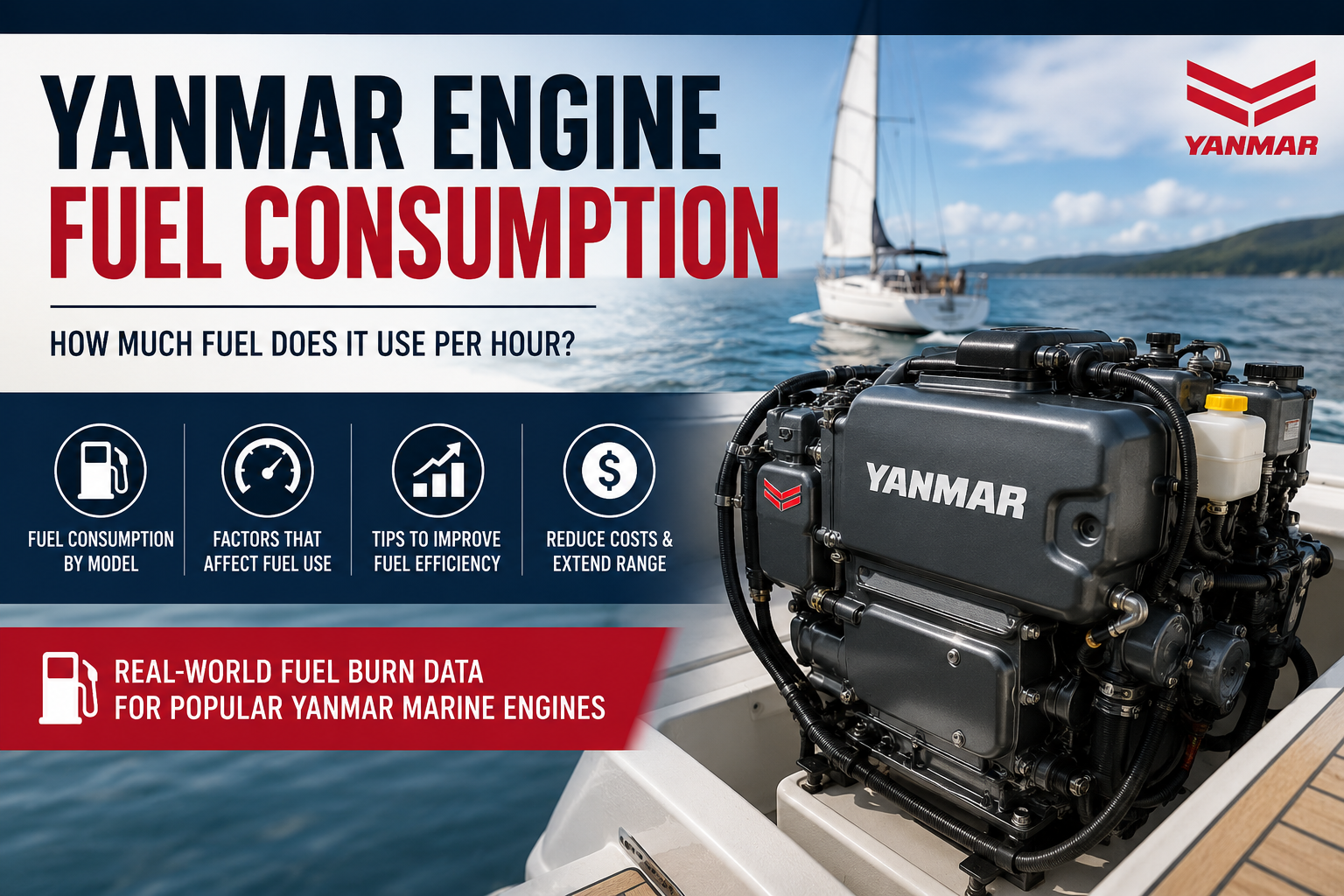
One of the most common questions we hear at Yanmar Marine Experts is:
“How much Yanmar engine fuel consumption should I expect per hour?”
It’s a fair question.
Whether you’re planning a long-distance cruise, calculating operating costs for a commercial vessel, comparing engine models, or considering a Marine Engine Repower, understanding Yanmar engine fuel consumption can significantly impact your boating budget.
The challenge is that there isn’t a single answer.
A Yanmar Marine Engine doesn’t consume the same amount of fuel every hour. Yanmar engine fuel consumption varies depending on engine size, RPM, vessel weight, propeller selection, sea conditions, hull cleanliness, and how hard the engine is working.
That’s why you’ll often see different fuel consumption figures online for the same engine model.
As specialists in Yanmar Marine Diesel Engines, we’ve helped hundreds of boat owners choose the right engine for their vessel. One thing we’ve learned is that understanding Yanmar engine fuel consumption is about much more than simply looking at horsepower ratings.
In this guide, we’ll explain how fuel consumption works, provide realistic fuel burn estimates for popular Yanmar engines, and share practical ways to improve fuel efficiency on your boat.
Fuel consumption affects more than just operating costs.
It influences:
For commercial operators, fuel often represents one of the largest operating expenses.
For recreational boat owners, understanding fuel burn helps determine how far they can travel before refueling and what their annual operating costs may look like.
When customers are comparing Yanmar Marine Engines for Sale, fuel efficiency is often one of the deciding factors.
After helping boat owners, captains, and commercial operators with Marine Engine Repower projects for years, we’ve noticed a common misconception: many people overestimate how much fuel their engine actually uses.
It’s understandable. Fuel costs are one of the biggest ongoing expenses associated with boat ownership, so owners naturally focus on fuel burn when comparing engines.
However, we’ve seen many customers avoid upgrading to a newer engine because they assumed a larger engine would dramatically increase fuel costs. In reality, a properly matched engine often improves overall efficiency because it doesn’t need to work as hard to move the vessel.
For example, we’ve worked with sailboat owners replacing aging engines with modern Yanmar 3JH40 and Yanmar 4JH57 models. In many cases, they experienced improved fuel economy despite gaining horsepower, simply because the newer engine and propeller combination operated more efficiently.
This is why understanding Yanmar engine fuel consumption requires looking at the complete propulsion system rather than engine size alone.
Marine diesel engines are typically measured in:
Fuel consumption varies according to engine load.
For example:
This means a Yanmar 4JH57 running at 2,400 RPM may consume significantly less fuel than the same engine operating at maximum RPM.
One of the biggest mistakes boat owners make is assuming maximum fuel consumption figures represent normal operating conditions.
In reality, most vessels spend very little time at full throttle. Yanmar fuel consumption
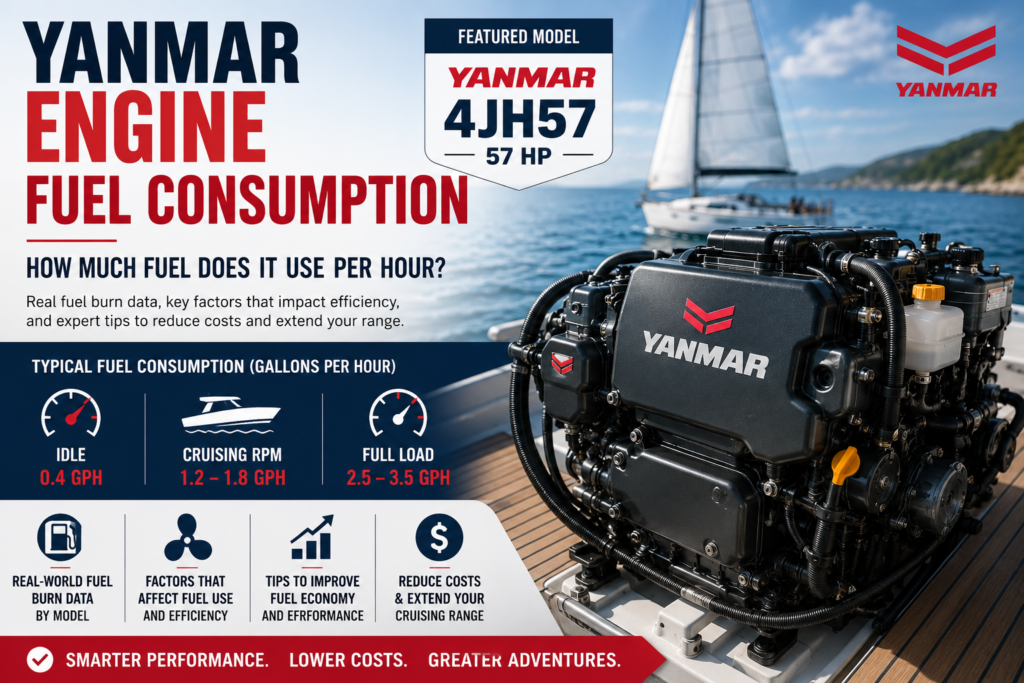
One of the biggest mistakes boat owners make is focusing entirely on horsepower ratings when evaluating fuel consumption.
Diesel engines are most efficient when operating within their ideal load range.
For example, a larger engine running comfortably at 60% load may consume fuel more efficiently than a smaller engine operating continuously at 90% load.
This is particularly important when selecting a new engine during a Marine Engine Repower project.
We’ve seen cases where customers selected the smallest possible engine to save fuel, only to discover that the engine needed to work harder under normal cruising conditions. In some situations, fuel consumption actually increased.
This is one reason why proper engine sizing remains one of the most important factors affecting Yanmar engine fuel consumption.
The following figures represent typical real-world operating ranges. Actual fuel consumption will vary depending on vessel type, propeller selection, operating conditions, and engine load.
The Yanmar 3YM20 is a compact 21 HP marine diesel engine commonly used in smaller sailboats.
Typical fuel consumption:
This makes it one of the most economical engines in the Yanmar lineup.
The Yanmar 3YM30AE remains one of the most popular sailboat repower engines in the world.
Typical fuel consumption:
Many sailors researching the Best Yanmar Engine for Sailboats are surprised by how little fuel this engine consumes during normal cruising.
The Yanmar 3JH40 is frequently chosen for cruising sailboats and auxiliary propulsion applications.
Typical fuel consumption:
For many cruising boats, the 3JH40 offers an excellent balance of power and efficiency.
The Yanmar 4JH45 provides additional smoothness and power while maintaining impressive efficiency.
Typical fuel consumption:
The Yanmar 4JH57 is one of the most common engines used in larger cruising sailboats.
Typical fuel consumption:
This engine is often recommended during Marine Engine Repower projects because it combines strong performance with excellent fuel economy.
The Yanmar 4JH80 is designed for larger vessels requiring additional power and torque.
Typical fuel consumption:
The Yanmar 4JH110 is popular among offshore cruisers and commercial operators.
Typical fuel consumption:
The Yanmar 4LV150 combines common-rail technology with exceptional fuel efficiency.
Typical fuel consumption:
The Yanmar 4LV170 combines common-rail technology with exceptional fuel efficiency.
Typical fuel consumption:
The Yanmar 4LV195 combines common-rail technology with exceptional fuel efficiency.
Typical fuel consumption:
Boat owners are often surprised when they compare fuel consumption figures from different sources and find conflicting numbers.
The reason is simple.
Fuel consumption is influenced by many variables, including:
A Yanmar 4JH57 installed in a lightweight sailboat may consume significantly less fuel than the same engine installed in a heavier cruising vessel.
This is why published fuel consumption figures should be treated as planning estimates rather than guarantees.
At Yanmar Marine Experts, we encourage customers to use fuel consumption data as a comparison tool while recognizing that real-world results may vary.
One thing we’ve learned from years of supplying Yanmar Marine Diesel Engines is that real-world fuel consumption rarely matches factory test conditions exactly.
Manufacturers test engines under controlled environments using specific loads, temperatures, and operating parameters.
In the real world, vessels encounter:
As a result, actual fuel burn can vary considerably.
While factory data provides useful benchmarks, actual Yanmar engine fuel consumption can vary significantly depending on vessel configuration, maintenance practices, operating conditions, and overall drivetrain efficiency.
This is why we always encourage customers to view fuel consumption figures as realistic planning estimates rather than guaranteed results. Yanmar Fuel “hourage” – Cruisers & Sailing Forums
Understanding these factors is essential because they directly influence Yanmar engines fuel consumption regardless of engine size or horsepower rating.
An incorrectly sized propeller can dramatically increase fuel consumption.
We’ve seen vessels consume significantly more fuel simply because the propeller was mismatched to the engine.
A propeller that is too large can overload the engine, while a propeller that is too small may prevent the engine from operating efficiently.
This is one reason why proper propeller selection is critical during a Marine Engine Repower.
A dirty hull creates drag.
More drag means the engine must work harder to maintain the same speed.
Even a relatively small amount of marine growth can have a noticeable impact on fuel efficiency.
We’ve seen boats improve fuel economy simply by cleaning the hull and propeller.
Additional weight requires additional power.
Extra fuel, water tanks, spare parts, equipment, and personal gear all increase displacement and fuel consumption.
Many owners underestimate how much additional weight accumulates over years of cruising.
Fuel consumption rises rapidly at higher RPM levels.
Many boat owners discover that reducing cruising speed by just one knot can significantly improve fuel efficiency and extend cruising range.
Headwinds, rough seas, and adverse currents force the engine to work harder.
This is why a boat may consume noticeably more fuel during offshore passages compared to calm-water cruising.
Let’s look at a practical example.
Imagine a cruising sailboat powered by a Yanmar 4JH57 that averages approximately 1.5 gallons per hour at normal cruising RPM.
If the vessel operates 200 hours annually and diesel fuel costs $4.00 per gallon:
Now compare that to a vessel operating only 75 hours annually:
This simple exercise demonstrates why understanding Yanmar engine fuel consumption helps owners estimate operating expenses before purchasing an engine or planning a repower.
Improving fuel efficiency doesn’t always require expensive modifications.
Some of the most effective strategies include:
Routine maintenance is one of the easiest ways to maintain fuel efficiency.
This includes:
A well-maintained engine generally consumes less fuel than a neglected one.
A clean hull reduces drag and improves performance.
For many boat owners, regular hull cleaning delivers immediate improvements in fuel economy.
Every engine has an optimal operating range.
Running continuously at maximum RPM often increases fuel consumption disproportionately compared to the speed gained.
Few changes improve efficiency more than proper propeller sizing.
Correct propeller selection helps the engine operate within its intended load range.
Reducing excess onboard equipment and unnecessary supplies can improve both performance and fuel economy.
One of the most common questions we receive is whether a Yanmar 3YM30AE consumes less fuel than a Yanmar 4JH45.
The answer is usually not as straightforward as many owners expect.
In many sailboat applications, cruising speed remains relatively similar regardless of engine size because hull speed becomes the limiting factor.
As a result, the difference in real-world Yanmar engine fuel consumption may be smaller than anticipated.
What matters most is selecting the engine that matches the vessel’s displacement, intended use, and cruising requirements.
Many boat owners assume they are.
Sometimes they are.
Sometimes they aren’t.
The reality is more complicated.
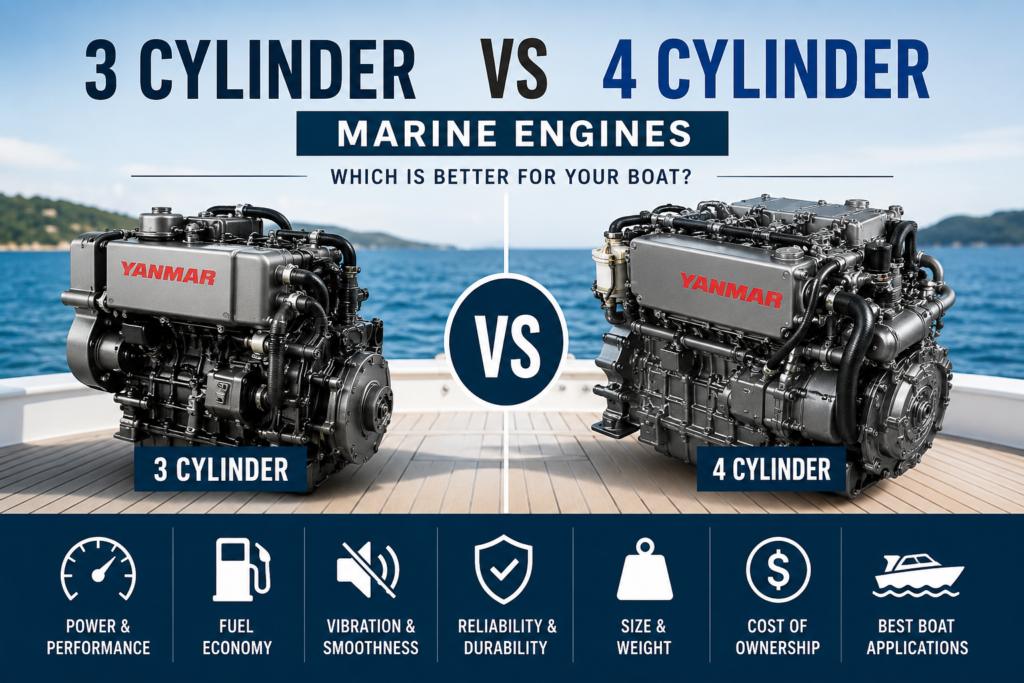
When comparing different engine configurations, many boat owners focus exclusively on horsepower. However, Yanmar engine fuel consumption is often influenced more by engine load, vessel displacement, propeller matching, and cruising RPM than by cylinder count alone.
A properly sized 3 Cylinder Marine Engine can be extremely economical.
However, an undersized engine operating near maximum load may actually burn more fuel than a properly sized 4 Cylinder Marine Engine running comfortably within its optimal operating range.
This is one reason why our recommendations are always based on vessel requirements rather than cylinder count alone.
If you’re interested in this topic, be sure to read our guide on 3 Cylinder vs 4 Cylinder Marine Engines.
If there’s one lesson we’ve learned after helping customers with Marine Engine Repower projects, it’s this:
Don’t choose an engine based solely on fuel consumption.
Fuel economy is important, but so are:
We’ve seen owners purchase engines that were simply too small for their application because they were chasing fuel savings.
In many cases, they ended up sacrificing performance while gaining very little real-world efficiency.
The best engine is usually the one that matches the boat.
After years of supplying Yanmar Diesel inboard Engines, we’ve learned that fuel efficiency isn’t determined by a single specification.
The most efficient engine is usually the one that is properly matched to the vessel.
A correctly sized engine, paired with the right propeller and maintained according to manufacturer recommendations, will almost always outperform an oversized or undersized installation.
This is why professional engine selection remains one of the most effective ways to optimize Yanmar engine fuel consumption over the long term.
So, how much fuel does a Yanmar Marine Engine use per hour?
The honest answer is:
It depends.
A small Yanmar 3YM20 may burn less than 1 gallon per hour under normal operating conditions.
A larger Yanmar 4JH110 may consume several gallons per hour when operating under heavy loads.
Understanding Yanmar engine fuel consumption is one of the most important factors when selecting a marine diesel engine. While fuel burn varies by engine model, vessel type, and operating conditions, choosing the correct engine can significantly improve efficiency and reduce long-term operating costs.
The key isn’t finding the smallest engine.
The key is finding the right engine.
A properly matched engine will deliver the best balance of:
At Yanmar Marine Experts, we help boat owners evaluate these factors every day.
Whether you’re researching Yanmar Marine Engines for Sale, planning a Marine Engine Repower, or comparing engines such as the Yanmar 3JH40, Yanmar 4JH57, or Yanmar 4JH80, our team can help you choose the right solution for your vessel.
For many sailboats, the Yanmar 3YM20 and Yanmar 3YM30AE are among the most fuel-efficient options available.
Not necessarily. Fuel consumption depends heavily on engine load, vessel weight, operating conditions, and propeller selection.
Most Yanmar engines achieve their best fuel economy at moderate cruising RPM rather than maximum throttle.
Absolutely. Incorrect propeller sizing is one of the most common causes of excessive fuel consumption and poor engine performance.
Several factors affect Yanmar engine fuel consumption, including propeller sizing, hull condition, vessel weight, cruising RPM, weather conditions, and engine maintenance. Even small changes in these areas can noticeably impact fuel efficiency.
Yes. Many owners undertaking a Yanmar Marine Engine Repower achieve improvements in fuel economy, reliability, performance, and overall operating costs.
If you’re evaluating Yanmar engine fuel consumption, researching Yanmar Marine Engines for Sale, or planning a complete Marine Engine Repower, our specialists are here to help.
We can assist with:
Whether you’re considering a Yanmar 3YM30AE, Yanmar 3JH40, Yanmar 4JH57, Yanmar 4LV250, or another model, Yanmar Marine Experts can help you identify the right propulsion package for your vessel and cruising goals.
