
Imagine this: you are standing over your boat’s engine with a failed water pump in one hand and your phone in the other. You know it is a Yanmar. You think it is around 30 horsepower. You search for the part, find three listings that look almost identical, and then notice they all claim to fit different Yanmar models.
That is where a simple parts search can turn into an expensive guessing game.
A representative situation like this is exactly why Yanmar engine identification matters. Before you order Yanmar marine engine parts, download a manual, investigate a fault, or plan a repower, you need to establish exactly which engine is installed.
The most important information is usually sitting on a small identification plate attached to the engine.
And there is one rule worth remembering throughout this article:
Identify the engine first. Order the part second.
Yanmar’s own marine FAQ says the engine serial number can be found on the engine information plate and that the engine model information is important to accompany the serial number. Yanmar USA is even more explicit: because of Yanmar’s large product range, engine identification can only be determined by providing the complete model number and serial number.
That distinction is the foundation of accurate Yanmar parts and service work.
A Yanmar engine serial number is the identifying number associated with a particular engine. It works together with the engine’s model designation to establish what engine you actually have.
That sounds straightforward, but there is an important distinction between the model and the serial number.
The model identifies the engine type or model within Yanmar’s product range.
Examples of Yanmar marine engine models include:
These are not simply random combinations of letters and numbers. They identify different engine families and configurations.
For example, Yanmar’s current YM range includes the 2YM15, 3YM20 and 3YM30AE. Yanmar lists them as different models with different rated outputs and engine speeds, even though they belong to the same broader series.
So writing “I have a Yanmar YM” is not the same as identifying the exact engine.
Likewise, “Yanmar 4JH” may be useful as a starting point, but it does not necessarily provide all the information required to identify a particular engine and its parts.
The serial number—or engine number, depending on the terminology used on the plate or in the documentation—distinguishes the individual engine.
Yanmar’s documentation uses fields such as ENG.No. and MFG.DATE on engine nameplates. In the 6LY documentation, for example, the nameplate includes the model, gear model, power, speed, engine number and manufacturing date.
The important point is not to treat the number as something you can always decode character-by-character from a generic online chart.
Instead, use it as an official identification reference together with the complete model.
Boat owners may encounter several terms:
Engine Number
Serial Number
ENG.No.
These may refer to the engine’s identifying number, depending on the documentation and engine series.
The safest approach is simple: copy the information exactly as it appears on the identification plate.
Do not rewrite it from memory.
Do not shorten it.
And do not guess a character that you cannot read.
This is one of the most important answers in the entire article.
Can you reliably identify a Yanmar engine using only the serial number?
Generally, no.
Yanmar USA states that identification requires the complete model number and serial number because of the size of its product range.
That means the correct identification workflow is:
Complete Model + Complete Serial Number
rather than:
Serial Number Only
This becomes even more important when dealing with older engines, legacy models, production changes, or an engine that has been repowered or modified.
The first place to look is the Yanmar identification plate, also called the engine nameplate or engine information plate.
Yanmar’s official FAQ specifically directs owners to this plate when looking for the engine serial number.
The exact location, however, depends on the engine series.
That is important because one of the most common pieces of bad internet advice is the idea that every Yanmar diesel has its serial number in the same place.
It does not.
The identification plate is the engine’s factory information source.
Depending on the model and generation, it may contain several pieces of information, including:
The exact fields vary by engine series.
For example, Yanmar’s YM Series operation manual shows an engine nameplate containing the model, output, engine speed, propeller-shaft speed, fuel-stop power, engine number and manufacturing date.
That is why photographing the entire plate is usually better than simply writing down one number.
On some older Yanmar engines, the nameplate is mounted on the rocker arm cover.
The exact location should always be confirmed against the operation manual for the engine you have rather than assuming every model follows the same layout.
This matters particularly with legacy Yanmar marine diesels, where the physical arrangement may differ from newer engines.
The location is particularly clear on Yanmar’s current YM documentation.
For the 2YM15, 3YM20 and 3YM30AE, Yanmar shows the engine nameplate attached to the rocker arm cover.
The same documentation also identifies separate plates for the marine gear and saildrive.
That means if you are working on a YM engine, do not confuse the engine identification plate with the propulsion-unit plate.
Yanmar’s JH Series operation manual identifies the engine nameplate on the rocker arm cover for the 3JH and 4JH common-rail engines. The manual also provides separate identification information for the marine gear and saildrive.
This distinction matters when ordering propulsion components because the engine and drive system have their own identifiers.
The 4LV Series is a good example of why generic identification advice can be misleading.
Yanmar’s 4LV operation manual states that the engine nameplate is attached to the top surface of the engine coolant tank/heat exchanger. The same manual shows a separate marine-gear nameplate.
So if you have a 4LV and start looking only around the rocker cover, you may simply be looking in the wrong place.
For the 6LY Series, Yanmar documentation states that the engine nameplate is attached to the top of the exhaust manifold. The marine gear has a separate nameplate on the gear case.
That is a perfect example of why the engine series matters when locating the identification information.
As you move into larger engines and newer generations, the information plate can also contain additional regulatory or emissions information.
For example, Yanmar’s 6LT documentation includes an emissions-control information label containing the engine serial number and manufacture date alongside other regulatory information.
Do not automatically assume that every number printed on the engine is the serial number.
Look for the field specifically identifying the engine number, serial number, model, or other factory identification data.
Once you locate the plate, slow down.
This is not the moment to take a blurry photograph from six feet away and start searching Google.
Read the plate line by line.
Copy the model exactly as shown.
For example:
3YM30AE
is more useful than simply writing:
3YM30
Likewise:
6LY400
provides more information than:
6LY
The difference may seem small, but exact model identification is critical when comparing technical specifications, manuals and parts information.
Yanmar’s own product pages distinguish individual models within the same series—for example, the YM family includes 2YM15, 3YM20 and 3YM30AE as separate models.
Next, record the full number shown beside ENG.No., Serial No., or the equivalent identification field.
Write every visible character.
Do not remove leading zeros.
Do not add spaces unless the plate shows them.
Do not replace an uncertain character because you think you know what it should be.
If a manufacturing date appears on the plate, record it too.
The date can become useful when working with older engines, documentation, production versions, or parts that may have changed during the life of a model.
Yanmar’s YM and 6LY documentation, for example, includes manufacturing-date information as part of the engine nameplate data.
If the engine plate includes a gear model, write that down.
Then separately inspect the marine gear or saildrive plate.
This gives you a much more complete picture of the installation.
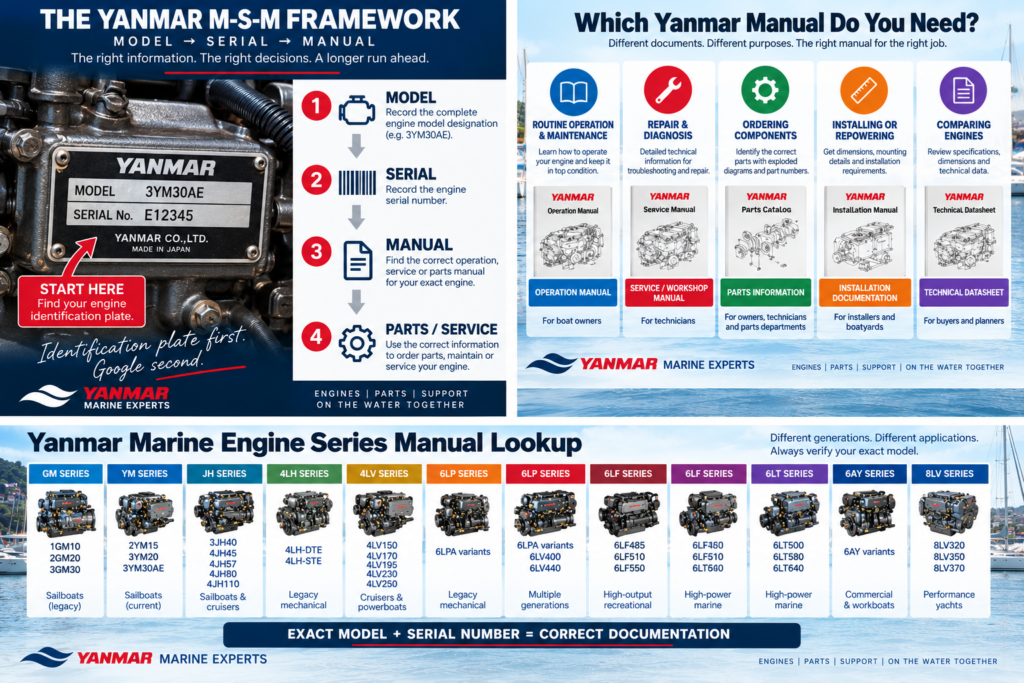
Here is the framework I recommend using whenever you need to identify a Yanmar marine diesel before buying parts.
Find and record the complete Yanmar engine model exactly as shown on the engine plate.
Record the complete Yanmar engine serial number or engine number.
Match those two pieces of information to the correct Yanmar documentation, engine generation, and configuration.
Only after those three steps should you move into detailed parts identification.
This framework leads to an important contrarian insight:
The part number is not the beginning of the parts search. Engine identification is.
A marketplace listing may show a photograph of a part that looks identical to yours.
That does not prove compatibility.
A search result may say “fits Yanmar.”
That still does not prove it fits your exact engine.
A forum post may recommend a particular component.
That recommendation may apply to a different model or production version.
The disciplined process is different:
MODEL → SERIAL → MATCH → VERIFY → ORDER
That small change in thinking can prevent a lot of unnecessary parts returns, installation delays, and downtime.
And it is especially valuable when dealing with an older engine where the model name alone may not tell the whole story.
When somebody asks, “What Yanmar engine do you have?” try not to answer with only the approximate horsepower.
Instead, find the identification plate.
Record the complete model.
Record the complete Yanmar engine serial number.
Record the manufacturing date and gear information where available.
Then verify the information against the correct Yanmar documentation.
That is the foundation for accurate Yanmar diesel engine model identification, parts research, manual selection, troubleshooting, and repower planning.
Finding the identification plate is only half the job.
The next question is usually, “Okay, I found the numbers—but what do they actually tell me?”
This is where a lot of Yanmar owners get into trouble.
A model such as 3YM30AE, 4JH57, 6LY400, or 8LV320 tells you considerably more than a simple horsepower figure. But it does not mean you should try to reverse-engineer every letter and digit as though Yanmar created one universal mathematical code for every marine engine it has ever produced.
There is a better approach.
Use the model designation to establish the engine family and exact model, use the serial or engine number to identify the particular engine, and then use Yanmar documentation to verify the specification and application.
That approach is slower than guessing for about five minutes—and much faster than fixing the wrong order later.
Not reliably.
This is worth answering directly because it is one of the most common questions surrounding a Yanmar engine serial number.
Yanmar Marine says owners can find the serial number on the engine information plate and specifically notes that the engine model information is important to accompany the serial number.
Yanmar USA provides the same basic principle for parts identification: the complete model and serial number are needed to identify the engine. (Yanmar USA)
So if you have something that looks like a serial number but you do not know whether the engine is a 3YM, 4JH, 6LY, 8LV, or another model, you are starting with incomplete information.
There are several reasons.
First, Yanmar has produced a large number of marine engine families over many years.
Second, an engine model can exist in multiple generations or configurations.
Third, propulsion equipment can differ. An engine may be paired with a different marine gear, saildrive, or other drive arrangement depending on the application.
And fourth, the engine sitting in your boat may not be the engine that originally came with the boat.
That last point catches people more often than you might expect.
A boat may have been repowered years ago. A previous owner may have replaced the gearbox. An engine may have been purchased used and installed in a different vessel. Accessories may have been changed during its service life.
In each of those situations, the boat itself is not a reliable substitute for the engine identification plate.
The serial number is valuable because it gives you an identifier for the individual engine.
But do not assume that you can take a number such as:
12345
or a longer factory number and independently decode every digit into:
“year + horsepower + cylinder count + production plant + exact component configuration.”
There is no good reason to guess.
The technically sound method is to use the complete model and serial information with the appropriate Yanmar documentation or qualified support channel.
That distinction is especially important when ordering parts.
One of the easiest ways to become confused is to search for “Yanmar engine” as though all Yanmar marine diesels belong to one large interchangeable family.
They do not.
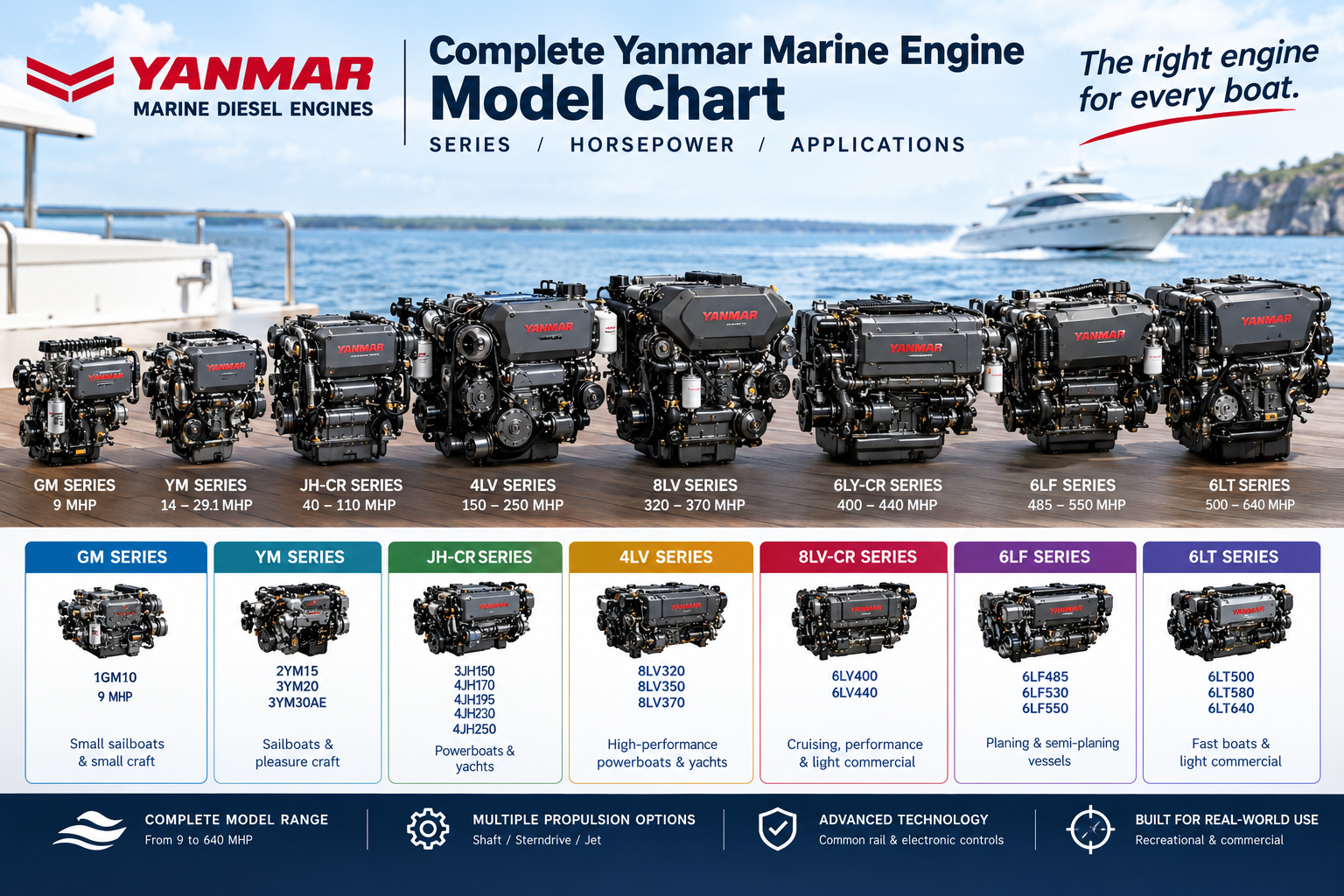
Yanmar’s marine range contains different engine families designed for different applications and power levels. Its official product information separates models into families such as GM, YM, JH-CR, 4LV, 6LY-CR and 8LV, among others.
Here is how to think about the major families relevant to this identification guide.
The older GM Series includes familiar engines such as:
These engines are especially common in older sailboats and cruising vessels.
When dealing with a legacy GM engine, resist the temptation to identify it by appearance alone. Marine installations often accumulate years of modifications, replacement components and repainting.
The original engine plate and documentation remain far more useful.
The YM Series includes:
Yanmar’s current documentation treats these as distinct models. The manufacturer’s product pages also provide separate specifications and technical drawings for the individual models.
That means an owner should not simply write:
“Yanmar YM 30.”
Write the complete model exactly as shown.
For example:
3YM30AE
is a much stronger identification than:
3YM30
or:
30 hp Yanmar
The extra characters may look insignificant, but exact model identification matters when you are matching documentation and parts.
The modern JH family includes the common-rail models:
Yanmar groups these engines under its JH-CR documentation and publishes the operation manual and technical information for the complete family.
There is an important lesson here.
If someone tells you they have a “4JH,” that narrows things down—but it is not necessarily the complete identification you need for a parts order.
4JH45 and 4JH110 are not the same engine merely because they share the 4JH designation.
The 4LV Series moves into a much larger and more modern class of Yanmar marine diesel.
Yanmar’s 4LV documentation covers individual models such as the 4LV150, 4LV170, 4LV195, 4LV230 and 4LV250.
The manufacturer also provides different technical drawings and compatible gear information for different configurations.
This reinforces a point that is easy to miss:
The engine model is only one part of the complete propulsion configuration.
The 6LY Series includes high-output marine diesel engines such as the 6LY400 and 6LY440.
Again, “6LY” is the family name—not necessarily the complete model identification you should use for a purchase enquiry.
This distinction becomes particularly important when working with older 6LY installations because the exact generation and configuration can affect documentation and component identification.
The 8LV Series is another good example.
Yanmar’s operation manual specifically tells the owner to check the engine’s model, output, RPM and serial number on the nameplate. The manual also shows that the nameplate contains fields including the gear model, engine number and manufacturing date.
So even on a large modern engine, the correct identification process is still remarkably simple:
Read the plate. Record the complete information. Verify it.
This sounds obvious, but it causes a lot of incorrect parts orders.
Your boat has a model.
Your engine has a model.
They are not the same thing.
You might own a sailboat built by Beneteau, Jeanneau, Bavaria or another manufacturer.
That information helps describe the vessel.
It does not, by itself, prove which Yanmar engine is currently installed.
The same is true for a fishing boat or commercial vessel.
A particular boat model might have been offered with different engine options depending on:
So “What boat do you have?” and “What engine do you have?” are two different questions.
A previous owner might remember:
“It is the original Yanmar.”
But memory is not technical documentation.
Another owner may remember:
“It is a 30-horsepower engine.”
Again, useful—but incomplete.
And sometimes a boat’s engine has already been replaced.
This is why your Yanmar engine model number and Yanmar engine serial number should come from the engine itself whenever possible.
Suppose someone says:
“I need a Yanmar part for my 30-horsepower engine.”
That sounds helpful.
It isn’t enough.
Horsepower does not uniquely identify a Yanmar marine diesel.
Even within one model family, different engines can have different specifications, and Yanmar’s official product information distinguishes individual models rather than treating horsepower as the sole identifier.
So the better question is:
What is the exact model and serial number on the engine plate?
That question immediately moves the parts search in the right direction.
Now we get to another mistake that can create serious confusion.
Your engine and your gearbox may have separate identification information.
Yanmar’s 4LV documentation explicitly notes that nameplates are provided on both the engine and marine gear and contain the respective model, serial number and other data.
That means an engine identification number should not be confused with a gearbox identification number.
The engine plate is used to identify the engine itself.
Depending on the model, that may include:
The marine gear has its own identity.
That can include:
This becomes especially important when ordering Yanmar gearbox parts.
A supplier who needs to identify a gearbox bearing, seal, clutch component or another internal transmission part may need the gear model and serial information—not simply the engine model.
Imagine you have:
Yanmar 4JH57
and a marine gear attached to it.
The fact that the gearbox is physically connected to a 4JH57 does not mean every 4JH57 uses the same gearbox.
Yanmar’s own 4JH57 product information shows multiple compatible gear options, reinforcing the point that the propulsion configuration needs to be identified rather than assumed.
So when the enquiry concerns the transmission, give the supplier the transmission information as well.
The same principle applies to a Yanmar saildrive.
Do not treat the saildrive as though it were simply another part number on the engine.
The saildrive has its own model and identification information, and Yanmar publishes compatibility information showing specific engine/saildrive combinations. For example, Yanmar lists the SD25 saildrive as compatible with engines including the 1GM10, 2YM15, 3YM20 and 3YM30AE.
That is useful because it demonstrates the correct relationship:
Engine identification + drive identification = complete propulsion picture
A good photograph can make a technical enquiry much easier.
A bad photograph can make it worse.
Start with a wider image showing the engine and the location of the plate.
This gives context.
It also helps when the plate is difficult to locate or several labels are visible on the engine.
Next, move close enough that every character is readable.
Try to keep the camera square to the plate.
Avoid taking the photograph at a sharp angle because reflections can distort or hide characters.
If one section of the plate is faded, damaged or corroded, take another close-up.
A second image from a slightly different angle can sometimes make a difficult character easier to distinguish.
This is a small rule with a big payoff.
If the plate appears to read:
3YM3?AE
do not automatically turn the unknown character into an “0.”
Write it down as uncertain.
The same applies when a character could be:
0 or O
1 or I
or another visually similar character.
One wrong character can point the entire parts search toward a different engine.
Now we get into the situations that require a little more detective work.
A missing plate does not necessarily mean the engine cannot be identified.
But it does mean you should be much more careful about making assumptions.
Search for:
Service records can be particularly valuable because a technician may have recorded the complete engine model and serial number during previous work.
Inspect the engine carefully for other factory identification markings, labels or documentation.
But remember that not every number found on an engine is the engine serial number.
A casting number, component number, part number, emissions label or gearbox number is not automatically the same thing as the engine number.
If the primary identification plate has disappeared, gather as much supporting information as possible.
Useful information includes:
Yanmar directs owners to its authorized support network for technical and spare-parts questions, and its official support material emphasizes using complete identification information.
The important thing is to distinguish identification assistance from proof of exact compatibility.
A photograph may strongly suggest which engine you have.
It does not necessarily prove that a particular replacement component is correct.
This is one of the most important E-E-A-T points in the article.
Online parts marketplaces make identification look deceptively easy.
You upload a photograph.
Someone says, “Yes, that’s the right part.”
You place the order.
Then the part arrives—and it does not fit.
The problem is that visual similarity is not the same as verified compatibility.
A component can look almost identical while having:
That is why a responsible Yanmar parts supplier should work from the engine’s identification information first and use photographs as supporting evidence.
Yanmar itself maintains a large authorized distributor and dealer network and directs customers toward that network for parts information and support. (Yanmar Marine Service & Parts)
The goal is not to make parts ordering complicated.
The goal is to make the identification accurate.
Imagine you have an older sailing yacht with a Yanmar engine and need a replacement fuel filter assembly.
You could start by searching:
“Yanmar fuel filter assembly.”
That produces a huge range of results.
Or you could record:
Engine model: 3YM30AE
Engine number: [complete number from plate]
Marine gear: [complete model]
Part required: fuel filter assembly
Quantity: 1
Photograph: attached
Now the search is tied to a known engine.
That difference is enormous.
You have gone from asking:
“Which Yanmar part looks right?”
to asking:
“Which part is specified for this exact engine and configuration?”
That is the mindset that prevents expensive mistakes.
By now, the identification process should be becoming much clearer.
The Yanmar engine serial number is important, but it should not be treated as a standalone decoder ring.
The complete model matters.
The engine number matters.
The manufacturing information can matter.
The marine gear or saildrive information can matter.
And the documentation used to verify the information matters just as much.
The simplest rule is:
Do not decode what you can verify.
Use the model and serial number to establish the engine’s identity, then use the correct Yanmar documentation or qualified support channel to confirm the details.
That approach is far more dependable than guessing from horsepower, boat model, photographs, or a marketplace listing.
Once you have the complete Yanmar engine model, engine serial number, manufacturing information and, where relevant, the marine gear or saildrive identification, the next step is not immediately placing an order.
It is verification.
This is where many otherwise careful boat owners make an expensive mistake.
They find the model, locate a part that appears to match, see a similar photograph online, and assume the job is finished.
It isn’t.
Engine identification tells you what engine you have.
Parts verification tells you what component belongs on that engine.
Those are two different steps.
A safer workflow is:
Identify → Verify → Match → Confirm → Order
That extra verification step can save you from ordering the wrong component, paying return freight, waiting for another shipment, or losing valuable boating time.
When contacting a Yanmar dealer, distributor, marine engineer or specialist supplier, don’t simply write:
“I need a water pump for my Yanmar.”
Give them the information needed to identify the application properly.
For example:
Engine: Yanmar 4JH57
Then attach a clear photograph of the engine identification plate.
That gives the person handling your enquiry something concrete to verify.
Some owners think that providing more technical information will make an enquiry complicated.
Usually, it does the opposite.
If you write:
“Yanmar 4JH57 water pump”
the supplier may need to ask:
Now a simple enquiry has turned into several rounds of messages.
Providing the identification information from the beginning gives the supplier a much better starting point.
It also makes it easier to discuss Yanmar parts price, availability and lead time after compatibility has been established.
For a straightforward parts enquiry, prepare a small identification package.
Copy the model exactly as shown on the identification plate.
For example:
3YM30AE
is better than:
YM30
or:
30 HP Yanmar
Record the entire number shown on the plate.
Don’t shorten it.
Don’t remove leading zeros.
Don’t replace an unclear character with one that simply looks more likely.
If the plate provides a manufacturing date, include it.
This can be useful when dealing with older engines or production changes.
If the requested component relates to the transmission or propulsion system, include the marine gear model.
For gearbox-specific components, this may also be necessary for proper identification.
If the engine is coupled to a saildrive, provide its identification information as well.
Attach a clear image of the engine plate.
For more complicated enquiries, also photograph:
Be specific.
Instead of:
“I need engine parts.”
say:
“I need one replacement raw-water pump.”
Or:
“I need the complete exhaust elbow.”
Or:
“I need a replacement starter motor.”
The clearer the request, the easier it is to determine what needs to be matched.
If you have a readable Yanmar engine serial number but cannot find the model, don’t immediately try to decode the number from a random online chart.
Start by gathering additional evidence.
Check for:
You can then provide this information to Yanmar or a qualified Yanmar specialist.
The objective is to establish the engine identity from reliable information rather than guessing from a number whose meaning you cannot independently verify.
If part of the plate is faded, scratched or corroded, photograph it from several angles.
Preserve whatever information remains.
For example, if you can confidently read:
4JH5?
don’t automatically turn the unknown character into 7 simply because you suspect the engine is a 4JH57.
An uncertain character is better than an incorrect character.
Additional photographs, service records and component information may allow the engine to be identified without guessing.
Once the engine has been properly identified, you can move to the next stage: part verification.
This is where Yanmar part numbers become important.
Finding a part number on a website does not automatically prove that the component is correct for your engine.
Ideally, the part number should be checked against appropriate Yanmar technical or parts documentation, or verified by a knowledgeable supplier.
One reason online parts searches can become confusing is that manufacturers may replace older part numbers with newer numbers.
You may therefore encounter a sequence such as:
Original part number → Superseded number → Current replacement
That does not automatically mean something is wrong.
A manufacturer can designate a newer component as the official replacement for an older one.
The important question is whether the replacement relationship has actually been verified.
Don’t assume that two numbers are interchangeable simply because an online seller says they are.
Online marketplaces may contain statements such as:
“Replaces Yanmar XXXXX.”
Before relying on that claim, determine where the cross-reference comes from.
It could be:
These are not necessarily equivalent.
For important engine components, documented compatibility is much more valuable than a similar-looking photograph.
Another common question is whether you should purchase genuine Yanmar parts or an aftermarket alternative.
The answer depends on the component, application, specification and supplier.
The important thing is to understand exactly what is being offered.
Genuine Yanmar parts are supplied through Yanmar’s parts ecosystem and are intended for specified Yanmar applications.
For components where exact specification is particularly important, verified genuine parts can simplify the compatibility question.
This can be especially relevant for components associated with:
Aftermarket parts can also be available for many marine engines.
But the word aftermarket does not automatically tell you whether a component is suitable or unsuitable.
The better questions are:
A reputable aftermarket component from an established manufacturer is a very different proposition from an unidentified component copied from an online photograph.
Imagine you find two replacement water pumps.
One costs substantially less.
The initial decision seems obvious.
But suppose the cheaper pump fails shortly after installation.
You may now have to pay for:
The original price difference can quickly become insignificant compared with the total cost of the problem.
This is why it is better to consider total replacement cost, not simply the lowest advertised price.
A good supplier should help you understand what you are actually buying, including specification, availability, warranty and compatibility.
Sometimes an owner needs a complete component.
Sometimes a repair kit is appropriate.
Those are not the same thing.
For example, depending on the component and its condition, a serviceable water pump may be repairable with the appropriate components.
In another situation, replacing the complete pump may be the more practical solution.
Before ordering, establish whether you need:
Repair kit
or
Complete assembly
Don’t assume that asking for a component automatically means the supplier will understand which version you want.
The same identification principles apply when buying or replacing Yanmar gearboxes.
If your enquiry concerns a marine transmission, don’t provide only the engine model.
Provide the gearbox information as well.
For example:
Engine: Yanmar 4JH57
A marine gearbox is part of a complete propulsion system.
Its suitability depends on more than whether the housing physically attaches to the engine.
You may need to consider:
This is particularly important when someone is searching for a Yanmar gearbox for sale.
A gearbox should not be selected simply because it appears compatible in a photograph or because it was installed behind a similar-looking engine.
The complete propulsion configuration needs to be checked.
The same principle applies to a Yanmar saildrive.
The saildrive has its own identification information and should be treated as a separate propulsion component.
When ordering saildrive parts, provide:
This gives the supplier a much better basis for checking compatibility.
Identification becomes even more important when you are planning an engine replacement.
A repower isn’t simply a horsepower-for-horsepower exchange.
For example, if your existing engine produces approximately 30 horsepower, that doesn’t mean every modern 30-horsepower engine is a direct replacement.
You need to consider the complete installation.
Before requesting a replacement-engine quotation, gather:
Existing engine
Marine gear
Engine installation
Vessel
Propulsion
Photographs
This information allows a supplier or marine engineer to assess the installation rather than simply matching horsepower.
A newer engine may have different:
This is particularly important when replacing an older mechanical engine with a newer electronically controlled model.
The correct question isn’t:
“Which newer Yanmar has the same horsepower?”
A better question is:
“Which current Yanmar propulsion package is suitable for this vessel and installation?”
That change in approach can make a repower discussion much more productive.
Once you have identified your engine, don’t make yourself repeat the process five years from now.
Create a simple engine record containing:
Yanmar model:
Engine number:
Manufacturing date:
Marine gear:
Gear serial:
Saildrive:
Installation date:
Major service history:
Take clear photographs of the identification plates and save them somewhere secure.
Keep digital copies of:
This becomes particularly valuable if the vessel changes ownership.
For boats that travel extensively or depend heavily on their propulsion system, take the record one step further.
Create a folder called:
Yanmar Engine Records
Keep the following inside:
You have effectively created a technical history for the engine.
When something goes wrong, you aren’t starting from zero.
Let’s bring everything together.
“I have a 30 HP Yanmar.”
Useful information, but not enough for precise parts identification.
“I have a 4JH.”
Again, useful, but provide the complete model whenever possible.
The boat model does not necessarily identify the engine installed today.
The marine gear can have its own model and serial number.
If the identification plate is difficult to read, don’t invent the missing character.
A component can look identical and still have different specifications.
A Yanmar engine family can contain multiple models and configurations.
The engine number can become particularly useful when dealing with older engines or production changes.
A boat may have been repowered before you purchased it.
Always verify the engine physically installed in the vessel.
Before submitting your next Yanmar parts enquiry, run through this list:
Engine
☐ Complete model recorded
☐ Complete engine/serial number recorded
☐ Manufacturing date recorded where available
☐ Engine plate photographed
Propulsion
☐ Marine gear model recorded
☐ Gear serial recorded
☐ Gear ratio confirmed where relevant
☐ Saildrive information recorded where applicable
Part
☐ Exact component identified
☐ Existing part number photographed if available
☐ Quantity specified
☐ Clear photographs attached
Verification
☐ Engine identification confirmed
☐ Part compatibility verified
☐ Superseded part number checked where applicable
☐ OEM or aftermarket status understood
☐ Price confirmed
☐ Availability confirmed
☐ Warranty and return conditions understood
This takes only a few minutes.
It can prevent a much longer and more expensive problem later.
There is no benefit in guessing when the component is important or the identification is uncertain.
Consider getting specialist assistance when dealing with:
A qualified specialist can determine what information is still missing and what needs to be verified before you purchase.
At Yanmar Marine Experts, the sales process should begin there.
The objective should not be to sell the first component that appears in a search result.
The objective is to understand the engine, establish the required component, verify compatibility and then provide accurate purchasing information.
Start with the engine identification or nameplate. The exact location varies by engine family, so use the documentation for your specific model when necessary.
No.
The model number identifies the engine model, while the engine number or serial number identifies the individual engine.
It is better to provide the complete model and serial number together.
This gives the supplier a much stronger basis for identifying the correct application.
Horsepower alone is not enough for precise parts identification.
Find the engine identification plate and record the complete model and engine number.
Not necessarily.
The vessel may have been offered with different engines, or the original engine may have been replaced.
Yes. The marine gear has its own identification information, which should be supplied separately when ordering gearbox components.
Gather photographs, service records, invoices, manuals and any visible model or component markings. Then seek assistance from Yanmar or a qualified Yanmar specialist rather than guessing.
A photograph can be very useful, particularly when the identification plate or model markings are visible.
However, a photograph alone should not automatically be treated as proof that a specific replacement component is compatible.
The manufacturing date can provide useful context when identifying production versions, documentation and possible component changes.
At minimum, provide the complete engine model, complete engine number or serial number and a clear photograph of the identification plate. For gearbox-related enquiries, include the gear model and serial number as well.
The longer you own a marine diesel, the more you realize that accurate identification is one of the simplest forms of preventative maintenance.
Engines change hands.
Boats get repowered.
Gearboxes are replaced.
Components are upgraded.
Labels become difficult to read.
And memories fade.
Your engine identification information gives you something much more reliable.
It provides a technical starting point.
So when you need Yanmar engine parts, a Yanmar gearbox, a replacement engine, technical documentation or a complete repower, resist the temptation to start with a marketplace search.
Start with the engine.
Find the complete model.
Record the complete Yanmar engine serial number.
Record the gear or saildrive information where applicable.
Take clear photographs.
Then verify the component before ordering.
The process can be reduced to five words:
Identify. Verify. Match. Confirm. Order.
That approach may take a few extra minutes at the beginning.
But those minutes can prevent days of unnecessary delays, incorrect parts, return shipping and installation problems.
And when you’re dealing with a marine engine that your boat depends on, getting the identification right isn’t a small detail.
It’s the first step toward getting everything else right.
