
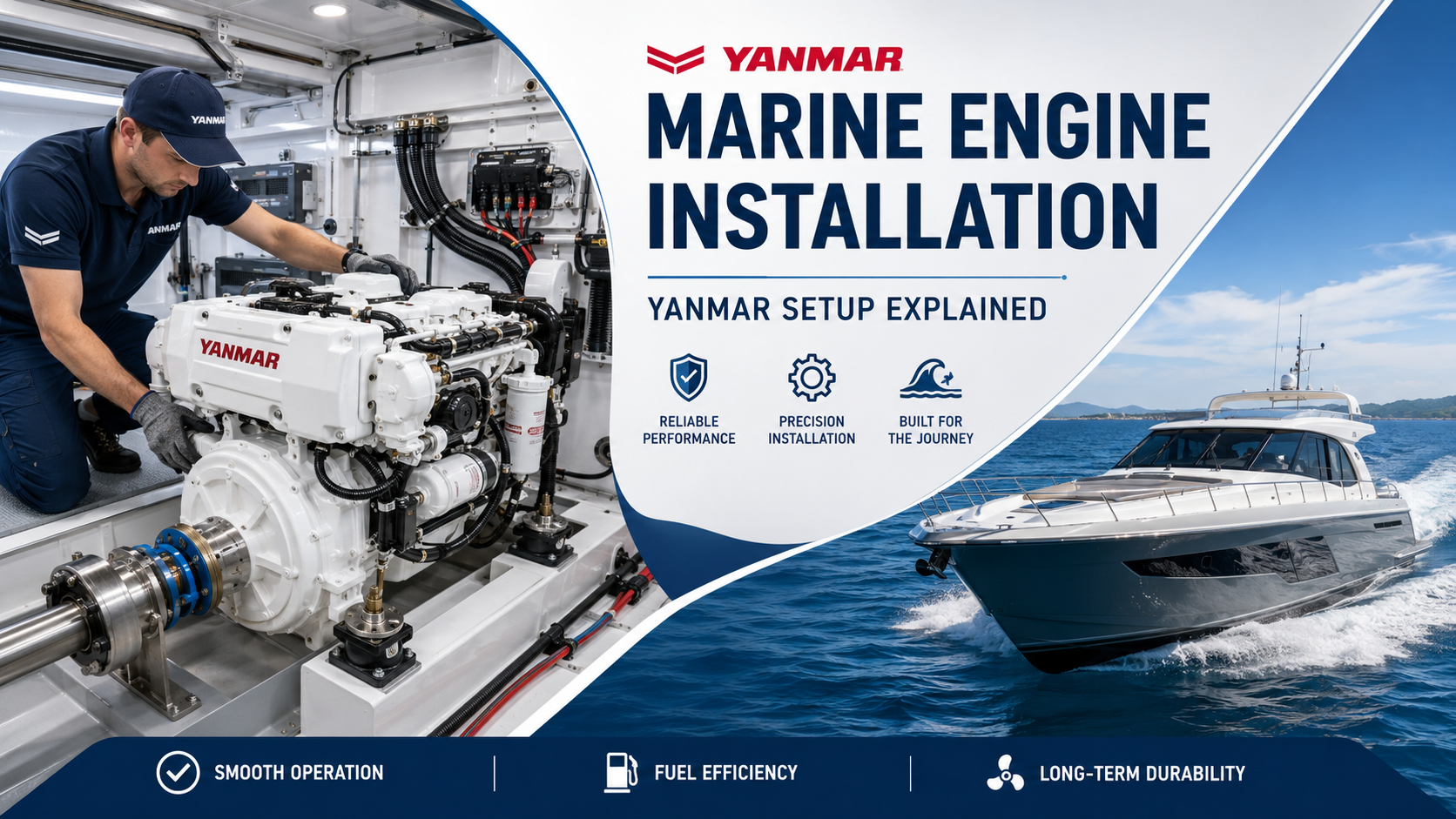
Installing a new Yanmar marine diesel engine is not simply a matter of removing the old engine, lowering the replacement into the engine room, and reconnecting the hoses.
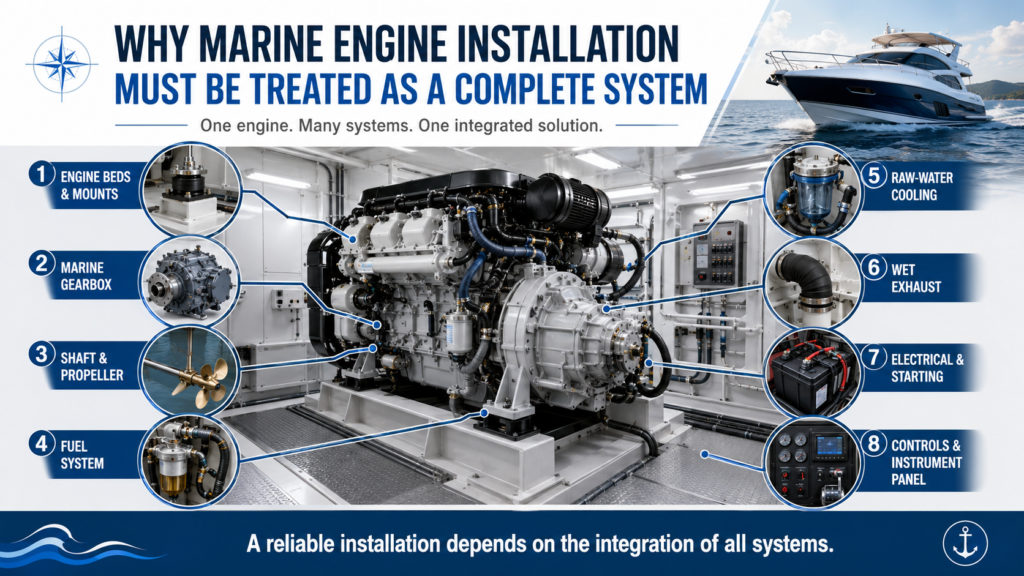
A reliable marine engine installation is a complete propulsion-system project. The engine must work correctly with the marine gearbox, flexible mounts, engine beds, propeller shaft, propeller, fuel system, cooling circuit, exhaust system, electrical wiring, instruments, and controls.
This is where many otherwise promising repower projects go wrong.
The engine may be brand new, but worn mounts, an unsuitable reduction ratio, poor shaft alignment, restricted cooling-water flow, or excessive exhaust backpressure can prevent it from performing as designed. In severe cases, an installation fault can contribute to vibration, overheating, black smoke, reduced engine life, or seawater entering the cylinders.
This guide explains the complete Yanmar marine engine installation process, from vessel assessment and engine mounting to dockside commissioning and the final sea trial.
It is intended to help boat owners understand what a professional installation should involve. Final dimensions, torque values, hose sizes, alignment tolerances, backpressure limits, and commissioning requirements must always come from the official documentation for the exact Yanmar engine, gearbox, and vessel configuration.
Before beginning a repower project, boat owners should review the available Yanmar marine diesel engines and confirm that the selected model is suitable for the vessel, operating conditions, and intended duty.
A marine diesel engine does not operate independently.
The engine produces power, but the gearbox, shaft, and propeller must convert that power into usable thrust. The fuel system must supply clean diesel without introducing air. The raw-water circuit must provide sufficient cooling. The exhaust must discharge gas and cooling water without restricting the engine or allowing seawater to return.
The electrical system must deliver enough current for starting and charging, while the control system must provide full throttle travel and positive engagement of forward, neutral, and reverse.
Experienced installers therefore assess the entire boat before recommending an engine.
A common mistake during a repower is to focus only on horsepower. Two engines with similar power ratings may have different operating speeds, torque characteristics, weights, mounting centers, exhaust requirements, gearbox options, and electronic systems.
That is why a successful boat engine repower guide begins with the vessel—not with the engine catalog.
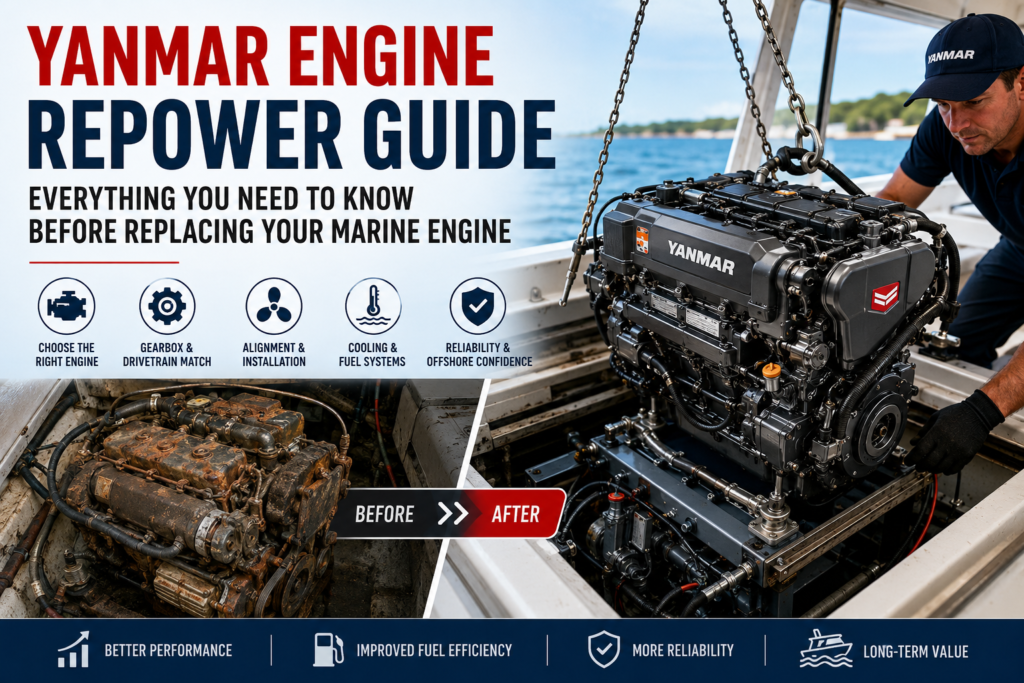
Owners planning to replace an older engine should also review a detailed Yanmar marine engine repower guide before selecting a replacement package.
Before choosing an engine, document how the boat is built and how it will be used.
Important considerations include:
A displacement vessel normally has very different power requirements from a planing boat. A commercial workboat operating for hundreds of hours every month also requires a different duty assessment from a privately operated leisure vessel.
The correct Yanmar model should be selected according to the hull, load, operating profile, and approved duty rating—not simply according to the highest horsepower that fits inside the engine compartment.
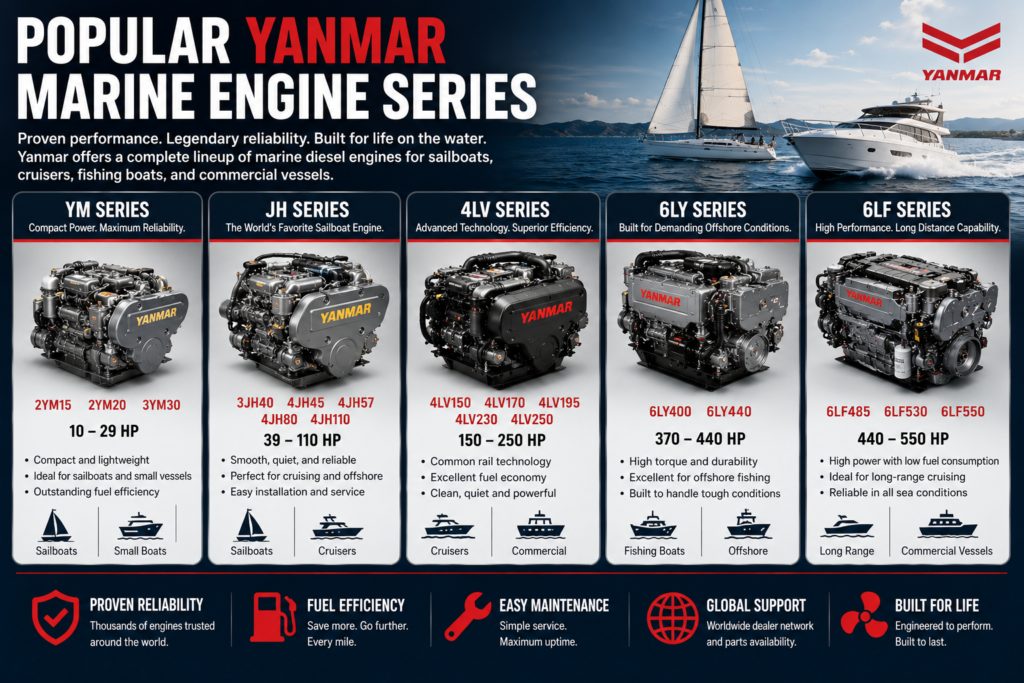
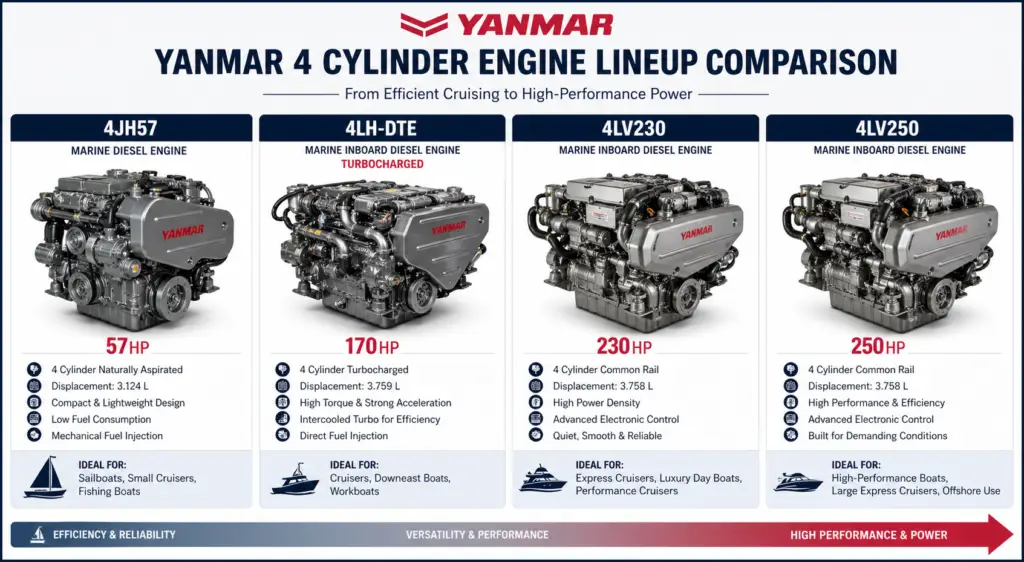
Smaller sailing vessels and displacement boats may be suitable for compact options such as the Yanmar 3JH40 marine diesel engine or models from the Yanmar 4JH marine engine range.
Higher-powered recreational vessels may require engines from the Yanmar 4LV marine engine range, while commercial applications may require options from the Yanmar 6LY, Yanmar 6LF, or Yanmar 6AYM marine engine range.
A proper marine engine selection guide can help owners compare horsepower, engine weight, duty rating, rated rpm, and installation dimensions before ordering.
The gearbox is not an accessory that should be selected after the engine has already been ordered.
The engine and transmission must be matched according to:
The reduction ratio directly affects propeller speed. Installing the wrong ratio can make it difficult or impossible to select a propeller that allows the engine to reach its specified loaded rpm range.
An over-propped installation may prevent the engine from reaching rated speed. This can place the engine under excessive load, increase exhaust temperature, produce black smoke, and reduce performance.
An under-propped vessel may reach maximum rpm too easily without transferring enough power into useful thrust.
Before ordering, confirm the complete Yanmar engine and marine gearbox package, including the transmission model, ratio, output-flange dimensions, control arrangement, and rotation.
Owners should review the available Yanmar marine gearboxes and, where necessary, consult a detailed guide explaining how to match a marine gearbox to an engine.
Measurements should be taken before the existing engine is removed and checked again after the engine room is empty.
Record:
Do not measure only whether the engine will physically fit.
You must also determine whether routine service can be completed after installation. A technically correct installation can still become an ownership nightmare when the oil filter, impeller, belts, coolant filler, or transmission dipstick cannot be reached.
A useful rule is to imagine replacing the raw-water impeller in rough weather. If the job would be nearly impossible with the engine installed, the layout needs further planning.
Before making a final selection, compare the Yanmar engine dimensions and specifications for the exact engine and transmission package.
Photograph every connection before disconnecting anything.
Capture clear images of:
Label each wire, hose, and cable. Record the existing shaft position, engine angle, mount height, and coupling dimensions.
This step appears simple, but it is one of the most valuable habits in professional marine diesel engine installation work. Once the old engine is removed, it can be surprisingly difficult to remember the original routing of a hose or control cable.
Before lifting the engine, disconnect the batteries, close the fuel shutoff valve, close the seacock, drain fluids responsibly, and protect the bilge and interior from contamination.
Only approved lifting points and properly rated lifting equipment should be used.
The engine beds support the weight, torque, vibration, and propeller thrust transmitted through the drivetrain.
Inspect them for:
Oil-soaked timber or damaged composite engine beds may not hold fasteners correctly. Corroded steel beds may appear solid on the surface while being weakened internally.
Where modifications are required, they should be designed to distribute loads into the vessel structure rather than concentrating them in a small repaired area.
The finished beds must place the engine at the correct height and angle while leaving enough adjustment range in the flexible mounts for alignment.
Owners planning a repower should also understand the process of Yanmar engine-bed preparation before modifying the existing structure.
Flexible mounts are selected according to engine weight, torque, gearbox arrangement, and the load carried at each mounting point.
Old mounts should not automatically be reused because they appear undamaged.
A mount may have softened, compressed, separated internally, or become contaminated by oil or fuel. It may also have been designed for a different engine weight and torque profile.
Use Yanmar flexible engine mounts specified for the exact engine and transmission package. Confirm their position, orientation, adjustment range, and fastening requirements using the relevant Yanmar installation documentation.
When the engine is initially placed on the beds, keep the mounts reasonably close to the center of their adjustment range. This leaves room for final height and alignment corrections.
Before lifting, confirm the combined weight of the engine and gearbox and verify that the lifting equipment is suitable.
Protect filters, sensors, wiring, and other exposed accessories while moving the engine through the vessel.
Lower the engine gradually and check:
Do not fully tighten the mounting system until the preliminary driveline alignment has been completed.
The engine position should not be forced to match badly positioned beds. Where the beds are incorrect, the structure should be corrected instead of using the flexible mounts to compensate for a major dimensional error.
A new engine should not be connected blindly to an old drivetrain.
Inspect:
Check the shaft for corrosion, wear, scoring, and runout. Inspect the coupling faces for damage or distortion.
A worn bearing or bent shaft can make proper marine engine alignment impossible. Adjusting the engine to compensate for a damaged shaft may produce an acceptable-looking coupling measurement at the dock while creating vibration under load.
Components should be measured and assessed before they are approved for reuse.
A dedicated marine propeller-shaft inspection guide can help owners understand when shafts, couplings, bearings, or seals should be replaced.
The shaft should first be positioned naturally in the center of its normal operating path. The engine is then aligned to the shaft—not the other way around.
Bring the coupling faces close together without using the bolts to pull them into position.
Adjust the flexible mounts gradually to correct vertical, horizontal, and angular misalignment. Recheck the coupling after every meaningful adjustment.
Never force the coupling together using bolts. This can place side loads on the shaft, gearbox bearings, seal, and flexible mounts.
The final alignment tolerance must follow the requirements of the gearbox, coupling, shafting system, and Yanmar installation documentation.
Alignment should also be checked again after the vessel has been launched and allowed to settle in the water. A hull supported ashore can flex differently from the same hull floating under normal loading.
For additional detail, owners and technicians should review a complete marine engine alignment guide before completing the final coupling adjustments.
The propeller must match the engine power, gearbox ratio, hull, displacement, shaft speed, and intended use.
Propeller selection involves:
The final test is not simply whether the boat moves.
The engine must reach its specified wide-open-throttle rpm range under normal loading. If it cannot, the propeller may be placing excessive load on the engine.
A qualified propeller specialist should calculate the initial specification, but the final selection should be verified during the sea trial.
Owners should consult a detailed guide on matching a propeller to a marine diesel engine before retaining an existing propeller after a repower.
Not every Yanmar installation uses a conventional propeller shaft.
Sailing vessels may use a Yanmar saildrive installation, while many powerboats and commercial vessels use a traditional Yanmar shaft-drive engine arrangement.
A shaft-drive system requires careful inspection of:
A saildrive installation requires attention to:
Depending on the engine and vessel, the installation may involve a Yanmar SD50 saildrive or Yanmar SD60 saildrive.
The correct engine and saildrive combination must be confirmed before ordering. Owners comparing the two systems should also review shaft drive versus saildrive before selecting a propulsion arrangement.
A new engine should not be supplied by contaminated fuel lines or a dirty tank.
Inspect the fuel tank for:
Replace old or unsuitable hoses. Confirm that the shutoff valve is accessible and that both the supply and return lines are correctly sized for the engine.
A dependable marine diesel fuel system installation normally includes a primary fuel-water separator before the engine-mounted final filter.
Filters should be positioned where they can be inspected, drained, and replaced without spilling fuel onto hot components or into the bilge.
Route hoses away from exhaust parts, sharp edges, and moving components. Support them properly and avoid unnecessary restrictions.
Prime and bleed the system according to the engine instructions, then inspect every fitting for leakage before and after the first start.
Clean fuel delivery also depends on correctly installed marine fuel filters and water separators. Replacement filters and compatible components can also be sourced through the Yanmar marine engine parts category.
Cooling problems are often caused by restrictions outside the engine.
Inspect:
The seacock must remain accessible. The strainer should be easy to inspect and clean.
Do not assume the existing seacock, strainer, or hose is large enough for the new engine. Cooling-water requirements can change significantly between models.
Use properly rated marine hose and suitable clamps. Avoid hose runs that collapse, trap air, or create unnecessary resistance.
Fill the closed-circuit cooling system with the coolant specified for the engine. Bleed trapped air from the engine and any connected water-heating circuit.
After the first start, check the raw-water discharge and inspect the entire cooling system for leakage.
Worn impellers, damaged pumps, restricted strainers, and deteriorated hoses should be replaced using compatible Yanmar cooling-system parts.
Owners experiencing temperature problems should also review the common causes of marine diesel engine overheating.
A wet exhaust system must perform two critical jobs:
The installation may include:
The exhaust-hose diameter and routing must satisfy the engine’s maximum backpressure requirements.
A hose that appears large enough may still create excessive restriction if it has long runs, sharp bends, internal damage, or poor routing.
The waterlock must be sized and positioned to contain water remaining in the exhaust after shutdown. The gooseneck and siphon protection must be designed according to the vessel’s waterline and installation geometry.
No universal exhaust layout is suitable for every boat. The final arrangement should be reviewed against the Yanmar installation manual and the requirements of the exhaust-component manufacturer.
Water ingestion is one of the most serious installation risks. Excessive cranking, incorrect hose routing, a poorly positioned waterlock, or siphoning can allow cooling water to reach the cylinders.
Owners can review compatible marine wet-exhaust system components, including the correct Yanmar mixing elbow, waterlock, gooseneck, and exhaust hose.
A related article explaining how to prevent water from entering a marine diesel engine can provide additional guidance on siphoning, exhaust routing, and excessive cranking.
A diesel engine requires a large volume of clean air.
The engine room must also release the heat produced by the engine, gearbox, exhaust, and alternator.
Check:
Insufficient airflow may reduce engine performance and increase engine-room temperature. High temperatures can also affect alternators, wiring, batteries, hoses, and electronic components.
Ventilation should be assessed under full operating load, not only while the engine is idling at the dock.
Inspect the starting battery, battery cables, isolator switch, circuit protection, engine ground, wiring harness, and instrument panel.
Confirm that:
Electronic Yanmar installations may also include digital displays, diagnostic functions, network connections, and electronic throttle and shift controls.
These systems must be configured according to the documentation for the specific engine and control package.
Additional alternators or heavy accessory loads should not be installed without confirming the approved mounting system, belt arrangement, pulley alignment, and load limits.
Owners replacing or upgrading instruments should review the available Yanmar engine control panels and compatible electronic-control systems.
Before the first start, verify:
A written checklist creates accountability and provides a permanent commissioning record.
A downloadable marine engine installation checklist can help installers document every mechanical, electrical, fuel, cooling, and exhaust inspection.
Start the engine and immediately confirm oil-pressure indication and cooling-water discharge.
At idle, inspect for:
Test forward and reverse at low speed. Confirm that the control lever moves the gearbox in the correct direction and returns fully to neutral.
Increase engine speed gradually while monitoring the instruments. Avoid immediate high-load operation before the engine has warmed properly.
A Yanmar engine sea trial is not an optional demonstration. It is the final technical verification of the installation.
The vessel should be tested under realistic loading conditions.
The sea trial should include:
The engine should reach the specified loaded rpm range. Failure to do so may indicate an unsuitable propeller, restricted fuel or air supply, excessive exhaust backpressure, or another installation issue.
After returning to the dock, perform a hot inspection. Recheck fluid levels, hose clamps, mounts, fuel fittings, shaft seal, exhaust system, and stored fault codes.
Record the results instead of relying on memory.
A structured marine engine sea-trial checklist can help document rpm, temperature, oil pressure, charging voltage, vibration, backpressure, and engine-room conditions.
The owner should receive:
The engine should be registered according to the applicable Yanmar engine warranty process.
Owners should also be shown how to inspect oil, coolant, belts, filters, the raw-water strainer, and the engine compartment before operation.
A complete marine diesel engine maintenance checklist can help owners establish a dependable inspection and service routine after installation.
A newly installed engine should be operated according to the guidance provided for the exact model.
The owner should understand:
The applicable Yanmar engine break-in and first-service guide should be reviewed before the vessel begins normal operation.
The most common mistakes include:
Most installation failures are not caused by one dramatic error. They result from several small compromises that were never properly inspected or documented.
A high-quality marine engine installation is built on measurement, compatibility, careful workmanship, and documented testing.
The engine must be matched to the vessel. The gearbox must suit the propeller and operating profile. The mounts and beds must support the engine correctly. The shaft must be aligned naturally. The fuel, cooling, exhaust, ventilation, electrical, and control systems must meet the requirements of the exact Yanmar model.
Most importantly, the installation must be verified under load during a proper sea trial.
This guide provides a professional overview, but it does not replace the official Yanmar installation manual, applicable marine standards, or the judgment of a qualified installer who has inspected the vessel.
Explore our complete selection of Yanmar marine diesel engines, Yanmar marine gearboxes, Yanmar saildrives, and Yanmar marine engine parts.
For help selecting an engine, gearbox, repower package, or compatible installation components, contact Yanmar Marine Experts or request a Yanmar engine quotation.
Customers requiring international delivery can also review our worldwide marine engine shipping options before placing an order.
