
If your Yanmar engine won’t start, first establish whether it does nothing, clicks, cranks slowly, or cranks without firing. Each symptom points toward a different diagnostic path. Replacing a battery, starter, or fuel pump before making that distinction can leave the original problem unresolved.
While preparing this guide, I paused over a warning in Yanmar’s YM operation manual: repeated starting attempts can allow seawater into the cylinders on a boat with a waterlift muffler. It is an easy detail to overlook when you are focused on getting the engine running. That warning shaped the approach here: make each check useful, and know when another starting attempt could make matters worse.
This guide for Yanmar Marine Experts explains twelve possible cause groups, the observations that help distinguish them, and when professional testing becomes necessary. Keep the manual for your exact Yanmar engine available; equipment and procedures vary between models and installations.
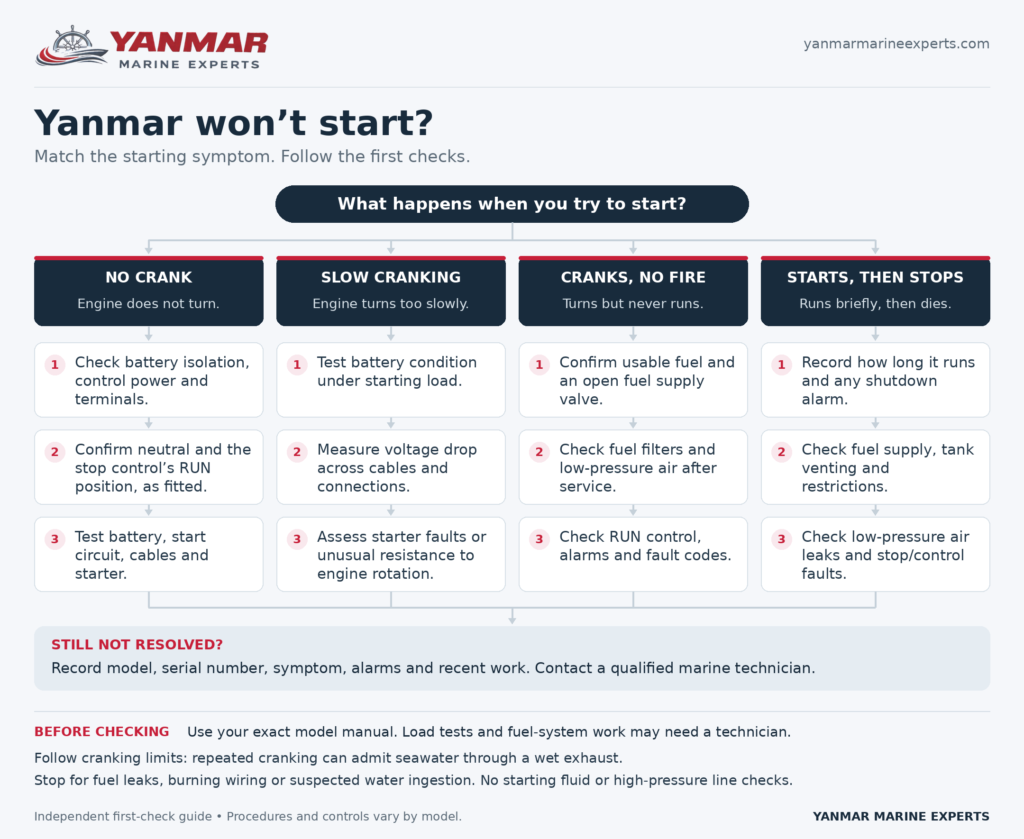
“It won’t start” describes the outcome. The next useful question is what happens when you operate the starting control.
When the engine does not rotate, you have a no-crank condition. Note whether the panel powers up and whether any click comes from the engine compartment.
If your Yanmar engine won’t turn over, begin with the starting battery, electrical supply, controls, and installed interlocks. A mechanical restriction is another possibility, particularly if the engine stopped abruptly beforehand.
These are different observations. A click suggests some part of the starting circuit has responded. Slow cranking means the engine rotates sluggishly. A fast whirring sound without engine rotation can indicate that the starter is not engaging correctly.
A Yanmar starter clicking does not establish which component has failed. Battery condition, cable losses, control-circuit faults, and starter problems require different checks.
Cranking means the starter is rotating the engine. Firing means combustion has begun.
When a Yanmar engine cranks but won’t start, fuel supply, stop controls, injection, and compression become relevant. On electronically controlled models, electrical supply and engine-management information also matter. Apparently normal rotation does not prove that every requirement for starting has been met.
Record how long it runs and whether an alarm appears. A Yanmar engine that starts then stops may need investigation of fuel delivery, air ingress, or shutdown controls. The timing helps guide the investigation; it does not confirm a cause by itself.
| What you observe | Initial direction | Useful first observation | Relevant causes |
|---|---|---|---|
| Silence; no engine rotation | Electrical supply and starting controls | Panel response and battery-switch position | 1–4 |
| Clicking or slow rotation | Battery, cables, controls, starter; possible mechanical resistance | Exact sound and change in panel brightness | 1–4, 12 |
| Starter whirs without turning the engine | Starter engagement | Whether the engine actually rotates | 4 |
| Engine rotates but does not fire | Fuel, stop controls, combustion, electronic control where fitted | Recent maintenance and displayed warnings | 5–12 |
| Engine fires, then stops | Supply interruption or shutdown control | Time before stopping and accompanying warnings | 5–9, 11 |
These are investigation routes. Several faults can produce the same symptom.
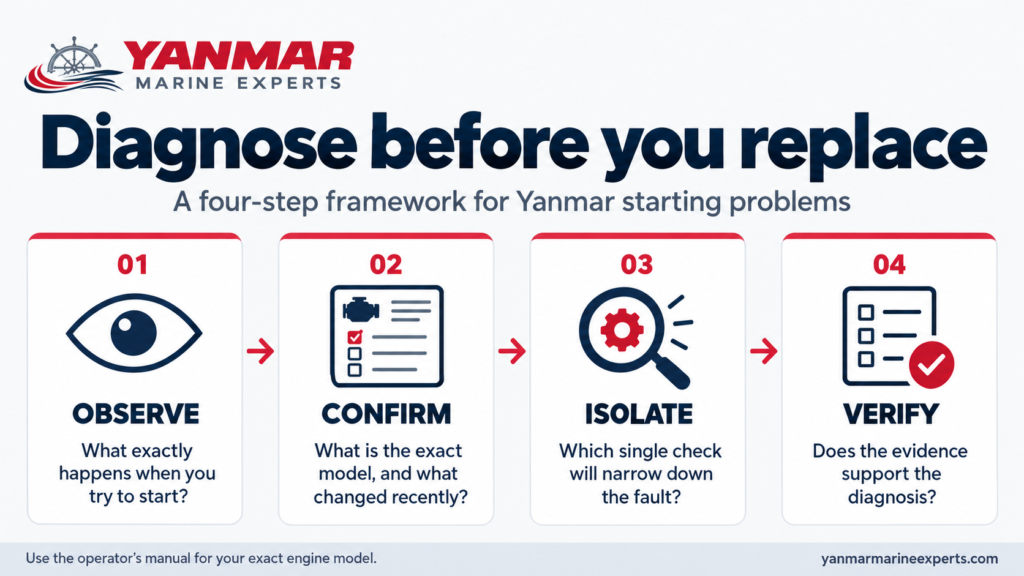
The following framework organizes Yanmar marine engine starting problems into useful observations and decisions. Use it alongside the manufacturer’s procedures.
Describe the symptom precisely: “one click with no rotation” is more useful than “the starter is bad.” Note whether the engine was cold, recently running, or unused for several months.
Use observations already available. Do not keep cranking simply to collect more information.
Record the complete model and serial number. Then ask what happened since the last successful start: a filter change, battery work, refueling, storage, or an unexpected shutdown?
Recent work is a clue. For example, a no-start after filter replacement justifies checking the serviced area and prescribed priming procedure. It does not prove that the new filter is defective.
Follow the symptom. A silent starter needs a different investigation from an engine rotating normally without firing.
Keep simple observations separate from measurements requiring equipment and experience. Change one thing at a time so the result remains interpretable.
Write down what was checked, what was found, and what changed afterward. Follow the exact manual for any controlled restart.
An intermittent engine that starts once has demonstrated a successful start. Further investigation may still be needed to establish why earlier attempts failed.
Repeated cranking can overheat a starter. On waterlift-equipped installations, it can also introduce cooling water into an exhaust system that is not clearing normally, creating a water-ingestion risk.
The YM manual gives specific failed-start instructions. Read the complete procedure for your model before retrying; do not improvise an intake-valve sequence from a general internet tip. Any required cooling-water isolation must be reversed according to that procedure before normal operation.
Stop if the engine locks abruptly, water ingestion is suspected, fuel is leaking, or electrical components smell burned or show damage. Arrange professional assessment rather than trying to force another start.
Do not bridge starter terminals, bypass safety interlocks, or loosen common-rail high-pressure fuel connections. Yanmar’s YM guidance also prohibits ether-type starting aids.
Before touching electrical connections, isolate the relevant supplies using the vessel’s documented procedure. If you cannot identify them confidently, leave the work to a marine electrician.
The following cause groups provide a practical investigation sequence. They are not a statistical ranking, and some equipment is model-dependent. Part 1 covers the first four, which concern electrical supply and starting operation.
Slow cranking, clicking, or no rotation can accompany inadequate battery performance. Panel lights may still illuminate; their operation does not establish the battery’s ability to supply starting current.
Identify the actual starting battery and its type. Review its charging history and look for visible damage before charging or testing it.
A resting-voltage reading alone is insufficient to establish starting performance. Delco Remy’s starter-diagnostic guidance includes charging and battery load testing before moving deeper into the circuit. Apply a test appropriate to the installed battery and its manufacturer’s instructions.
A failed battery test identifies a problem requiring attention. A discharged battery also raises a second question: why was it discharged? Restoring charge without investigating a recurring charging or drain problem may leave you facing another no-start later.
Your Yanmar diesel engine may be hard to start electrically even with a serviceable battery. Clicking, slow rotation, or inconsistent starting can justify checking the current path.
With supplies safely isolated, inspect accessible terminals, cables, and the engine’s negative return connection for corrosion, looseness, damaged insulation, or overheating.
A connection can appear acceptable yet perform poorly under load. A qualified technician can measure voltage loss along the positive and negative paths and compare it with the applicable specifications. Delco Remy’s diagnostic manual treats these paths separately when assessing cable losses.
Excessive loss identifies a supply-path problem that needs correction and retesting. Replacing the starter will not repair a defective cable or connection feeding it.
The panel may power up while the starter remains silent, or pressing start may produce an intermittent response. Those observations justify investigating how the start command reaches the starter.
Confirm the prescribed starting-control position. Check whether your installation actually has a neutral-start interlock; do not assume every Yanmar system uses the same arrangement.
Use the correct wiring diagram to identify switches, fuses, relays, and harness connections. A technician can then test the command circuit without guessing at connector functions. Starter-control voltage losses can prevent proper solenoid engagement.
An interrupted or inadequate start command directs attention upstream of the starter. Repeatedly pressing the button until the engine happens to crank leaves the intermittent fault unexplained. Bypassing an interlock is not a repair.
A starter fault becomes more plausible when appropriate battery, cable, and control checks pass but cranking remains abnormal. Free spinning without engine rotation also calls for examination of the engagement mechanism.
A technician may need to assess starter operation, current draw, pinion engagement, and flywheel ring-gear condition. Mechanical resistance must also be considered before assuming a slow or stationary engine proves starter failure.
Yanmar’s JH troubleshooting information distinguishes starter-system faults from excessive resistance in engine rotation, supporting a measured diagnosis rather than replacement based on sound alone.
If testing confirms a starter defect, identify the correct replacement using the full engine details and starter identification. Similar appearance is insufficient evidence of compatibility. Correct engagement and any associated damage also need attention before the repair is considered complete.
Part 2 of 3 — Fuel delivery, engine controls, mechanical causes, and model differences
Once you have described the cranking behavior and completed the appropriate starting-system checks, the next step is to investigate fuel delivery, controls, and combustion. Keep the observations from Part 1 beside you: they help determine which of the following checks is relevant.
The engine turns over without firing, or it stopped after operating with a low fuel level. The problem may also follow work that required the fuel supply to be isolated.
Confirm that usable fuel is available using the vessel’s approved checking method. A gauge reading alone does not establish that fuel is reaching the engine. Check the correct tank selection and fuel-supply valve position, where applicable.
If the engine ran out of fuel, follow its prescribed priming procedure after refilling. Adding diesel does not necessarily remove air introduced into the supply system.
An empty tank or closed supply explains a delivery interruption. If the engine still will not start after supply and priming are correctly restored, continue through the fuel-system checks.
Hard starting may follow power loss, irregular running, or a recent refueling. Water or debris in the separator is another reason to investigate fuel quality and filtration.
Identify the primary filter/water separator and the engine-mounted filter where fitted. Review their service history and verify replacement part numbers against the correct documentation.
Inspect or drain the separator only as its instructions permit, with the engine stopped and appropriate fuel isolation. Collect drained fuel in a suitable container and dispose of it properly. Persistent restriction may require inspection of the tank pickup, vent, or supply hose.
A new filter does not rule out a restriction elsewhere. Parker Racor’s troubleshooting guidance specifically directs attention to the tank pickup when problems persist with a new element. Investigate repeated contamination at its source; another filter or an additive chosen without identifying the problem may not resolve it.
If your Yanmar engine won’t start after a fuel filter change, investigate the serviced area and the specified priming process. Similar symptoms can follow running out of fuel or opening a fuel connection.
Check that the correct element was installed and that seals, drain fittings, and disturbed connections were reassembled according to their instructions. Damaged or poorly seated seals can allow air ingestion.
Follow the engine’s documented low-pressure bleeding procedure. Use only the designated points and equipment. Do not loosen high-pressure injector pipes as a general troubleshooting shortcut.
Initial trapped air and recurring air entry require different responses. If air keeps returning, the source still needs investigation.
Automatic air bleeding during normal operation does not eliminate required priming after maintenance. Yanmar’s JH-CR manual explicitly distinguishes these situations. Repeated cranking is not a substitute for that procedure.
The engine cranks but does not fire after its stop control was used, or the trouble began following cable, panel, or electrical work. If your Yanmar engine starts then stops, shutdown-control operation may also warrant investigation.
On an engine with a manual stop cable, confirm its normal operating position using the manual. Do not force a stiff cable or adjust its travel by guesswork.
Other engines use electric stop equipment or electronic control. For example, Yanmar lists an electric stop solenoid in the current 3YM30AE package. Its operation should not be assumed identical to a manual cable or another solenoid design. YANMAR Marine International
A control remaining in the stop condition can prevent starting. A qualified technician should establish whether the cause is mechanical travel, wiring, or control operation before replacement. Defeating the shutdown function leaves an unresolved problem.
Fuel is available, but the engine’s low-pressure supply is not being restored as expected. Starting difficulties may persist after the specified filter and priming checks.
Identify the pump arrangement for your engine. The feed pump supplies the injection system; it is different from the equipment that generates injection pressure.
A technician can test delivery against the model’s specifications while checking the supply upstream. A pump that makes a sound has not necessarily demonstrated adequate flow, and poor delivery does not by itself identify the pump as the cause.
The diagnosis should distinguish an upstream restriction or air leak from an actual pump fault. Confirm that distinction before ordering a fuel-feed pump. Yanmar includes supply-pump failure among the JH starting-fault possibilities, alongside other delivery problems.
A Yanmar diesel that is hard to start when cold may restart more readily after warming up. Record whether cold cranking is slower or whether the engine rotates normally but takes longer to fire.
Review the starting-battery condition, the oil viscosity approved for the expected temperature, and the engine’s prescribed starting sequence.
Verify whether the exact model has glow plugs or another approved starting aid. Do not assume that every Yanmar marine diesel has the same equipment or preheating time. Have fitted equipment tested using the relevant specifications, and avoid ether-type starting fluids.
Temperature dependence helps narrow the investigation, but does not establish worn cylinders or failed glow plugs. First document cranking performance and the condition of any fitted starting equipment. Escalate persistent problems for fuel-system and mechanical assessment.
The engine cranks without starting despite appropriate preliminary checks. An electronically controlled engine may also display an alarm or diagnostic trouble code.
Identify whether the engine uses mechanical injection or an electronically controlled common-rail system. The test equipment and diagnostic process differ.
Record Yanmar common-rail fault codes exactly, together with the circumstances in which they appeared. Follow the model’s troubleshooting information and obtain specialist help with controller supply, sensors, injection-pressure data, and injector testing where relevant. Yanmar directs owners to the manual or authorized support for interpreting diagnostic codes. YANMAR Marine International
A code records a detected condition; it is not automatically a parts order. A technician must determine whether the cause lies in the component, its wiring, its supply, or another operating condition. Preserve the evidence before codes are cleared.
Persistent difficult starting, unusual cranking behavior, or abnormal mechanical noise may justify deeper investigation after the appropriate preliminary checks. An abrupt stop followed by an engine that will not rotate requires immediate escalation.
A qualified marine diesel technician may assess compression, valve condition and adjustment, or mechanical resistance using the correct service procedure. Intake or exhaust obstruction should also be considered where the history supports it—for example, after storage preparations.
If liquid ingestion is suspected, do not keep attempting to start the engine.
An internal fault needs evidence: measurements, inspection, and comparison with model-specific limits. Yanmar’s JH troubleshooting chart includes compression leakage and intake/exhaust blockage among possible causes. Neither possibility can be confirmed from engine age, hours, or smoke alone.
The symptom-first approach works across these families, but the equipment and procedures must match the actual engine.
For Yanmar 1GM10, 2GM20, and 3GM30 starting problems, record the complete designation before looking up instructions. A procedure for one engine should not automatically be transferred to another.
The current 1GM10 uses indirect injection with an in-line pump. Its operating manual is a useful source for that model; it does not document every older GM installation or a control system modified during the boat’s life.
Identify whether you have a 2YM15, 3YM20, 3YM30, or 3YM30AE. Keep the suffix when requesting documentation and parts.
Yanmar specifies indirect injection with an in-line pump for the current 3YM30AE. “Mechanical injection” describes its fuel system; it does not mean the engine has no electrical starting or stopping equipment. That distinction matters when investigating a no-start. YANMAR Marine International
The 4JH45, 4JH57, 4JH80, and 4JH110 use common-rail injection. Earlier engines with different JH designations require their own documentation. A mechanical throttle-control option does not turn a common-rail engine into a mechanically injected engine.
| Engine identification | Documentation to use | Diagnostic distinction |
|---|---|---|
| GM: exact model and suffix | Matching engine manual and installed control diagram | Confirm the actual stop and starting arrangements |
| YM: include the full designation | Correct model/edition, including installed panel | Mechanical injection still works alongside electrical equipment |
| JH: identify the generation | Matching JH or JH-CR manual and control information | Electronic injection introduces additional data and specialist tests |
Before requesting a part, take a clear photograph of the identification plate. The Yanmar engine serial-number guide explains the information to collect. Accurate identification makes the next diagnostic or parts enquiry more useful.
Part 3 of 3 — Practical scenarios, prevention, FAQs, and getting the right support
When starting behavior changes immediately after maintenance or a period of inactivity, the timing helps organize your checks. Identify the symptom first, then review what changed.
If your Yanmar engine won’t start after a fuel filter change, review the filter installation, fuel-supply valve position, seals, and prescribed priming procedure. A new filter does not establish that fuel delivery has been restored.
Here is a hypothetical example using the four-step framework. An owner changes a filter, then finds that the engine cranks without firing. They record the symptom, confirm the model, and review the work. If inspection identifies a misplaced seal, it must be corrected before completing the manual’s priming and restart procedure. If the engine then runs normally, the observations support a maintenance-related supply problem rather than an immediate conclusion that the injection pump failed.
If air or starting difficulty returns, the investigation remains open. Repeatedly bleeding a system without identifying recurring air entry can leave the underlying fault unresolved. Filter manufacturer Parker Racor identifies damaged or dirty seals and inadequate priming as relevant troubleshooting concerns. www.parker.com
Start with the storage record. Was the battery isolated? Were fuel valves closed? Were intake or exhaust openings covered? Were any systems disconnected?
Follow the engine’s return-to-service instructions and the vessel’s installation requirements. Check battery condition and review fuel-system condition before assuming an internal engine failure. Restore any storage measures deliberately, including the normal cooling-water arrangement before operation.
Yanmar directs owners to their operation manuals for seasonal maintenance guidance. The correct procedure depends on the engine and how it was prepared for storage. YANMAR Marine International
Compare the cranking behavior in both conditions. Does it rotate at a similar speed? Does the panel behave differently? Does it fire briefly or never fire at all?
Those details are more useful than reporting that the engine “doesn’t like being hot.” Keep a record of operating temperature, time since shutdown, warnings, and the circumstances of each failure. Let the symptom determine the next test rather than choosing a replacement part from temperature alone.
Seek professional help when the preliminary checks leave the cause unclear, the problem keeps returning, or the next step requires specialist electrical, injection, or mechanical testing.
Stop further starting attempts if you suspect water ingestion, an abrupt mechanical lock, a fuel leak, or overheating electrical components. If the vessel is in immediate danger, prioritize appropriate marine assistance over continuing the diagnosis.
For an electronically controlled engine, preserve displayed fault information. Yanmar advises consulting the troubleshooting documentation or authorized support when interpreting diagnostic codes. YANMAR Marine International
Use this record when requesting help with Yanmar marine engine starting problems. Supply observations you already have; do not perform extra cranking or hazardous tests just to fill every field.
| Information | What to record |
|---|---|
| Engine identification | Complete model, serial number, and identification-plate photograph |
| Vessel details | Boat make/model, location, and whether it is safely secured |
| Starting symptom | Silence, clicking, slow cranking, normal cranking without firing, or starting then stopping |
| Timing | Last successful start; cold or hot; length of storage if relevant |
| Recent changes | Filter service, refueling, battery work, repairs, or an unexpected shutdown |
| Warnings | Exact alarm messages and fault codes |
| Checks completed | What was inspected or tested, and the actual findings |
| Support needed | Diagnostic help, parts identification, location, and required timeframe |
An existing photograph or safely obtained video can add context. A clear written description remains valuable when no recording is available.
Follow the maintenance schedule for your exact engine, battery, and installed fuel-filter equipment. Use the specified service intervals and approved replacement parts rather than borrowing a schedule from a similar model.
Record filter changes, battery testing, connection repairs, and the confirmed cause of previous starting faults. Recurring contamination, repeated battery discharge, and intermittent controls deserve investigation beyond routine replacement of consumables.
Complete the manufacturer’s post-service checks while the vessel is safely secured. Confirm that the normal operating configuration has been restored, watch for leaks and warnings, and check cooling-water discharge as instructed for the installation.
Give yourself time to identify a problem before leaving the berth. Record any remaining irregularity rather than treating a single successful start as proof that an intermittent issue has disappeared.
A Yanmar engine that cranks but won’t start may have interrupted fuel delivery, trapped air, a stop-control problem, injection faults, or inadequate compression. Electronic models also require the correct electrical supply and control conditions. Confirm the model, recent changes, and cranking behavior before selecting the next diagnostic step.
Clicking alone does not establish starter failure. Battery performance, cable or connection losses, the control circuit, the starter, and mechanical resistance may need investigation. Battery and circuit testing help distinguish these possibilities before a starter is removed or replaced.
Check that the correct filter and seals were installed, the supply was restored, and the prescribed priming procedure was completed. A disturbed connection or trapped air can interrupt delivery. An automatic air-bleeding function during normal operation does not remove the need for specified post-maintenance priming.
No. Cold-start equipment varies by model and configuration. Consult the exact operation manual to identify what is fitted and how it should be used. Do not apply another engine’s preheating time or assume that cold-start difficulty confirms a glow-plug fault.
Use the limit and complete failed-start procedure in your engine’s manual. For example, the February 2025 YM manual specifies a maximum 15-second starting attempt and about a 15-second wait before another attempt. It also gives additional instructions for waterlift installations. Those timings are not permission to repeat attempts indefinitely.
Do not use ether-type starting fluid. Yanmar’s YM starting guidance explicitly warns against it because engine damage can result. Follow the approved procedure for the exact engine and investigate the reason it is not starting. yanmar.com
Possible causes include interrupted fuel supply, restriction, air in the system, or a shutdown-control problem. Record how long it runs and whether any warning appears. These observations help distinguish a supply issue from a control-related shutdown; timing alone does not prove either one.
No. A starting failure alone does not establish that replacement is necessary. Diagnose the fault first. If major internal damage is confirmed, compare repair, overhaul, and replacement using the engine’s overall condition, parts availability, installation requirements, and expected ownership costs.
When your Yanmar engine won’t start, the most useful first step is an accurate description of what happens. Silence, slow cranking, and cranking without firing lead to different checks.
Use the four-step framework: observe, confirm, isolate, and verify. Follow the correct manual, record the results, and recognize when specialist testing is needed. That approach gives you a clearer basis for deciding what to repair and which parts, if any, to purchase.
Contact Yanmar Marine Experts to discuss diagnostic support or parts identification. Send your complete engine model, serial number, starting symptom, vessel location, and details of recent maintenance. Include any recorded alarms and let the team know how soon you need assistance.
