
By Yanmar Marine Experts | Editorial update: October 9, 2026
Your engine ran fine last weekend. Today, the starter clicks, the engine stalls after a minute, or the boat struggles to reach its usual cruising speed. It is frustrating—and guessing at replacement parts can make it more expensive.
When comparing the manufacturer’s troubleshooting charts for this guide, the distinction was clear: a starter that doesn’t turn and an engine that turns but doesn’t fire require different investigations. It’s easy to overlook when you just want to get underway.
Good Yanmar marine engine troubleshooting starts with a precise description of what happens, followed by a check that narrows the possible causes. This guide gives you that sequence.
This guide combines Yanmar documentation with general starting, charging and diesel-engine guidance from component and engine manufacturers. General guidance helps organize testing; your exact engine and drive manuals determine procedures and limits. The worked examples are illustrative, and this article does not replace an inspection or claim a completed technical review.
Identify the exact symptom, confirm the engine model, check for unsafe conditions, then investigate one relevant system at a time. Verify the result before replacing a component.
“The engine is bad” gives you very little to work with. “The starter turns slowly after three months of storage” gives you a useful starting point.
Record the full model designation, serial number, drive type and engine hours. Then describe whether the fault happens cold, warm, at idle or under load. Photograph the identification plate if necessary; our Yanmar engine serial-number guide can help.
Reading an alarm, checking a fluid level using the manual, and photographing a leak are different from measuring fuel pressure or working on live starter connections.
A useful Yanmar engine fault diagnosis asks two questions: what does this observation establish, and what still needs testing? A component should not be condemned simply because it appears on a list of possible causes.
Keep three levels of evidence separate:
| Evidence level | Example | What it establishes |
|---|---|---|
| Observation | The engine cranks slowly | A starting-performance symptom |
| Hypothesis | A cable connection may be restricting current | A reason to test the circuit |
| Confirmed finding | A competent technician measures an excessive loss against the applicable specification | A demonstrated circuit problem requiring correction |
This distinction prevents a plausible explanation from becoming an expensive assumption.
Fuel leakage, burning wiring, severe knocking, uncontrolled speed and serious operating alarms require prompt action. Protect the vessel and people aboard, follow the applicable emergency instructions, and stop the engine as soon as safely possible.
Keep hands away from running belts and shafts. Never open a hot coolant pressure cap. Repeated failed starting attempts can introduce water into an engine with a wet-exhaust installation; follow the manual’s cranking limits and specific precautions. Do not improvise with starting fluid, bypass start interlocks or open high-pressure common-rail fuel connections. Yanmar’s manuals provide essential starting and wet-exhaust warnings.
This is our editorial framework for organizing Yanmar diesel engine troubleshooting. It is not an official Yanmar service procedure.
Describe what you can see and hear. Does the starter click? Does the engine turn? Does an alarm appear before it stops?
Write the observation before writing your explanation. “Runs for 30 seconds, then stops” is stronger evidence than “probably the fuel pump.”
Confirm the model and circumstances. Ask whether the problem began after refueling, filter replacement, battery work, winter storage or cooling-system maintenance.
A recent change deserves attention, but it does not prove causation. It simply helps you choose a useful first check. Keep a short record of each check and its result so the next person does not have to repeat the investigation.
Choose a check with a purpose. Battery testing and circuit measurements can help separate a supply problem from a starter problem. Random replacement cannot do that reliably.
Change one thing at a time when practical. Otherwise, you may get the engine running without knowing what fixed it.
A successful restart is encouraging. It is not enough if the original problem happened after 20 minutes under load.
Verification should match the original conditions where safe. Never reproduce a damaging fault just to complete a test.
Use this simplified Yanmar troubleshooting flowchart to choose the correct starting branch. It directs the investigation; it does not authorize continued operation with a serious fault.
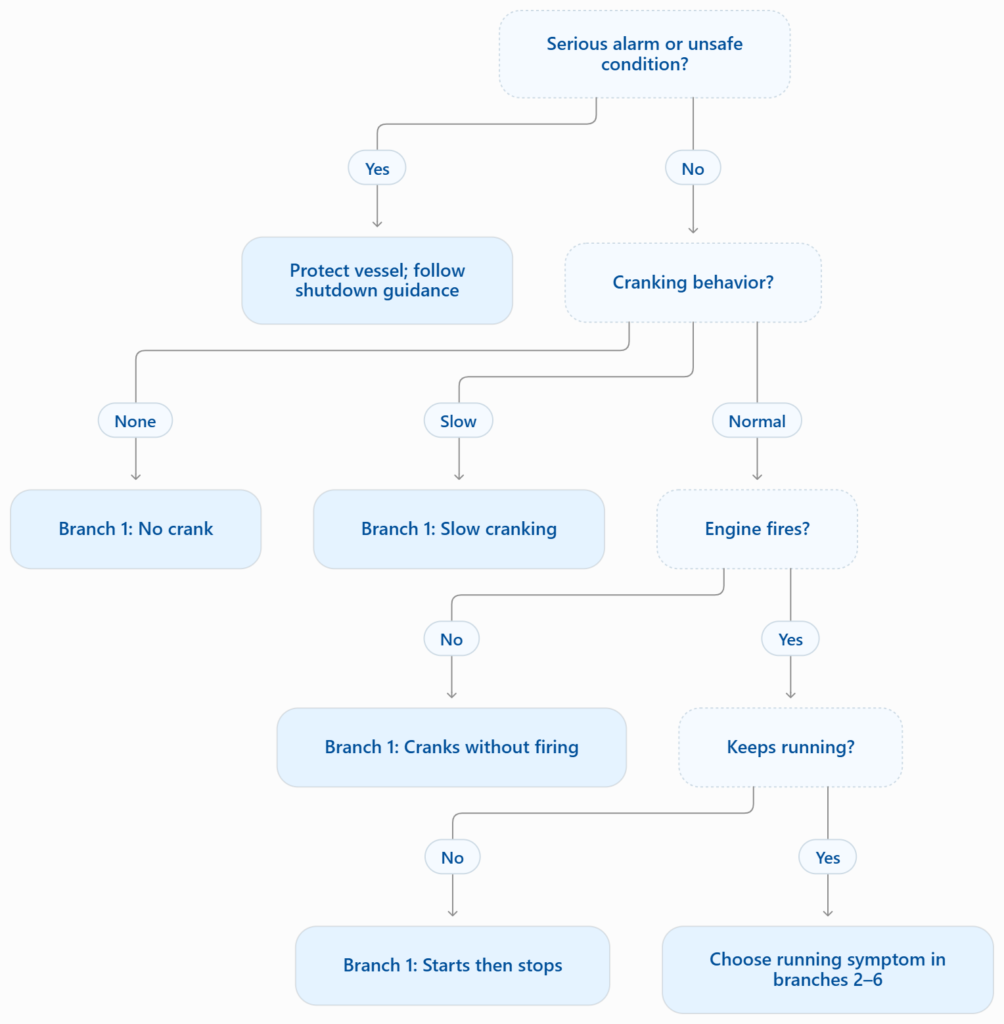
If a dangerous condition appears at any stage, return to the stop-and-escalate decision. Do not finish the flowchart before responding.
Separate no crank, slow crank and normal cranking without firing. Each calls for different evidence.
For a running engine, identify the main symptom: rough running, power loss, smoke, overheating, alarms, charging trouble or vibration.
Follow this sequence: observation → possible systems → useful check → interpretation → next step. If the result does not support your original suspicion, change the investigation.
When your Yanmar engine won’t start, first establish whether it actually cranks.
With the engine stopped, confirm the intended battery supply and control power are available. Check the control position required by the manual, including neutral where applicable. Record whether you hear a click.
A click does not prove the starter is faulty. Delco Remy’s starting-system guidance distinguishes click/no-crank, no-click/no-crank and slow-cranking complaints, then checks batteries and circuits. Its vehicle-specific numerical limits should not be transferred automatically to a marine installation.
Working cabin lights do not establish that the battery can supply starting current.
The useful technician checks are battery performance under load and voltage loss through the starting circuit. Connections and cables can impair cranking even when the starter itself is serviceable. If electrical checks are satisfactory, investigate the starter and any unusual resistance to engine rotation.
Ask the technician to explain the result: did the battery fail its appropriate test, did the circuit show excessive loss, or did both pass? Each finding changes the next step.
Avoid trying repeatedly while cables overheat or cranking behavior deteriorates.
For Yanmar engine cranks but won’t start symptoms, record fuel availability, supply-valve position, recent filter work and the applicable run/stop control state.
Follow only the model-approved fuel-priming procedure. Low-pressure priming is not permission to loosen common-rail injection pipes.
The YM troubleshooting chart includes fuel-supply, filter and other possibilities; unresolved injection or compression concerns require appropriate technical investigation.
If your Yanmar engine starts then stops, time the shutdown and record any alarm or code.
A gradual stumble and an abrupt stop are different observations. Fuel supply interruptions and applicable electronic-control faults are among the possibilities in JH troubleshooting information. Use the evidence to decide which system needs testing.
For a fuller investigation, see our article, Yanmar Engine Won’t Start: 12 Common Causes & Diagnostic Steps.
An engine that idles smoothly but struggles in gear needs a different investigation from one that runs unevenly in neutral.
For Yanmar engine losing power, record RPM, throttle response, smoke and temperature indications. Compare the behavior with a documented healthy baseline, not a vague memory.
Restrictions, air entry and supply problems can affect operation. Check the maintenance history and investigate the low-pressure supply using the appropriate procedure before deciding an injector needs replacement.
A recently fitted filter does not eliminate problems around its installation. “New” describes age; it does not establish correct fitting or unrestricted supply.
Intake, exhaust and applicable turbocharger or charge-air faults can belong in a power-loss investigation. The JH-CR troubleshooting information includes several of these systems, alongside overload and fuel-related causes.
Identify what your engine actually has. Advice about boost hoses is irrelevant to a naturally aspirated engine.
Here is the useful challenge to the usual assumption: an engine complaint can begin outside the engine.
For Yanmar engine not reaching full RPM or Yanmar engine stalls under load, compare vessel loading, hull condition, propeller condition and drivetrain behavior with the previous healthy setup.
Yanmar’s YM guidance emphasizes correct propeller loading and the ability to reach the specified rated speed under full load. Do not conduct a full-load trial until the fault and operating conditions make it safe.
Persistent Yanmar engine black smoke can accompany air restrictions, fueling problems or excessive load. It does not identify one failed part.
Record whether smoke occurs briefly during acceleration or persists with poor performance. Load and operating conditions help determine the next check.
Yanmar diesel white smoke needs context. Unburned fuel and water-related vapor are different possibilities; starting behavior, temperature and fluid-level changes help distinguish them.
Perkins’ general diesel guidance separates white smoke at startup from steam-related concerns. That supports investigation rather than diagnosing a head gasket from appearance alone. genui{“citation”:{“ref”:”turn79search0″}}
Blue smoke can indicate oil entering combustion. Record the oil level using the manual’s method and track any consumption.
Perkins identifies possible sources including valve-related wear, piston wear and turbocharger problems. These are diagnostic possibilities, not automatic repair instructions for a Yanmar engine. genui{“citation”:{“ref”:”turn78search1″}}
| Observation | Evidence to collect | Diagnostic direction |
|---|---|---|
| Persistent black smoke | Load, RPM and air-supply condition | Combustion and loading checks |
| White smoke at startup | Starting quality and whether it clears | Starting and combustion checks |
| Suspected steam | Temperature, discharge and fluid trends | Cooling-related investigation |
| Blue haze | Oil-level trend and operating conditions | Oil-entry investigation |
Photograph or film from a safe position. Do not lean into exhaust gases to identify their smell.
Yanmar marine engine overheating is not diagnosed by assuming every model has the same cooling circuit.
The 1GM10 uses direct seawater cooling. Other models use a closed coolant circuit with seawater heat exchange. Identify the arrangement before checking components.
After shutdown, use the correct procedure to assess the seawater supply, strainer, hoses and pump. Opening seawater plumbing can admit water into the boat; manage the seacock and system according to the manual.
Jabsco’s impeller guidance connects damage with supply blockage, suction leaks and downstream restrictions. It also advises checking discharge plumbing for missing impeller pieces. Replacing the impeller alone may leave the underlying fault unresolved.
For closed-circuit models, investigate coolant level, leaks and circulation only after the engine has cooled sufficiently. Never run the engine with its required seawater supply shut off.
Record when temperature rises and what happens to cooling-water discharge.
Water leaving the exhaust proves some flow, not adequate heat removal at every load. The YM troubleshooting chart includes low coolant, insufficient seawater and cooling-system contamination as separate possibilities.
Our Why Is My Yanmar Marine Engine Overheating? Complete Diagnostic Guide develops the Flow–Temperature–Load approach in greater detail.
Record the exact symbol, message or code. “The alarm sounded” is less useful than identifying the warning and when it appeared.
Check the manual’s expected pre-start indications. A warning during operation needs its own assessment.
A Yanmar low oil pressure alarm requires prompt attention and the applicable shutdown response.
After stopping, check the oil level using the correct method and look for leaks. Yanmar’s GM troubleshooting guidance includes low oil level among possible causes of an oil-pressure warning. Restoring the level does not by itself establish why it fell or confirm normal pressure.
A technician may need to verify actual pressure and test the warning circuit. Do not assume the sender is faulty because replacing it seems convenient.
Yanmar engine fault codes can help direct diagnosis on equipped engines. Yanmar explains that some diagnostic trouble codes appear in the operation manual; unresolved codes require appropriate diagnostic support.
Save the complete code, accompanying text and conditions when it appeared. Do not assume every Yanmar model uses the same codes.
Where available, record active and stored faults before clearing them.
A code describes a detected condition. It does not always establish which component caused it. Clearing the display cannot substitute for finding and correcting the underlying problem.
For Yanmar alternator not charging, inspect applicable belt condition and electrical connections with the engine stopped. Battery condition and charging-circuit measurements may also be needed.
Delco Remy’s charging guidance considers batteries, belt condition and circuit losses before condemning the alternator. Use specifications appropriate to the installed marine system. genui{“citation”:{“ref”:”turn82view2″}}
Do not disconnect a battery or turn off its isolator with the engine running as an improvised alternator test.
Does the vibration occur in neutral, only in gear, or within a particular RPM range?
That observation helps a technician plan mounting, alignment and propulsion checks. Severe new vibration warrants stopping and inspection. Keep hands, clothing and tools away from rotating machinery.
Record the relationship between engine speed and vessel movement. Treat this as a propulsion-system investigation rather than assuming reduced engine output.
Use the installed marine-gear or saildrive documentation. Avoid repeated high-throttle attempts to force engagement.
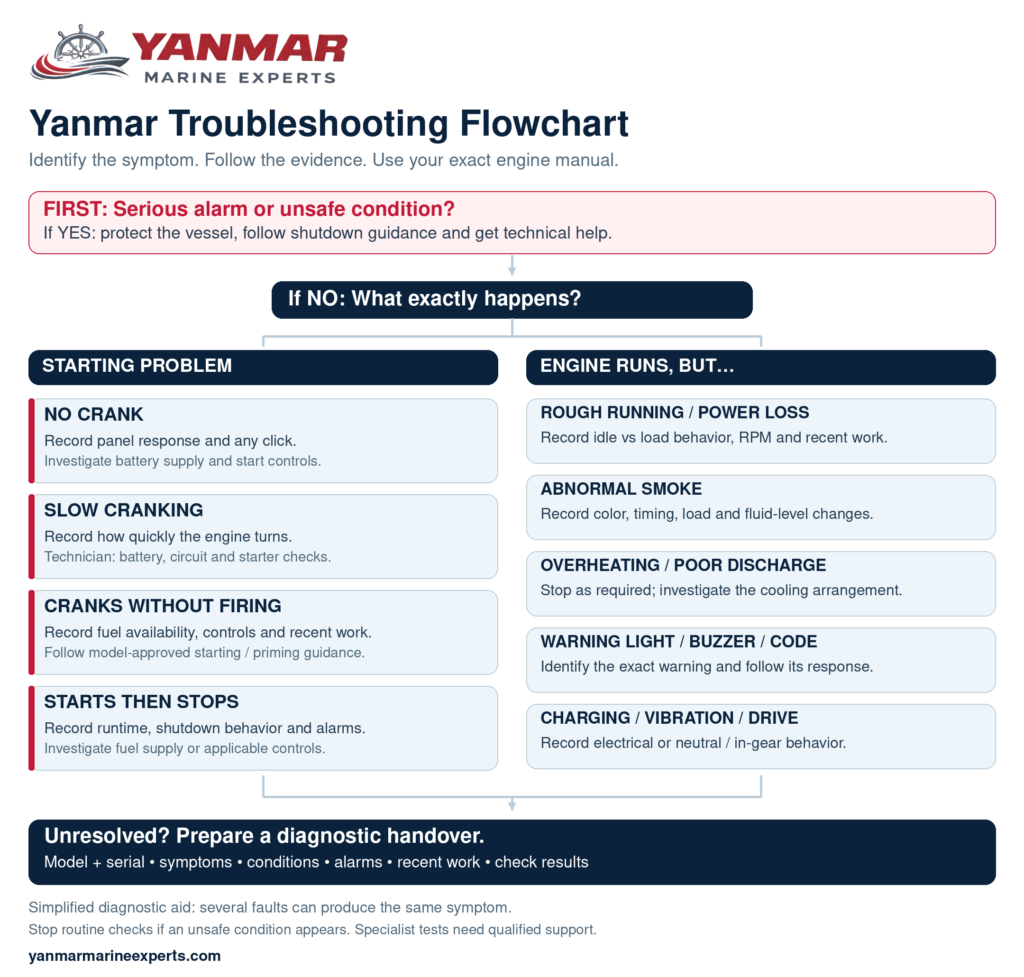
This table organizes Yanmar marine engine problems into investigations. The entries are possibilities, not diagnoses.
| Symptom | Record first | Useful next step | Escalate when |
|---|---|---|---|
| No crank | Click, panel response, controls | Confirm supply and start conditions | Circuit testing is needed |
| Slow crank | Storage history and behavior | Battery/circuit testing | Heating or abnormal resistance appears |
| Cranks without firing | Fuel, recent work, alarms | Model-approved starting checks | Basic checks do not explain it |
| Starts then stops | Runtime and shutdown behavior | Investigate supply or control branch | Shutdown repeats |
| Power loss | RPM, load and smoke | Compare engine and vessel conditions | Safe checks leave cause unclear |
| Persistent smoke | Color and operating conditions | Collect supporting evidence | Smoke is severe or fluids change |
| Overheating | Alarm, temperature, discharge | Stop; investigate cooling safely | Fault persists or discharge fails |
| Oil-pressure warning | Exact indication | Follow shutdown guidance | Pressure needs verification |
| Charging warning | Belt, connections, battery history | Charging-system testing | Output remains abnormal |
| New vibration | Neutral/in-gear and RPM relationship | Stop and arrange inspection | Vibration is severe or unexplained |
Yanmar GM troubleshooting requires exact identification. The 1GM10’s direct seawater arrangement should not become a blanket assumption for every legacy GM variant.
The full nameplate and matching manual are more useful than simply saying “three-cylinder GM.”
For Yanmar YM troubleshooting, identify the 2YM15, 3YM20 or 3YM30AE and the fitted panel and drive.
For example, Yanmar specifies indirect injection with an in-line pump and natural aspiration for the 3YM20. Turbocharger-specific advice therefore does not fit that engine.
Yanmar 4JH troubleshooting is not one universal procedure. Older mechanical versions and newer common-rail models need different fuel-system and diagnostic approaches.
Yanmar’s 4JH45 specification identifies common-rail injection. Confirm the complete designation before choosing a procedure.
These are illustrative scenarios, not claimed customer repairs.
The engine turns slowly after months unused. The owner suspects the starter.
A better sequence confirms storage history, tests battery performance and checks circuit losses. If the battery fails its appropriate test, address that finding and recheck. If the battery passes but a connection shows excessive loss, investigate the circuit. If both pass, the technician investigates the starter and rotational resistance. These are conditional routes, not reported test results.
The engine starts, then stops after recent fuel-filter work.
Begin by confirming the correct element and reviewing the installation and priming procedure. Check what was disturbed during the work, using the applicable instructions. If correcting an identified installation or priming problem restores operation, verify reliable running. If no fault is established there, widen the investigation. The timing makes the serviced area worth checking, but does not prove the element is defective.
Verification means establishing reliable operation after the actual fault is corrected.
The engine idles normally but struggles underway. The boat has also developed hull fouling.
The investigation compares vessel resistance with fuel, air and exhaust evidence. Even a visible boat-side issue should not end diagnosis if the symptom remains after correction.
This is the practical value of the framework: it keeps a plausible explanation from becoming an unsupported conclusion.
Before restarting after work, confirm components are correctly reassembled, tools removed, fluids checked and required supplies restored.
Inspect for leaks and warnings during an appropriate controlled check. A problem that occurred under load needs suitable verification beyond idling at the dock. Let a technician plan testing where recurrence could damage the engine.
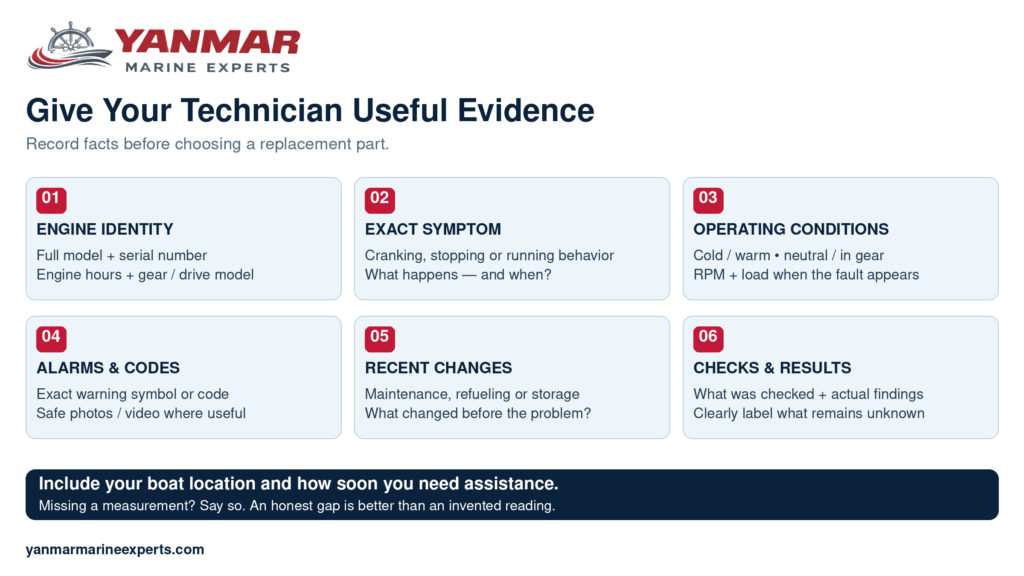
Provide the full model and serial number, engine hours, boat and drive details, location, symptoms, alarms and recent work.
Include what happened before the problem, measurements already taken and any safe photos or video. Distinguish observations from guesses.
“Stops after about one minute following filter replacement” gives a technician a clearer starting point than “needs a new pump.”
Use a simple handover format: symptom → conditions → recent changes → checks → results → unresolved questions. If you do not have a measurement, say so. An honest gap is more useful than an invented reading.
Use the exact manual’s schedule and keep a brief log of maintenance, normal operating readings and unusual symptoms.
Our Yanmar engine maintenance guide can help organize that routine. The engine and drive manuals remain the references for specifications and intervals.
Identify any unsafe condition, confirm the engine model and describe the exact symptom. Then choose the matching flowchart branch.
Normal cranking does not establish that fuel delivery, controls or combustion are correct. Follow model-specific starting checks and escalate unresolved faults.
Record how long it runs and whether it stumbles or stops abruptly. That evidence helps separate supply-related problems from applicable control-system investigations.
Investigate engine output and vessel load together. A smooth idle does not establish healthy performance under propulsion load.
It indicates a combustion-related symptom needing context. Load, air supply and fueling are possible directions; color alone does not identify a failed injector.
Yes. Some discharge does not prove adequate flow, coolant circulation or heat transfer. Investigate the full applicable cooling arrangement.
Record the exact code and use the matching manual or diagnostic support. A code guides testing; it is not automatically a replacement instruction.
No. Model, cooling arrangement, injection system, controls and drive equipment affect the appropriate checks.
You can collect useful observations and perform checks within your competence that the manual permits. Leave hazardous measurements and specialist repairs to a qualified technician.
Provide model, serial number, hours, operating conditions, exact symptoms, alarms, recent maintenance and checks already completed.
Effective Yanmar marine engine troubleshooting makes the problem more specific with each useful check.
Describe the symptom. Confirm the engine and circumstances. Isolate the relevant system. Verify the repair. That approach helps you spend time and money on work supported by evidence.
Contact Yanmar Marine Experts for diagnostics and repair support with your model, serial number, symptoms, alarm details and recent maintenance history.
Include your boat’s location and how soon you need assistance so we can help determine the next diagnostic step.
These references support the diagnostic principles discussed above. Always match the manual to your engine; a listed manual is not universal guidance for every Yanmar model.
